

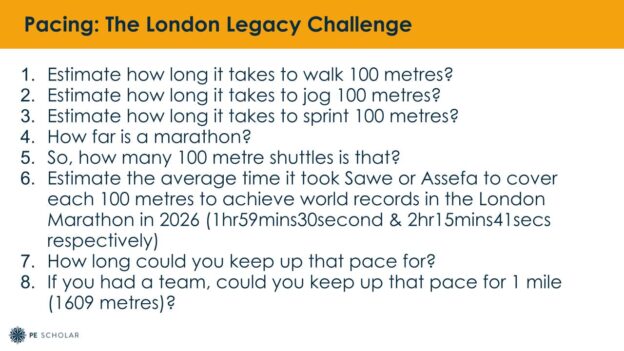
These resource cards will help you with teaching for understanding around time and distance before target setting and challenging for pacing against world record marathon times.
Sawe’s Sub-2: How long can your pupils hold the World Record pace? 🏃💨
History was made on the streets of London this summer. Sabastian Sawe has officially broken the 2-hour marathon barrier in a competitive race, setting a staggering new World Record.
While we can’t all be elite Kenyan runners, we can use this “moon landing” moment to inspire our students to explore the limits of human performance in our athletics lessons this week.
To help you “bridge the gap” between the TV screen and track, here is the maths for you.
📊 The “Sub-2” Benchmarks (Pace: approx. 2:50 min/km)
– 100m Split: 17.0 seconds
– 200m Split: 34.1 seconds
– 400m Split: 68.2 seconds (1:08)
– 1 Mile Pace: 4 minutes 34 seconds
Meanwhile, Tigst Assefa’s set a new women’s world record with 2:15:41 (Pace: approx. 3:13 min/km) which breaks down with an average split of:
– 100m in 19.3 seconds
– 400m in 1:17
– 800m in 2:34
– 1 mile – 5:11
In terms of wheelchair athletes, Marcel Hug finished in 1:24:13 (12 second per 100 metre pace) and Catherine Debrunner in 1:38:29 (14 second per 100 metre pace). Thanks for the reminder on these additions Simon Scarborough
🚀 Try these “London Legacy” Challenges:
1. The “Sawe & Assefa” Pace Test (Individual): Challenge individuals to see how many 100m reps they can complete at the 17.0s (Men’s WR) or 19.3s (Women’s WR) pace. This is a brilliant way to teach running economy and rhythm.
2. The “Marathon Mile” Relay (Team): Can a team of 4 or 8 pupils cover a single mile in 4:34 or 5:11?
– In 4s: Each pupil runs 400m (splits: 68s for Sawe pace; 77s for Assefa pace).
– In 8s: Each pupil runs 200m (splits: 34s for Sawe pace; 38.5s for Assefa pace).
– Inclusion Focus: Use the wheelchair stats (12s per 100m!) to discuss adaptive practice and mechanical advantage. Can your fastest sprinters beat Marcel Hug’s average 100m pace over 26 miles?
– Alternative: Each team chooses who will run what distance in their attempt to cover 1609 metres as a collective.
This moves the lesson from “just running” or traditional pacing lessons with a middle distance time captured for each student to Meaningful PE, prioritising social interaction and collective challenge.
Evidence-informed tip: Use these benchmarks not just for the “fastest” runners, but to discuss Physical Literacy. It’s about the motivation and confidence to engage with a world-class standard, regardless of where their starting point is.
Responses