


Introduction
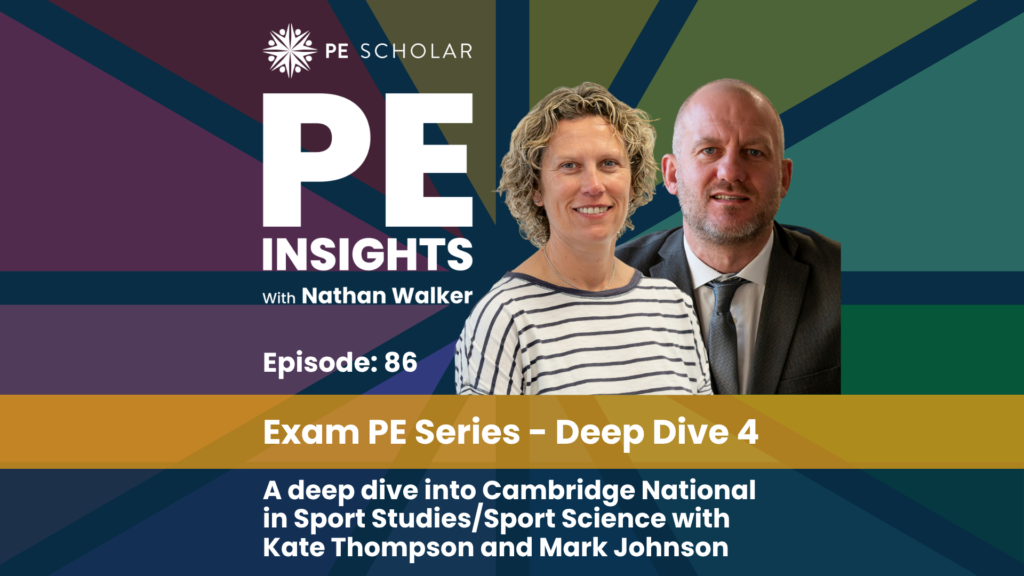
In Episode 86 of the PE Insights podcast, host Nathan Walker and co-host Will Swaithes continue their series on examination Physical Education. They are joined by Kate Thompson and Mark Johnson, who both serve as Physical Education and sport subject advisors at Cambridge OCR. The conversation provides a comprehensive deep dive into the Cambridge National qualifications in Sport Studies and Sport Science, offering practical advice for teachers regarding planning, delivery, and assessment.
Educational Journey and Context
Both guests bring extensive teaching experience to their advisory roles at Cambridge OCR. Kate spent over 18 years teaching across primary, secondary, and further education, holding positions such as Head of Department and School Sports Coordinator. Before joining the exam board, she also spent three years developing sport in South African townships.
Mark has been with Cambridge OCR for nearly nine years. Prior to this role, he spent roughly 15 years teaching at a large inner-city college in Peterborough, delivering Pearson, NCFE, and City and Guilds qualifications across various levels. Interestingly, his very first teaching post was at his own former secondary school, which he described as a strange experience going into the staff room where he previously used to be sent for detentions.
First Steps and Teacher Support
For departments introducing a Cambridge National qualification for the first time, Mark strongly recommends booking an onboarding call. Through an online booking system, teachers can schedule a 50-minute Teams call with a subject advisor. This session includes a guided tour of ‘Teach Cambridge‘, the designated website for resources, where teachers can locate past papers and topic exploration packs. These exploration packs are custom-built presentations designed so that even non-specialist teachers can effectively deliver the content.
Kate adds that the absolute first step must be reading the specification thoroughly. Mark notes that the advisory team can help answer frequently asked questions during the onboarding call to prevent teachers from panicking about moderation or exam dates later in the year.
Choosing Between Sport Studies and Sport Science
When deciding which pathway to offer, Kate advises leaders to look closely at their specific cohort and their school facilities. She outlines the core differences between the two qualifications. Sport Studies leans more towards practical application, featuring modules on outdoor education, performance, leadership, and sport in the media. Kate notes the media unit is particularly relevant today as it explores the positives and negatives of social media platforms. Importantly, the practical element in Sport Studies focuses on participation and showing a sustained engagement in physical activity over a long period, rather than exclusively elite performance. However, it still requires students to identify their own strengths and weaknesses to create an action plan.
Conversely, Sport Science is much more theory-based. It covers topics such as diet and nutrition, sports injuries, and the socioeconomic reasons why certain groups take part in sport.
Assessment Structure and Managing Workload
Both courses share a consistent format featuring one externally marked exam and two internally assessed units. The examined unit is Contemporary Issues for Sport Studies and Sports Injuries for Sport Science. This terminal exam lasts 1 hour and 15 minutes, is worth 70 marks, and includes one 8-mark extended answer question.
A critical rule for these exams is the terminal rule. Students have opportunities to sit the exam in the January or June windows, but the final attempt is the mark that definitively counts. For example, if a student achieves a merit in January but decides to resit in June and achieves a pass, the pass is the final recorded grade.
For the Non-Examined Assessment units, the assignments change every year on the first of June. Mark explains this was a direct mandate from regulators to ensure students are genuinely applying their knowledge to a new context, rather than just copying textbook information. For instance, one year students might write a diet plan for a figure skater, and the next year they might have to apply the same nutritional principles to a swimmer. When assessing this work, teachers are permitted to provide generic cross-class feedback if they notice common patterns of missing information, but they cannot give specific, individualised instructions to a student on what exact details to add.
Regarding moderation, Mark highlights that the scaling issues often associated with new qualifications have now stabilised significantly. In a recent January series, Cambridge OCR only received two requests for a review of moderation across the entire series. This demonstrates that the moderator reports provide excellent detail and that centres are highly satisfied with their outcomes.
Teaching Application and Staying Current
Will raises the challenge of teaching evolving topics like nutrition or drugs in sport, noting that specifications can become slightly dated by the time they are published. Kate acknowledges this tension and advises teachers to explicitly teach the specification requirements for the exam, but to expand the conversation to explore current trends if lesson time allows. Mark points out that updating specifications continuously is incredibly difficult due to the lengthy approval processes required by regulators.
The Future of Physical Education Qualifications
Looking ahead, Mark firmly believes that the practical component of the GCSE needs to be reduced to two sports. He notes that the lingering effects of the pandemic mean fewer students specialise in three sports, and high-performing athletes simply do not have the time to train for a third sport alongside their main academy commitments. Reducing this requirement would alleviate significant stress for both students and the teachers trying to assess them.
Both guests want to see better promotion of the varied career pathways available in the broader sports industry. Mark notes that many 16-year-olds only view sport as participating or being an elite performer, entirely missing roles in sports science, nutrition, and journalism. Kate agrees, adding that parental perceptions often hinder students from taking sports qualifications, not realising how well these courses lend themselves to medical or scientific careers.
When discussing potential name changes to attract more students, Mark reveals that a recently shelved OCR qualification was working under the title ‘Sport, Health and Exercise’. Kate suggests that while ‘wellbeing’ is a current buzzword that attracts interest, it may naturally fade in popularity over the coming years. She passionately advocates for more authentic, practical learning experiences, suggesting that taking a class to a hospital physiotherapy department to see the application of their studies in real life would be highly beneficial.
Why Choose Cambridge OCR?
When asked why a centre should switch to Cambridge OCR, Mark emphasises their superior support system. The team operates a daily triage system, guaranteeing that queries are dealt with on the day or within 48 hours. He also points to their unmatched resource package, including the topic exploration packs and exemplar materials. Kate adds that the coursework tasks are highly straightforward, giving students clear bullet points to hit without needing to overthink the process.
Conclusion
The conversation underscores that the Cambridge National qualifications offer robust, highly supported pathways for students. Whether a centre opts for the practical focus of Sport Studies or the theoretical depth of Sport Science, the key to success lies in utilising the extensive support available from the exam board, actively applying knowledge to real-world scenarios, and guiding students toward a broad range of future industry opportunities.
Find out more via this link https://hubs.li/Q04lxwbs0 or Cambridge OCR’s own social media accounts that can be found via the following links:
Youtube: https://www.youtube.com/@CambridgeOCR
Facebook: https://www.facebook.com/cambridgeocr
LinkedIn: https://www.linkedin.com/company/cambridgeocr/
Instagram: https://www.instagram.com/cambridgeocr
Listen
To listen to the full episode please follow these links to Spotify or Apple podcasts.

Responses