


Being on maternity leave has given me something I rarely allow myself in the busyness of school life: time to pause and reflect.
Now, as a first time mother, I find myself thinking differently. I think about the experiences I had growing up in school. I think about the moments that shaped how I saw myself and, most importantly, I think about what I would want my daughter to experience as she grows up and finds her place in the world.
It is that reflection that has led me to write this letter to my younger self—the Year 9 girl who didn’t feel like she belonged in PE.
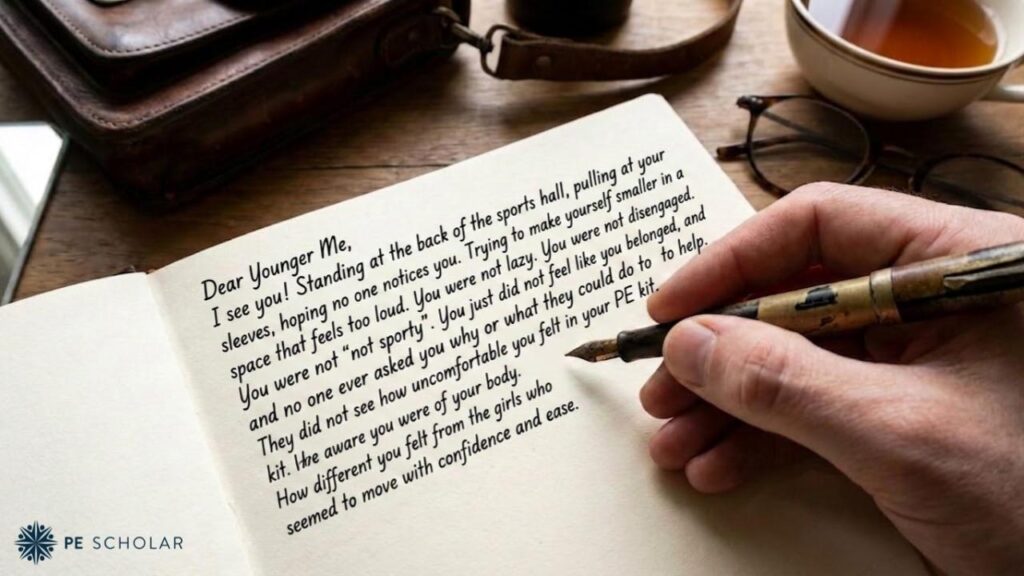
“Dear Younger Me,
I see you!
Standing at the back of the sports hall, pulling at your sleeves, hoping no one notices you. Trying to make yourself smaller in a space that feels too loud. You were not lazy. You were not disengaged. You were not “not sporty”. You just did not feel like you belonged, and no one ever asked you why or what they could do to help. They did not see how uncomfortable you felt in your PE kit. How aware you were of your body. How different you felt from the girls who seemed to move with confidence and ease.
But, here’s what I need you to know.
You were never the problem. The system simply was not built with you in mind. And the research tells us this is not just your story, it is the story of many girls. Only around 59% of girls say they enjoy PE in secondary school with confidence, body image and periods all acting as key barriers. This is in contrast to significantly higher levels in boys, but why? Further research highlights that girls are more likely to lack confidence in PE than boys, with those facing additional inequalities, such as ethnicity or socioeconomic background experiencing even greater barriers (Youth Sport Trust, 2023).
The truth is, PE has not always reflected your identity, culture or lived experience. It has not always created space for girls who do not see themselves as “sporty”. For some, this meant wearing a PE kit that did not align with their cultural or religious values, leaving them feeling exposed rather than comfortable. For others, it was being placed in activities that never reflected their interests, with lessons dominated by sports where they felt out of place. Some girls worried about how their bodies were perceived in front of peers, while others felt uncomfortable in changing rooms or lacked the confidence to participate at all. Many never saw role models who looked like them or understood their background. Research highlights that barriers such as body image, peer judgement and lack of role models can all reduce willingness to take part (Brennan et al., 2024).
You did belong. You always did. What you could not see then is that one day you would walk back into that same space, but this time at the front of it. Not as the girl who felt invisible, but as the teacher determined to make sure no student ever feels the way you did.
Today, when I stand in a PE lesson, I look for you. I notice the girl who hangs back. I notice the child who hesitates before joining in. I notice the individual who laughs it off but never quite commits. That’s because I know that behind that behaviour is not a lack of ability, but a lack of belonging. To better understand the barriers girls face in PE, I conducted a pupil voice survey, which highlighted that support from teachers, peers and family is one of the most significant factors influencing participation. So, my role is to make that support visible. I try to create spaces where students feel safe before they feel successful. I offer choice, flexibility and understanding. I think carefully about language, grouping and representation. I challenge the idea that PE is only for the confident, the athletic or the naturally skilled, because PE should be for everyone. When that environment is created, where girls truly feel they belong, something incredible happens
They show up. They try. They grow.
Not because they suddenly became “sporty”, but because someone finally made space for them. So, this is to you, the girl at the back of the sports hall, hold on. One day, your experience will become your strength; your voice will help shape spaces that once excluded you, and your story will give other girls permission to step forward. You will not just belong in PE, you will change what it means to belong. This is bigger than PE; it is about identity, it is about representation, and it is about creating environments where every young person feels seen, valued and capable. I promise you this: every time a girl steps into my lesson and feels like she belongs, that is for you.”
I often wonder now… how many PE departments have someone who remembers what it felt like to stand on the outside? And if they don’t, who is advocating for those girls who still feel like I once did?
Practical Takeaways for Teachers: Creating a Sense of Belonging in PE
If we want more girls to engage in PE, we need to move beyond simply increasing participation and instead focus on creating a sense of belonging. From my experience, this is not about doing something completely new but about being more intentional with the choices we make every day. How many of these 8 suggestions do you do already? Which ones could you prioritise next?
- Starting with pupil voice
Take the time to understand the barriers your students face. This could be through a simple survey or just casual conversations with individuals, because listening to students is key. When girls feel heard, they are more likely to feel valued. - Prioritise feeling safe before being successful
Create an environment where students feel comfortable to try, make mistakes and learn. - Offer choice and flexibility
Build in opportunities for choice within lessons, whether that is through levels of challenge, roles or ways to take part. This helps to reduce anxiety and gives students a sense of ownership over their experience. - Be intentional with grouping
Think carefully about how and why you group students. Grouping should support confidence. - Use language that builds, not labels
The language we use in PE matters. Focus on effort, progress and development rather than reinforcing fixed ideas of ability. - Redefine what success looks like
Success in PE should not be limited to performance. Celebrate effort, resilience, teamwork and personal progress so that more students can see themselves as successful. - Increase representation
Ensure that students can see themselves reflected in PE. This might be through the activities you offer, the examples you use, or the role models you highlight. Representation matters in helping students feel that PE is for them. - Make support visible
Be deliberate in showing support. Check in with students, offer encouragement and recognise small moments of progress.

Do you know someone who would benefit from reading this or perhaps you have similar thoughts? If so, we would love to hear from you!
References
- Brennan, C., Hendry, K. and Aspinall, C. (2024) Pre-teen girls’ experiences of physical activity and sport.
- Youth Sport Trust (2023) Girls Active: Understanding girls’ engagement in PE and sport.
Responses