


Physical education has always made ambitious claims about its contribution to the development of young people. As a subject, we often speak confidently about confidence, resilience, teamwork, leadership, motivation, respect, responsibility and wellbeing. These claims are part of the reason PE matters. At its best, PE offers something distinctive within the school curriculum: pupils learn through movement, with others, in situations that are embodied, emotional, social and often immediate.
However, as PE curricula become more explicitly concerned with holistic development, a familiar concern can emerge. Some teachers worry that the physical is being pushed aside.
This concern is understandable. PE has, at times, been pulled in different directions by policy language, wellbeing agendas, assessment demands and broad educational claims that can feel detached from the practical reality of teaching pupils to move well. When teachers hear language such as confidence, motivation, emotional regulation, social connection, reflection or lifelong participation, some understandably ask whether the subject is drifting away from its physical core.
But this is a misinterpretation.
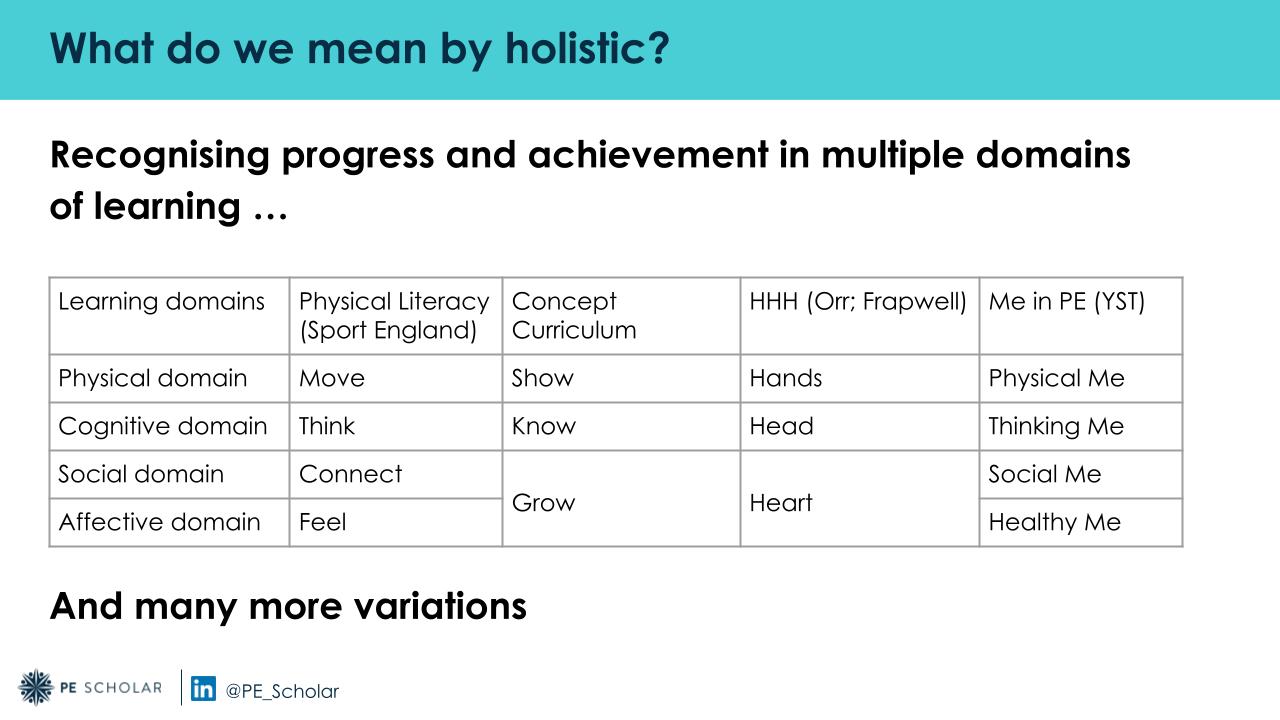
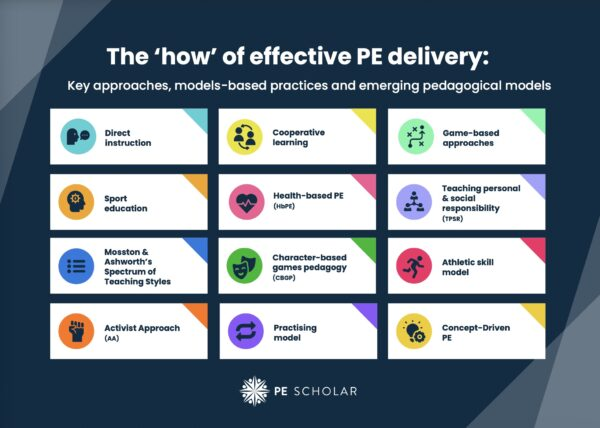
In this article, GROW refers to the personal, social and affective learning developed through movement, including how pupils manage themselves, relate to others and build a meaningful relationship with physical activity. The image below shows that this can be understood in a number of frameworks.
A curriculum concerned with growth does not remove the physical from physical education. It asks us to think more carefully about what the physical is for, how it is experienced, and what pupils learn through it. The physical remains central. Movement remains central. Skill development, effort, challenge, practice, performance and physical competence remain central. The question is whether those physical experiences are designed only to improve performance within activities, or whether they also help pupils develop a stronger relationship with movement, themselves and others.
This is where the GROW dimension becomes important. GROW criteria should not be understood as a soft alternative to physical learning. It should be understood as the personal and social development that happens through well-designed physical learning. It asks how pupils are developing as people through movement. It asks whether they are becoming more confident, more resilient, more reflective, more responsible, more connected and more able to see movement as part of a meaningful life. That is not less physical. It is a deeper form of physical education.
The false divide
One of the problems in PE curriculum debate is that we too often create a false divide between physical development and holistic development. On one side sits the traditional view of PE as activity, skill, sport, fitness and performance. On the other side sits the language of wellbeing, confidence, motivation, inclusion and personal growth. This divide has been, and continues to be, unhelpful.
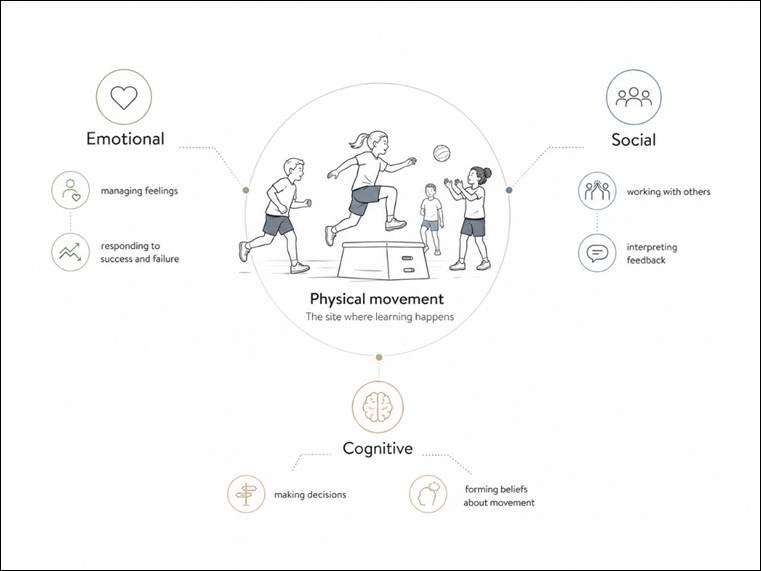
Pupils do not experience PE in separate compartments. When a pupil attempts a vault, carries a ball into contact, performs a sequence, runs hard in a fitness task, leads a warm-up, misses a shot, wins a rally, loses a race or tries a movement they find uncomfortable, the experience is never only physical. It is also emotional, social and cognitive. They are making decisions, managing feelings, interpreting feedback, comparing themselves with others, responding to success and failure, and forming beliefs about what movement means to them. The physical is the site where this learning happens.
A pupil learning to perform a gymnastic sequence is not only learning balance, coordination and control. They may also be learning to manage fear, persist after failure, accept feedback and take pride in gradual improvement. A pupil playing an invasion game is not only learning passing, movement and tactical decision-making. They may also be learning to communicate under pressure, include others, regulate frustration and act fairly when the game becomes competitive.
Physical experiences are never neutral. They shape how pupils feel about themselves, how they relate to others and how they come to understand movement. Ignoring this does not protect the physical integrity of the subject; it narrows it.
This is not a local argument
The move towards more holistic physical education is not confined to one school, one country or one particular framework. It is visible across a number of contemporary curriculum directions.
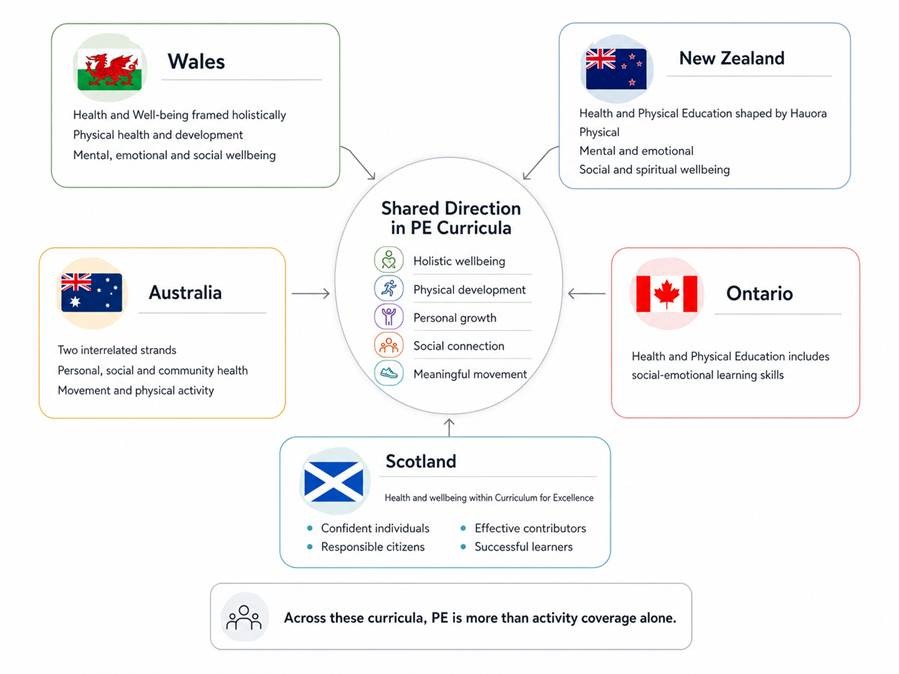
In Wales (where I am currently teaching), Health and Well-being is framed holistically, with attention to physical health and development, mental health, and emotional and social well-being. New Zealand’s Health and Physical Education curriculum is shaped by the concept of “Hauora”, which attends to physical, mental and emotional, social and spiritual dimensions of wellbeing. Australia organises Health and Physical Education through two interrelated strands: personal, social and community health, and movement and physical activity. Ontario includes social-emotional learning skills within Health and Physical Education. Scotland’s Curriculum for Excellence places health and wellbeing within a wider commitment to developing confident individuals, responsible citizens, effective contributors and successful learners.
The language differs, but the direction is clear. PE is increasingly expected to contribute to pupils physically, personally and socially.
Across these curricula, physical competence remains fundamental because it shapes pupils’ confidence, access, enjoyment and willingness to participate. Without increasing control, coordination, fluency and skill, pupils’ relationship with movement is likely to become constrained. The difference is not that physical competence matters less, but that it is no longer viewed as an isolated end point. It serves a wider educational purpose.
The problem with assuming growth
PE has often relied on the belief that personal growth naturally emerges from participation. Pupils play in teams, therefore they learn teamwork. Pupils experience competition, therefore they develop resilience. Pupils face challenge, therefore they build confidence. Pupils are asked to lead, therefore they become leaders.
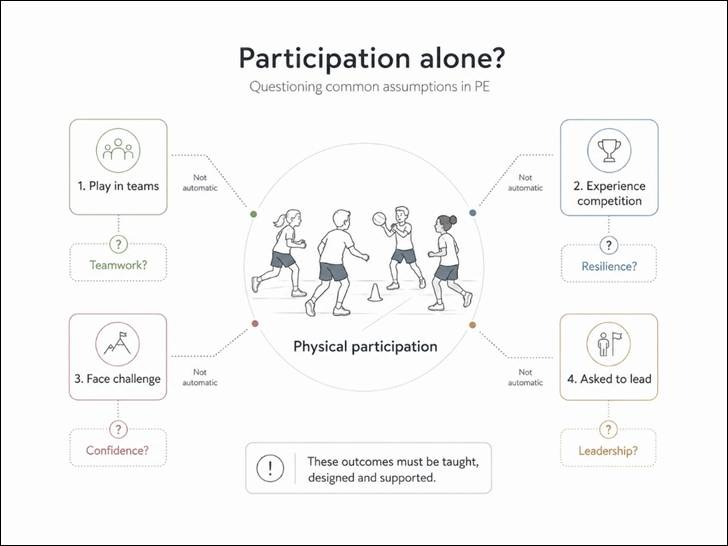
Sometimes this happens. PE can create powerful conditions for growth. It exposes pupils to effort, success, failure, pressure, cooperation, disagreement, uncertainty and joy. It gives pupils opportunities to experience their bodies differently. It allows them to belong, contribute and improve.
But opportunity is not the same as curriculum design.
Being placed in a team does not automatically teach collaboration. Experiencing competition does not automatically develop resilience. Being asked to lead does not automatically produce leadership. Taking part in physical activity does not automatically create a positive relationship with movement.
For some pupils, poorly designed physical experiences can do the opposite. They can reinforce embarrassment, anxiety, exclusion or avoidance. A pupil can complete years of PE and still leave school believing that movement is not for them. They may have participated. They may have complied. They may even have improved in selected activities. But have they grown?
This is an important professional question because if confidence, motivation, self-regulation, inclusion, fairness and responsibility are not deliberately planned for, taught, revisited and reflected upon, then they remain hopes rather than secure curriculum outcomes.
What GROW criteria adds
GROW gives PE teachers a way of taking the personal and social dimensions of physical education seriously. It helps explain what pupils might become through physical learning. A serious approach to GROW would need to include at least two dimensions.
The first is intrapersonal. This concerns how pupils relate to themselves through movement. It includes confidence, self-belief, persistence, motivation, enjoyment, emotional management, self-regulation, personal goal-setting and willingness to engage with challenge. It asks whether pupils are learning to understand their own responses to movement, effort, success, failure and uncertainty.
The second is interpersonal. This concerns how pupils relate to others through movement. It includes cooperation, communication, empathy, inclusion, fairness, respect, leadership, shared responsibility, ethical behaviour and the ability to contribute to something beyond oneself. It asks whether pupils are learning to move with others, support others, listen to others, include others and act responsibly within shared physical experiences.
These dimensions matter because they stop holistic PE becoming vague. They also stop GROW being reduced to effort or behaviour.
A pupil who brings kit and follows instructions may be compliant, but that does not necessarily mean they are growing in confidence. A pupil who works in a group may be physically present, but that does not necessarily mean they are learning to collaborate. A pupil who wins often may look successful, but that does not necessarily mean they are developing humility, empathy or respect for others. A pupil who avoids risk may not lack effort; they may lack trust, confidence or a sense of safety.
GROW helps teachers look more carefully. It asks: where do pupils learn to manage themselves? Where do they learn to persist? Where do they learn to handle frustration? Where do they learn to include others? Where do they learn to communicate under pressure? Where do they learn that movement can be personally meaningful, not merely something performed for assessment or comparison? These questions make the PE experience more educationally precise.
Growth must be taught through movement
Physical competence is not the alternative to personal growth; it is one of its principal enablers.
GROW should not become a classroom discussion attached to PE. It should not become a worksheet about resilience while pupils sit out of physical activity. It should not become a wellbeing label added to lessons that are otherwise disconnected from meaningful movement.
For GROW to be authentic, it must be embedded in physical experience.
Pupils learn persistence by meeting physical challenge that is demanding but achievable. They learn confidence by experiencing improvement, competence and success in different forms of movement. They learn emotional regulation when competition, performance or uncertainty creates pressure. They learn collaboration when physical tasks require genuine interdependence. They learn fairness when games and activities require ethical decisions. They learn leadership when others depend on their clarity, encouragement and judgement.
Physical content is therefore not diminished but used with greater educational intent. Movement remains the medium through which pupils learn both to perform and to grow.
A GROW-informed invasion games lesson still needs movement, skill, decision-making and tactical understanding. A GROW-informed gymnastics lesson still needs balance, control, fluency, body management and performance. A GROW-informed fitness lesson still needs effort, intensity, adaptation and knowledge of training principles. A GROW-informed athletics lesson still needs running, jumping, throwing, pacing, power and technique.
What changes is the teacher’s curriculum intent. The teacher is not only asking, “Can pupils perform this skill?” They are also asking, “What are pupils learning about themselves and others through the process of developing this skill?” That is probably a more demanding version of PE, not an easier one.
Pedagogy has to match the claim
A curriculum that values growth cannot rely only on teacher direction, activity completion and visible performance. Recent professional discourse in PE has reinforced the need for teachers to continue developing their pedagogical confidence and competence. Pupils do not develop autonomy if every meaningful decision is made for them. They do not develop responsibility if responsibility is never transferred. They do not become reflective if lessons never create time or language for reflection. They do not learn to collaborate simply because they are placed in groups.
This does not mean PE should become loose or unstructured; a trope often thrown at conceptually-driven PE. Growth requires skilful teaching. It requires clear routines, carefully designed tasks, purposeful questioning, meaningful challenge and thoughtful feedback. Autonomy without structure can quickly become confusion. Group work without teaching can become domination by the confident and disappearance by the quiet. Reflection without guidance can become superficial. The point here is not to remove the teacher, the point is to teach with greater intent.
A growth-informed PE lesson would provide pupils with meaningful choices within clear boundaries. It would allow pupils to lead, but would teach what leadership requires. It would ask pupils to cooperate, but would make communication, listening and inclusion visible. It would expose pupils to challenge, but would help them understand how to respond to difficulty. It would value performance, but would not allow performance to become the only visible form of success.
This has implications across activity areas. In invasion games, GROW might involve pupils learning to communicate, adapt, include others, respond to tactical failure and handle winning or losing with maturity. In gymnastics, it might involve trust, controlled risk, feedback, vulnerability and pride in improvement. In health-related fitness, it might involve pupils developing a more informed relationship with effort, progress, motivation and their own bodies. In outdoor learning, it might involve risk awareness, shared responsibility and confidence in unfamiliar environments. In dance, it might involve expression, courage, respect and the confidence to be visible in a different way.
The activity provides the context. The pedagogy determines what pupils learn from it.
Assessment without reducing pupils to a number
Assessment presents a challenge. Personal and social growth can be observed, supported and discussed, but it should not be reduced to crude grading. Teachers should not be grading personality. They should not confuse quietness with lack of confidence, compliance with responsibility, or extroversion with leadership.
However, avoiding assessment altogether creates another problem. If PE only assesses what is easy to count, time, score or compare, then the subject becomes narrower than its own stated or claimed purpose. We cannot claim to value confidence, motivation, responsibility, inclusion and self-regulation while only collecting evidence of technique, fitness and performance. For many teachers, that represents a difficult tension to resolve.
A more thoughtful approach would treat assessment of GROW as formative, developmental and professional. Evidence may come through observation, dialogue, pupil reflection, peer feedback, self-assessment, learning conversations and patterns of engagement over time. The purpose is not to label pupils. The purpose is to understand how they are developing and how teaching can support the next step.
This requires judgement and care. A pupil who avoids leadership may not lack responsibility; they may lack confidence. A pupil who struggles to work with others may need explicit teaching in communication or emotional regulation. A pupil who appears disengaged may have learned, through previous experiences, that PE is a place of embarrassment rather than belonging.
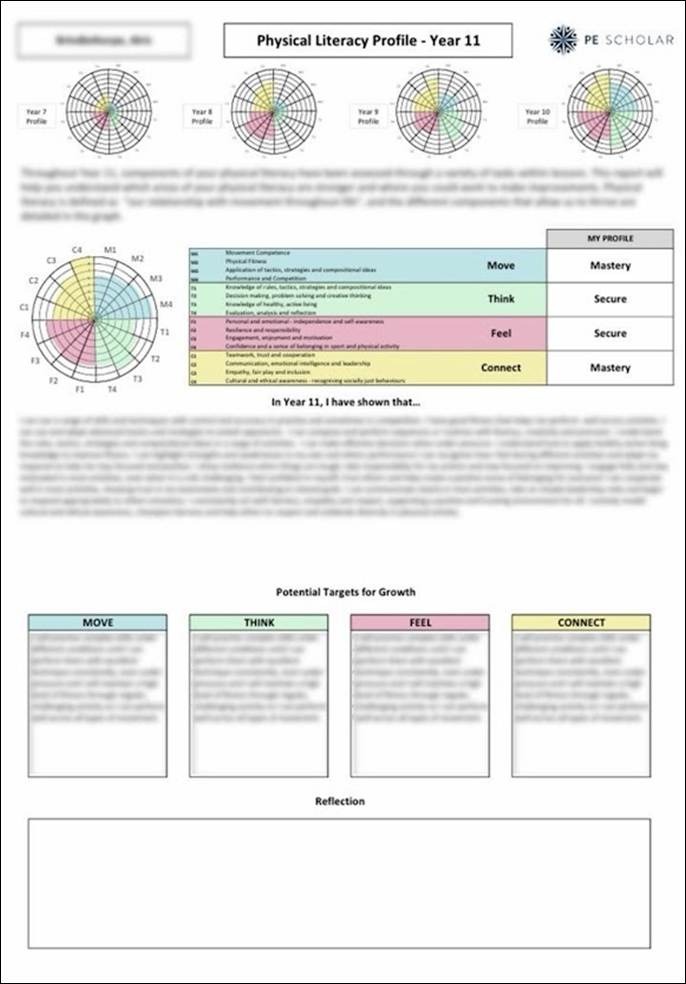
Assessment of GROW should help teachers ask better questions. It should not become a blunt instrument for ranking character. The image below, for example, breaks down elements GROW (through the Feel and Connect strands) to give a student a clear profile of their progress over time. The assessment data behind this tool, which is part of the PL PACK resource, is taken from a variety of sources and formative and ipsative assessment activities.
The physical still matters
A holistic PE curriculum should not make pupils move less. It should not reduce challenge. It should not remove skill development. It should not dilute the need for physical competence, fitness, technical progression or performance. If anything, it should make those things more meaningful. The aim is to recognise that the personal develops through the physical when the curriculum is designed with sufficient care.
A pupil who becomes more physically competent may also become more confident. A pupil who learns to move with greater control may feel safer and more willing to participate. A pupil who understands tactics may feel more able to contribute to a team. A pupil who develops fitness knowledge may feel more agency over their health. A pupil who experiences improvement may begin to see movement as part of their identity.
Physical learning is therefore not separate from growth. It is one of the main ways growth is made possible. This is why the debate needs to move beyond the fear that holistic PE is somehow less rigorous. Poorly designed holistic PE may be vague, weak or tokenistic. But well-designed holistic PE is demanding. It expects pupils to move well, think clearly, manage themselves and connect responsibly with others. It asks more of the teacher, not less. It asks more of the curriculum, not less.
What could a PE curriculum become?
A PE curriculum should be more than a timetable or carousel of sports.
It could be a carefully designed journey through which pupils learn to move with increasing competence, think with increasing clarity, feel with increasing confidence and connect with increasing responsibility.
It could help pupils understand how movement affects their health, emotions, identity and relationships. It could teach pupils how to manage challenge, not simply endure it. It could help them develop the confidence to participate, the humility to learn, the empathy to include others and the agency to make movement part of their lives beyond school.
But this will not happen by accident. It requires departments to move beyond the comfort of activity maps and ask harder curriculum questions. Where is growth taught? How does it progress? What pedagogies support it? How do pupils know they are developing? How do teachers know? What evidence is meaningful? Which pupils are benefiting from the curriculum as it currently exists, and which pupils are merely passing through it? These questions are not easy, but they are necessary.
Physical education has extraordinary potential. It can develop physical competence, confidence, motivation, social connection, emotional understanding and lifelong engagement. Yet potential is not the same as practice. A curriculum only fulfils its promise when its claims are designed into the lived experience of pupils. The physical has not disappeared from this vision of PE. It sits at the centre of it. Perhaps the next stage of PE curriculum design is not simply to ask whether pupils have played enough sports, learned enough techniques or completed enough units. Perhaps the more important question is this:
- If pupils complete our PE curriculum, what have they grown into? And how deliberately was that growth designed through movement?
————–
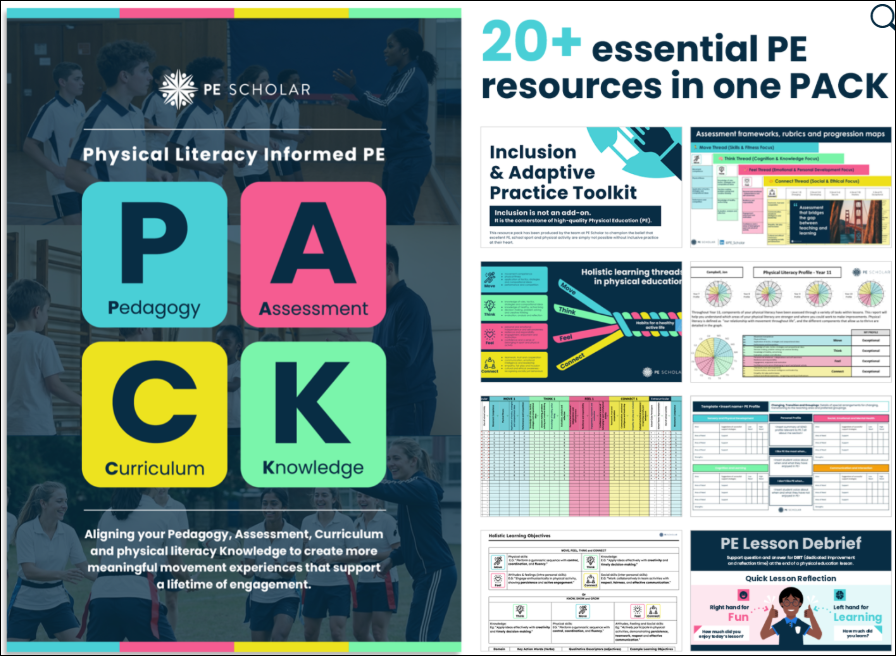
Are you looking to develop your school curriculum to meet the needs of all students? The PE Scholar PL PACK is a resource to check out.
Further Reading
Australian Curriculum, Assessment and Reporting Authority (ACARA) (n.d.) Health and Physical Education: Understand this learning area. Australian Curriculum. Available at: https://www.australiancurriculum.edu.au/curriculum-information/understand-this-learning-area/health-and-physical-education
Education Scotland (n.d.) Health and wellbeing. Curriculum for Excellence. Available at: https://education.gov.scot/curriculum-for-excellence/curriculum-areas/health-and-wellbeing/
Education Scotland (n.d.) What is Curriculum for Excellence? Available at: https://education.gov.scot/curriculum-for-excellence/about-curriculum-for-excellence/what-is-curriculum-for-excellence/
Ministry of Education, New Zealand (n.d.) The New Zealand Curriculum: Health and Physical Education. Available at: https://newzealandcurriculum.tahurangi.education.govt.nz/the-new-zealand-curriculum—health-and-physical-education/5637209122.p
Ministry of Education, New Zealand (n.d.) Hauora. New Zealand Curriculum. Available at: https://newzealandcurriculum.tahurangi.education.govt.nz/hauora/5637172340.p
Ministry of Education, Ontario (2019) The Ontario Curriculum, Grades 1–8: Health and Physical Education. Available at: https://www.edu.gov.on.ca/eng/curriculum/elementary/2019-health-physical-education-grades-1to8.pdf
Ministry of Education, Ontario (2019) Social-Emotional Learning Skills: Health and Physical Education, Grades 1–8. Available at: https://www.ontario.ca/document/health-and-physical-education-grades-1-8/social-emotional-learning-sel-skills
OECD (2019) Making Physical Education Dynamic and Inclusive for 2030: International Curriculum Analysis. Paris: OECD Publishing. Available at: https://www.oecd.org/en/publications/making-physical-education-dynamic-and-inclusive-for-2030_7abe6b02-en.html
OECD (2019) Making Physical Education Dynamic and Inclusive for 2030: International Curriculum Analysis [PDF]. Available at: https://www.oecd.org/content/dam/oecd/en/about/projects/edu/education-2040/2-4-subject-specific-curriculum-analysis/Making_Physical_Education_Dynamic_and_Inclusive_for_2030.pdf
Routledge (2012) Debates in Physical Education, edited by Susan Capel and Margaret Whitehead. Available at: https://www.taylorfrancis.com/books/mono/10.4324/9780203100189/debates-physical-education-susan-capel
Welsh Government (2020) Curriculum for Wales: Health and Well-being Area of Learning and Experience. Hwb. Available at: https://hwb.gov.wales/curriculum-for-wales/health-and-well-being/
Welsh Government (2020) Curriculum for Wales: Health and Well-being — Statements of What Matters. Hwb. Available at: https://hwb.gov.wales/curriculum-for-wales/health-and-well-being/statements-of-what-matters/
Welsh Government (2020) Curriculum for Wales: Health and Well-being — Descriptions of Learning. Hwb. Available at: https://hwb.gov.wales/curriculum-for-wales/health-and-well-being/descriptions-of-learning/
PE Scholar (2026) Holistic Learning Objectives: MOVE, FEEL, THINK and CONNECT. (Part of the PL PACK resource) https://www.pescholar.com/store/schemes-of-work/physical-literacy-informed-pe-pack/
Responses