


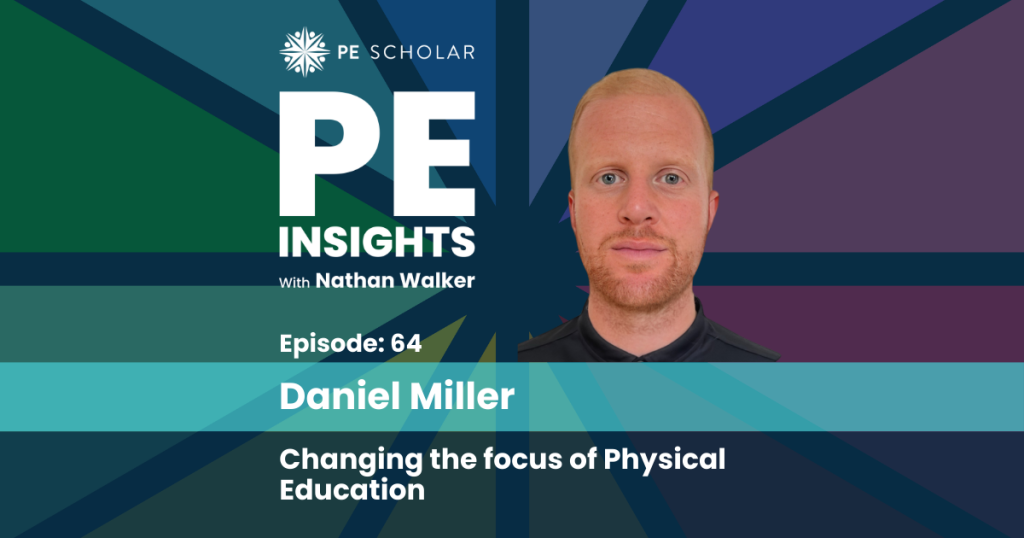
In this conversation, host Nathan Walker speaks with Daniel Miller, Head of PE in Doha, Qatar, about his philosophical evolution in teaching, the necessity of adopting a concept-based curriculum and managing diverse student needs in an international school setting.
Philosophical Shift and Contextual Needs
Dan’s philosophy began with a traditional, rigid, sport-block curriculum. His moment of realisation came when he understood that “a class of 25 isn’t 25 of me”. He realised the purpose of a PE teacher is to ignite physical activity in everybody, not just the already motivated students.
His current department is rooted in this understanding, moving towards a conceptual approach that was accelerated by the specific constraints of teaching in Doha:
- Weather Constraints: Extreme summer heat necessitates frequent indoor activity, preventing constant reliance on outdoor sports like football.
- Facility Constraints: The school’s resources demand open-mindedness regarding activities.
- Diverse Needs: They manage a wide spectrum of ability, from “very top end, very low end,” requiring a curriculum that caters for the “masses and not the minority”.
Concept Curriculum Delivery and Assessment
Dan’s department focuses on concept-based learning, using activities like dodgeball, handball, and ultimate frisbee.
- Core Objective: The teaching aims to develop confidence and an understanding of health, rather than focusing rigidly on skill technique.
- Assessment: Assessment moves away from technical analysis and towards holistic self- and peer-reflection. Questions focus on understanding the concept: Are you feeling more confident? Do you understand when you should pass or move?
- Technique Philosophy: They deliberately move away from asking about specific, rigid technique (e.g. “what angle should your arm be when you are shooting a handball?”) because technique is individualised.
Managing High Performers: The Three Pathways
Dan highlights that the biggest challenge of a concept curriculum is always catering for the most able students. To address this without reverting to an elite focus in core PE, the school established three distinct pathways:
- Curriculum Time (Core PE): Dedicated to growing confidence and understanding the importance of health.
- ECA Time: Extracurricular Activities – offering additional opportunities for diverse sports.
- Performance Time: National or international level competition, where the elite end is specifically catered for.
Dan notes the importance of resisting the urge to appoint higher-achieving pupils only as “coaches” in the curriculum setting, as this fails to challenge their own development.
Pedagogical Models and Examination PE
Dan’s department employs modified pedagogical models to ensure purposeful learning, particularly in culturally popular sports like football:
- Sport Education: They use a modified version of the Sport Education model to avoid better players dominating, ensuring that less able or less confident students have meaningful roles (e.g. media analysts, skills coach, captain). The goal is to prevent less confident players from hating football and disconnecting it from a positive view of health.
- TGFU: For Key Stage 4 (KS4) recreational PE, they use the Teaching Games for Understanding (TGFU) model, focusing on games-based learning and enjoyment with minimal teacher intervention.
Theoretical Booklets for KS4
A major shift in Dan’s approach for theoretical KS4 PE was the implementation of bespoke and challenging theoretical booklets.
- Rationale: This “simple formula” was adopted to eliminate administrative “dead time” (e.g. cutting and sticking diagrams for the respiratory system).
- Impact: The booklets ensure students are continually on task, moving at a consistent pace. They also serve as a helpful scaffolded resource for students with English as an additional language (EAL) and provide clear evidence of missed content for those with attendance issues.
- Simplicity: Dan concludes that often the simplest ideas are the most effective, as “gimmicks” can often distract from genuine learning.
Quickfire Questions and Professional Insight
Dan’s rapid responses focus heavily on high expectations and adaptability:
| Category | Response Details |
| Non-Negotiables | High standards (kit, behaviour, speech). Lessons must have good pace and enjoyment. |
| Mantra | Always put yourself in a position to adapt and change (and have the professional dialogue to justify it). Keep things simple as they are often more effective. |
| Removal from PE | The belief that no teacher is perfect, suggesting that teachers must realise that aiming for perfection in every lesson (highly effective) is impossible. |
| Advice for New Teachers | Take advice on board and do not take it personally. Remember that no teacher is perfect. |
| One Word for PE | Powerful. PE has a unique power and opportunity to impact pupils across all abilities throughout their lives. |
Conclusion
Dan views PE and sport as a “marriage” where the two can be separated but should support each other, with the key difference being explicit understanding of where the performance time (high pressure) is separated from the confidence-building core curriculum.
About the Guest
This episode is a conversation with Daniel Miller, Head of PE in Doha, Qatar.
Listen
To listen to the full episode please follow these links to Spotify or Apple podcasts.

Responses