


Introduction
Will Grove returns to the podcast to detail the extensive curriculum development project he has led, shifting his department’s focus towards “Purposeful PE” anchored in the four domains of Physical Literacy.
Defining Purposeful PE and Curriculum Intent
Will’s reflections began by questioning the purpose behind traditional PE activities, citing the disengagement often reported by older students who view PE as merely a “break from learning”.
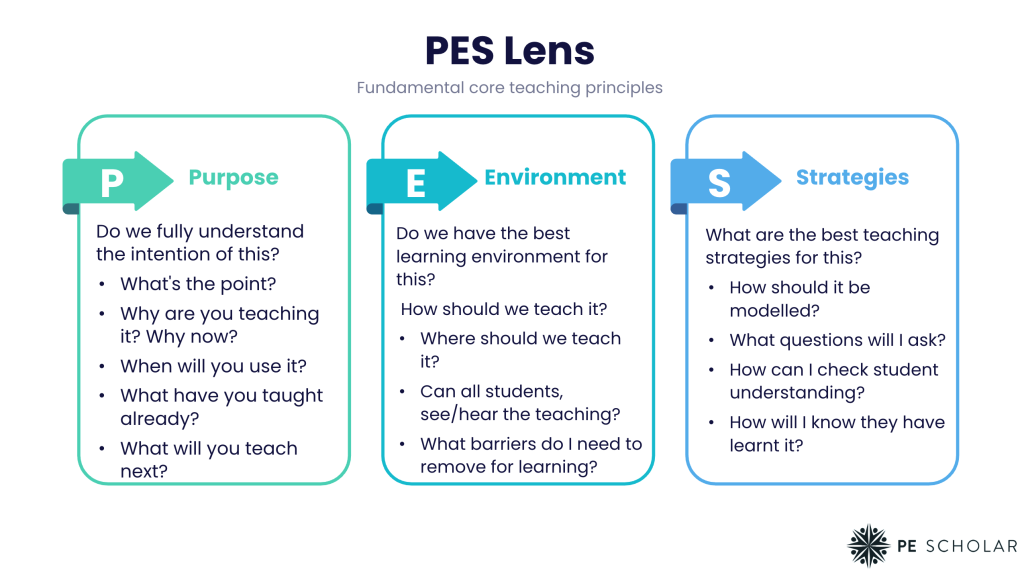
He adopted Phil Cocks’ PES model (Purpose, Environment, Strategy) but pivoted to defining Purpose as the foundational component.
- Curriculum Intent: The intent is defined as nurturing a lifelong commitment to health and physical activity by developing physical literacy.
- Focus on Transfer: The goal is for students to learn principles (e.g. generating power) that can be transferred across activities (e.g. javelin connects to general throwing skills).
- Challenge to Entrenched Habits: Will notes the difficulty of challenging experienced staff members (some teaching for 30+ years) to question why they deliver certain lessons (e.g. “Why do I bother getting out all the long jump stuff… for them all to have one jump?”).
The Physical Literacy Model: Move, Think, Feel, Connect
Will structured his curriculum around the four domains of Physical Literacy, heavily influenced by Professor Liz Durden-Myers‘ work.
- Move to Learn: Will holds the strong philosophical belief that pupils must “learn to move and then we can move to learn”. Movement competence (Move) is therefore prioritised as the foundation required to “unlock” the other areas.
- Domain Prioritisation: Will argues that Move and Think (knowledge/understanding) should precede Feel (confidence/motivation) because feelings are transient.
- Sequencing and Granular Movement: Movement is broken down into granular, underpinning skills for progression (locomotion and manipulation skills).
- Locomotion Example: Teaching “agility” means breaking it down into specific footwork patterns like “cut step, cross step, drop steps,” and learning to backpedal efficiently.
- Progression: These skills are built sequentially from Year 7, where they are simplified, before being applied into specific contexts like flag football, where movements can be pre-empted and practised.
Holistic Assessment and Impact
Will’s team uses the four physical literacy domains (Move, Think, Feel, Connect) to assess students, giving a rating out of five for each.
- Inclusivity: This model allows students with low physical competence (Move) to still achieve highly through knowledge (Think) or motivation (Feel).
- Assessment for Learning (AfL): AfL is conducted through dialogue, particularly for Feel (motivation and confidence). If a teacher observes a student showing low confidence (e.g. avoiding the trampoline or going to the back of the queue in rounders), they can use the assessment data to differentiate the task and address the barrier.
- Psychological Focus: The Feel unit explicitly uses concepts like the inverted-U theory and arousal to help students understand how to control their emotions for performance, linking PE concepts to exam strategies and life management.
- Impact: The shift has led to a significant increase in GCSE PE uptake, with the department seeing over 70 students pursuing examination PE across two year groups.
Challenges and Future Direction
Will acknowledges that challenging established teaching habits is the greatest difficulty. His team has learned to use their constraints (e.g. limited facilities) to their advantage, programming specific skills based on the available space, thereby encouraging adaptability.
- Ultimate Vision: The end goal is to ensure that “everyone in the school has the same shared purpose of what physical education is”.
- Progression: Will’s next steps involve interleaving the four domains (Move, Think, Feel, Connect) rather than teaching them as separate units, to show the intrinsic connection between movement and the holistic self.
- Performance vs. Core: He separates competitive sport time (extracurricular/club) from core PE, noting that Core PE provides the foundational movement skills that allow students to thrive in their chosen club sports later.
Professional Insight
Will’s advice focuses on intellectual curiosity and purpose:
- Purpose: The central theme is asking: “What was the purpose of my lesson today?” and communicating this to the pupils.
- Expertise: Teachers must be aware of their own expertise boundaries and manage high-performing students by focusing on transferable skills (e.g. decision-making, responsibility) where the teacher’s knowledge is high, rather than niche techniques where it may be limited.
Conclusion
Will’s goal is to nurture a lifelong commitment to health and physical activity by developing physical literacy, utilising the strands of move, connect, think, and feel.
Will champions the philosophy of “learn to move, and then we can move to learn,” prioritising the meticulous development of fundamental movement competence. This involves breaking down movements (locomotion, manipulation, stabilisation) into granular steps to help students “unlock movement problems” and access a wider range of activities.
He advocates for intellectual accountability among his staff by constantly asking: “Why are you teaching that lesson?” His assessment tracks progress across all four physical literacy strands, ensuring that students who may not be competent movers can still achieve success through demonstrating knowledge or motivational confidence
About the Guest
This episode is a conversation with Will Grove, Head of PE at Broadwater School in Surrey and also supports PE across the Greenshaw Trust.
Listen
To listen to the full episode please follow these links to Spotify or Apple podcasts.

Responses