


Introduction
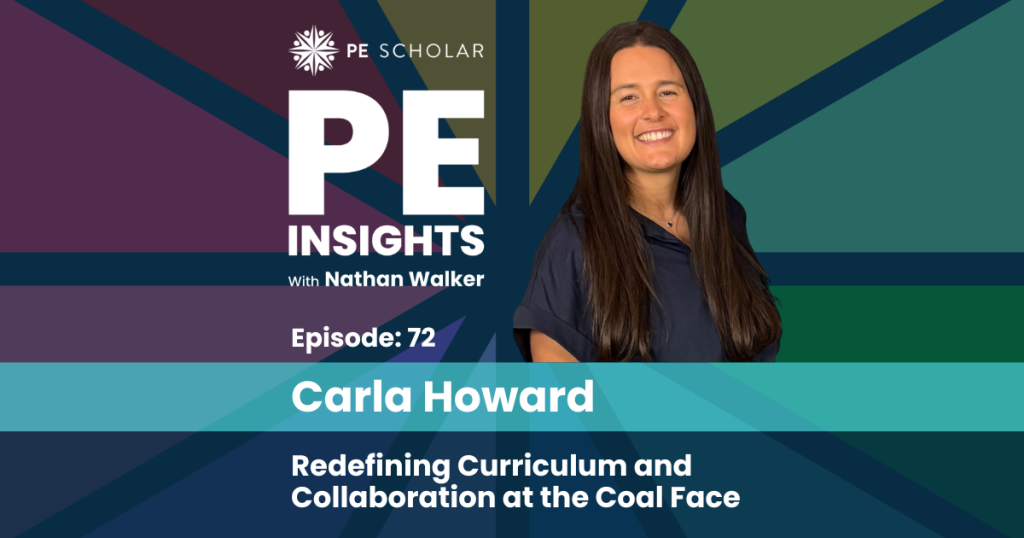
We were delighted to host Carla Howard, Head of PE at a secondary school, for a rich conversation with Nathan Walker on the PE Insights Podcast. Our discussion was particularly timely, coinciding with the release of the Curriculum and Assessment Review Final Report, allowing us to unpack what these changes might mean for Physical Education.
Here is a summary of the key insights shared by Carla, focusing on her department’s approach and her work in fostering collaboration across the sector.
1. PE Must Be ‘For All’ and Holistic
For Carla, inclusivity is a central focus of her professional journey and the department she leads. This emphasis stems partly from negative personal experiences growing up, such as her “worst experience” playing football on a boys’ team, cementing the importance of inclusion throughout her life.
A major change implemented in her department is the clear distinction between Physical Education and sport: “PE and sport are two different things”.
- Holistic Focus: Carla’s department defines its curriculum around holistic development, encompassing four key domains: physical, cognitive, social, and affective. This model ensures that every student can “thrive” in a variety of ways, not just through elite performance or mastery of skills.
- Non-Linear Progress: Carla fundamentally views the assessment of a child’s physical development and physical literacy journey as “not linear” because students progress at different rates.
- Progress Defined: Her ultimate aim is for students to leave school as “healthy active adults” who can confidently and competently move and apply their skills in different contexts.
- Addressing Barriers: Whilst competitive sport remains important, Carla acknowledges that the idea of competition can be a “barrier” for some people, and curriculum application must support those who might not thrive in that environment.
2. Securing the Curriculum Through Student Voice
Carla’s department actively uses student voice to shape curriculum delivery and secure an inclusive offering. They engage in open dialogue, moving away from an “us and them” relationship.
- Choice and Autonomy: Students frequently ask for choice. Her department is developing ways to give students more autonomy over the “route they go”.
- Small-Sided Adaptations: Recognising that the “big large team environment isn’t for them” for a high proportion of students, particularly girls, they predominantly use small-sided activities (e.g., 3v3 or 2v3) for invasion games, rather than full mass games. This approach, rooted in physical education rather than sport, allows concepts to be applied “quite easily” in a smaller group context.
- Assessment Language: The department uses shared language in self and peer assessment, focusing on confidence and competence ratings (e.g., “What does it mean to acquire a skill? What does it mean to thrive in a skill?”) to help students reflect on their progress.
3. The Heads of PE Network: Collaboration at Scale
Five years ago, Carla founded the Heads of PE Network on WhatsApp to support each other, share ideas and importantly share struggles with a focus on:
- The Need for a Safe Space: Carla initiated the network after experiencing severe imposter syndrome early in her career. She felt that while public social media was useful for sharing successes, it was not the forum to “ask for help” or sanity check ideas. The private network provides a “safe space”.
- Supporting Middle Leaders: She describes the role of a middle leader as “a beast in itself”. The network affirms that leaders are “not alone in this journey”.
- Shared Resources: Carla advocates for sharing resources, such as tracking dashboards or faculty overviews, stating they should not be a “secret”.
- Future Development: She aims to develop an aspect of the network specifically for aspiring leaders to hear the “realities” of what leadership is like.
4. Views on the Curriculum and Assessment Review
Carla provided her reaction to the recommendations from the Curriculum and Assessment Review in 4 main areas:
| Review Recommendation | Carla’s Key Points |
| Redrafting the Purpose and Aims | Carla agrees that holistic development (physical, cognitive, social, emotional) needs a bigger focus. She likes the idea of sport being a “vehicle” for teaching principles (e.g., attacking/defensive). She notes that the deployment of Outdoor Adventurous Activities (OAA) is difficult for many schools due to context and resources. |
| Renaming GCSE Physical Education | She strongly agrees the name should change (suggesting Sport Science or Sport Studies) to “give PE the respect it deserves” and clearly distinguish it from Core PE. Core PE and accredited GCSE PE are “completely separate entities”. |
| Making the Activity List More Inclusive | She supports reviewing the activity list. However, she grappled with the idea that if the GCSE focuses purely on science, the physical application component might be lost entirely. She notes the current practical waiting is minimal (30%) and achieving high marks is difficult due to high national standards. |
| Qualification Purpose | The purpose of any qualification must be to provide an “accessible step” to the next stage of learning, such as post-16 education. |
Conclusion
Carla’s approach defines high-quality PE as an inclusive and holistic experience, fundamentally ensuring that PE is “for all”. Driven by personal experience, her department focuses on supporting students’ holistic development across physical, cognitive, social, and affective domains. This commitment redefines success, prioritising student progress (viewed as non-linear) and confidence over solely elite performance. A core component of her philosophy involves integrating student voice, which highlighted a preference for small-sided application over full competitive sport, confirming the shift towards physical education.
About the Guest
This episode is a conversation with Carla Howard, Head of PE at a secondary school in Surrey and creator of the Head of PE network on WhatsApp.
Listen
To listen to the full episode please follow these links to Spotify or Apple podcasts.

Responses