


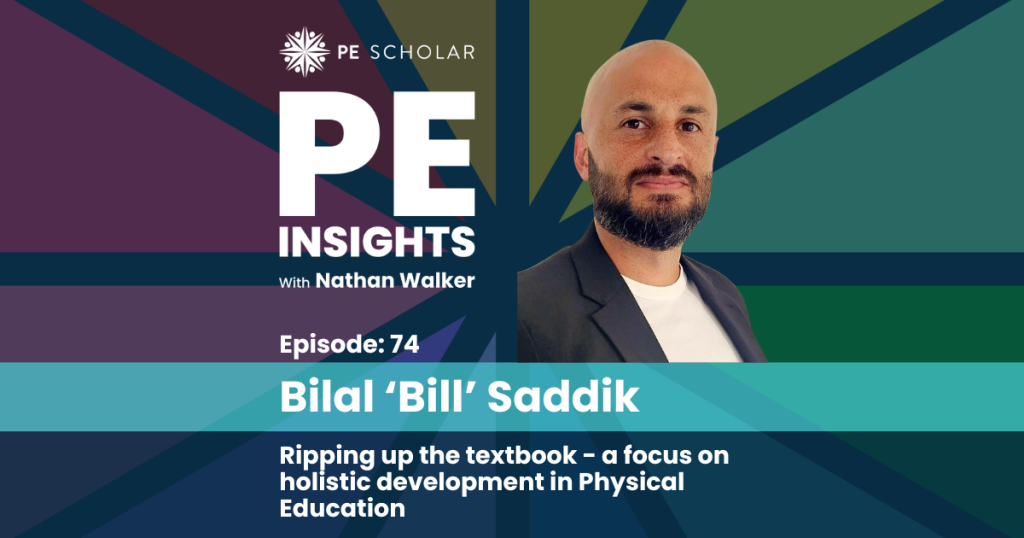
Episode 74, subtitled “Ripping up the textbook – a focus on holistic development in Physical Education,” features a conversation with Bilal (Bill) Saddik . Bill is a highly passionate individual and a real advocate for holistic development. He currently resides and works in Singapore.
The core message and philosophy shared by Bill throughout the discussion is that PE should prioritise the holistic development of the whole child by focusing on emotional, social, physical and creative thinking rather than narrowly focusing on just the physical learning. He firmly states that he is “not a fan of one size fits all” and encourages listeners to share their thoughts on the conversation.
The Journey from Coach to Educator
Bill’s educational journey began in the Middle East. His entry into the world of PE was through elite sport:
- He started as a professional football freestyler, winning his first Red Bull football freestyle competition in the Middle East, which gave him significant exposure.
- His freestyle career led him to travel globally, work with major companies such as Adidas and Nike, and perform at events like the Asian Cup.
- He transitioned into coaching, working as a football coach at prominent international academies, including the Barcelona Football Academy and Everton in the Middle East.
- He subsequently co-launched and ran his own successful football academy in Kuwait, which grew to include over 400 players across all ages (3 to 18) and attracted large sponsors.
Bill credits this intense focus on the sporting side of the spectrum with shaping his philosophy, giving him the “real knowledge about the difference between being a teacher and a coach”. He realised that the context of physical education in schools has evolved past the historical focus on producing soldiers or exclusively serving boys; modern PE must embrace inclusivity and aim for the holistic development of the student.
Ripping Up the Textbook: Philosophy and Planning
Bill believes that PE is about discovery and that students must find their own way; it is not something that can be fully learned from an “A-to-Z guide” or a book. This principle underlies his approach to planning and adaptive teaching:
- Challenging Traditional Expectations: Bill admits that when he first started as a PE educator, his biggest mistake was setting high expectations based on what he wanted, rather than focusing on the students’ needs. He contends that trying to produce professional athletes through just 45 minutes of PE once or twice a week is unrealistic.
- Adaptive Teaching is Key: Since teachers often face up to 20 different abilities within a single class, rigidly adhering to an A-to-Z lesson plan means not everybody will meet the (potentially unrealistic) high expectations set.
- Planning Method: While acknowledging that new teachers need structured guidance, Bill advises moving away from detailed lesson plans long-term. He now relies primarily on keywords or concepts held in his head, allowing him to adapt and change based on student abilities. For instance, if the learning objective is “throw with power,” but a child is afraid to hold the ball, the lesson must pivot to address the emotional or physical readiness barrier first.
The Centrality of Holistic Development
Bill emphasises that learning begins at the emotional level. He structures his lessons to ensure foundational non-physical needs are met first:
- Foundational Focus: He asserts that if the emotional stage is not achieved, the social stage, the physical stage and eventually the creative stage cannot be achieved.
- Practical Application: He applies this necessity by focusing on emotional and social learning in Week 1 and 2 before he introduces or taps into the physical aspect of the unit.
- The Power of Play: Bill is a strong advocate for meaningful play as a mechanism for development. Play is crucial for developing social skills (listening, following instructions and playing fair) and foundational physical skills (hopping, jumping, skipping).
- Storytelling and Ownership: Instead of using rigid instruction, he utilises storytelling and creative games to foster engagement and imagination. He uses existing activities like parachute games but encourages students to invent different games – such as “steal the cheese” – which gives them ownership and motivates them to stay active. He notes that the students themselves often suggest and discover new learning methods that are not found in the textbook.
Gender, Equity, and Technology
Bill highlights the challenge that PE can often be implicitly geared up for boys. He shares a reflective personal example of setting up a mini-Futsal court: the boys quickly occupied the space, while the girls refrained from participating because they did not want to engage in the specific, pressurised demands of the traditional game. He calls for challenging these existing stereotypes, especially in international contexts.
In terms of utilising modern resources, Bill integrates technology into his practice, citing examples such as the use of a robot idea with a big screen. He also developed a technological resource called “Track PE”, an all-in-one tool intended to help PE teachers, particularly Heads of PE, save time and streamline their work so they can focus on what truly matters: the students.
Quickfire Insights
Bill’s final reflections condense his philosophy:
- Non-Negotiable: Teachers must be ready to be adaptable, emphasising that there is “no one size fits all” approach.
- Controversial Removal/Advice: He advocates for teachers to get rid of the A-to-Z guide and, if they have the choice, to throw the coaching hat away.
- One Word for PE: Change. He clarifies this means “Positive Change” – encompassing emotional, social, physical, and independent development – rather than just physical change.
Conclusion
Bill’s advocacy for ripping up the textbook and focusing on emotional readiness before physical skill acquisition is akin to tuning an instrument before asking a musician to perform a complicated concerto. The internal systems (emotional and social) must be calibrated and functioning safely and joyfully; otherwise, the external performance (the physical skill) will inevitably fail to meet its full potential.
About the Guest
This episode is a conversation with Bilal Saddik. Bill is a PE teacher, sports coach and former football freestyle champion currently based in Singapore.
Listen
To listen to the full episode please follow these links to Spotify or Apple podcasts.

Responses