


Introduction
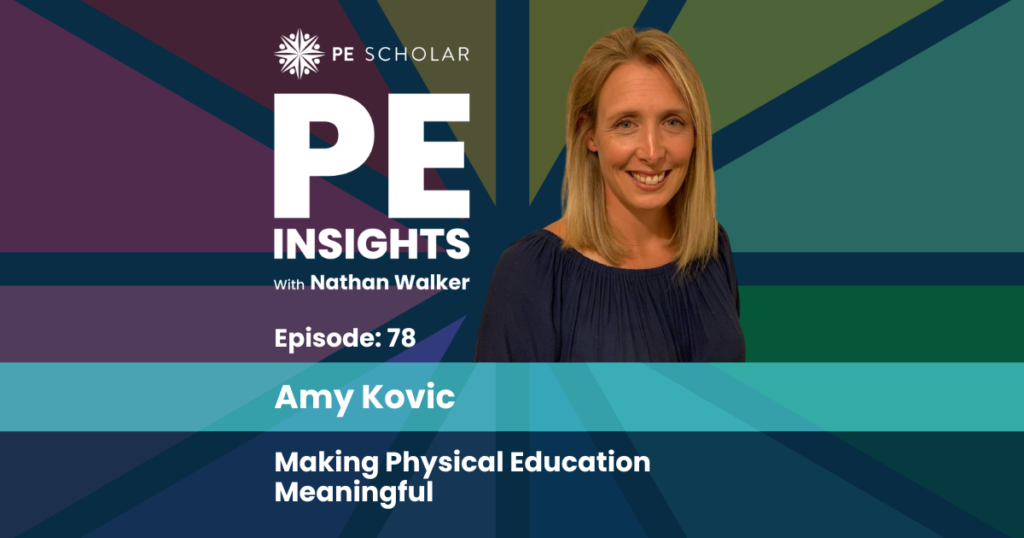
Amy joins the podcast to discuss her role leading Physical Education (PE) in a large secondary school and her efforts to transform a traditional curriculum into one focused on meaningful experiences and holistic student development. Drawing on her background in leading skills and competency-based programmes, Amy details the challenges and strategies involved in radically reshaping both the PE curriculum and the assessment framework to prioritise student confidence, well-being and sustained physical activity beyond school life.
Educational Journey and Philosophy
Amy has over 16 years of teaching experience, having always worked with young people. Prior to her current role as Head of PE, she led a comprehensive skills and competency-based programme called “Winston Extra.” This programme focused on five key competencies: communication, collaboration, resilience, analysis and ingenuity. Its core purpose was to help students find “pathways out” of challenging situations. Amy emphasised that this programme was not merely Personal, Social, Health Education (PSHE) but was attributed directly to life skills, often using “strategies, not targets,” and incorporating Learning Review Days where students came in for one-to-one conversations with a parent and a tutor.
Upon taking over her PE leadership role in a large school of 1500 students, Amy inherited a traditional curriculum that focused on blocks of sport, such as passing, receiving and defending within invasion games over short three-week periods. She saw herself as “quietly disrupting” this status quo, challenging her department to question why they followed these entrenched practices.
Creating Meaningful Experiences and Prioritising Inclusion
Amy and her team collectively decided that the core curriculum intent for PE should ensure that young people leave the school feeling confident and competent to move their body and able to feel successful in PE. She insists that success does not necessarily equate to being highly skilful; it can be achieved through teamwork, communication, organisation and simply knowing how to be an active, healthy adult.
A significant focus of Amy’s department is identifying and supporting “outliers”—students who stand on the outside of participation. She challenges her teachers to understand the barriers those students face and why they may lack confidence in the PE environment.
To address inclusion and well-being, Amy collaborated with external partners to integrate the Rise Up programme into the curriculum. Every class now has a Rise Up unit, exploring concepts such as inclusive teams, stress busters and energisers. These principles were also disseminated into tutor time using bespoke student booklets to help connect physical health with mental health.
Curriculum Innovation and Assessment Overhaul
Amy championed several curriculum innovations:
- Leadership Unit: A Year 9 leadership unit allows students to choose non-performer roles, such as sports journalist, physiotherapist, coach, or officiator. They participate in theory work and then apply these roles in a tournament setting, widening their understanding of what “sport” can be.
- Adaptive Grouping: The department adapted their practices to use smaller-sided teams and games to ensure environments where more students can experience success.
The traditional assessment system was one of the first elements Amy overhauled, as it failed to communicate students’ true progress. Working with staff and student voice, the department developed a non-linear assessment model based on four core categories:
- Knowledge: Understanding rules and regulations.
- Skill: Practical application of movement.
- Effort: Application and contribution to the environment.
- Leadership: Ability to lead and to be led.
This system is communicated to students via statements on their online learning platform, allowing them to see that proficiency is multifaceted. The department replaced “assessment week” with “feedback week,” using one-to-one conversations to discuss student progress across these four domains, thereby making the assessment process more intentional and meaningful.
Future Direction and Measuring Success
Amy is currently exploring the possibility of introducing shorter, more employable certificates (rather than the traditional GCSE PE course) tailored for students who are passionate about coaching or fitness but may struggle with the high academic demands of the examination subject. The goal is to ensure the provision is “fit for purpose” for the learners in their context.
The department’s success is measured not by exam results but by whether students can confidently explain why physical activity is important for them and if they have identified pathways to remain physically active after leaving school. This holistic approach has already resulted in a massive increase in the student well-being score across the school.
Conclusion
Amy’s work exemplifies a successful transition from a traditional, sport-centric model to a responsive, meaningful curriculum. By championing intentional inclusion, overhauling assessment to be multifaceted and focusing relentlessly on student voice, she has fostered an environment where the department can continuously tweak and adapt its provision, ensuring that PE serves its purpose in developing confident, physically active and mentally resilient young adults.
About the Guest
This episode is a conversation with Amy Kovic, Head of Physical Education at a large secondary school who shares how she has led a bold shift away from a traditional, sport-centric curriculum towards one rooted in meaningful experiences, inclusion, and lifelong physical activity.
Listen
To listen to the full episode please follow these links to Spotify or Apple podcasts.

Responses