


Introduction
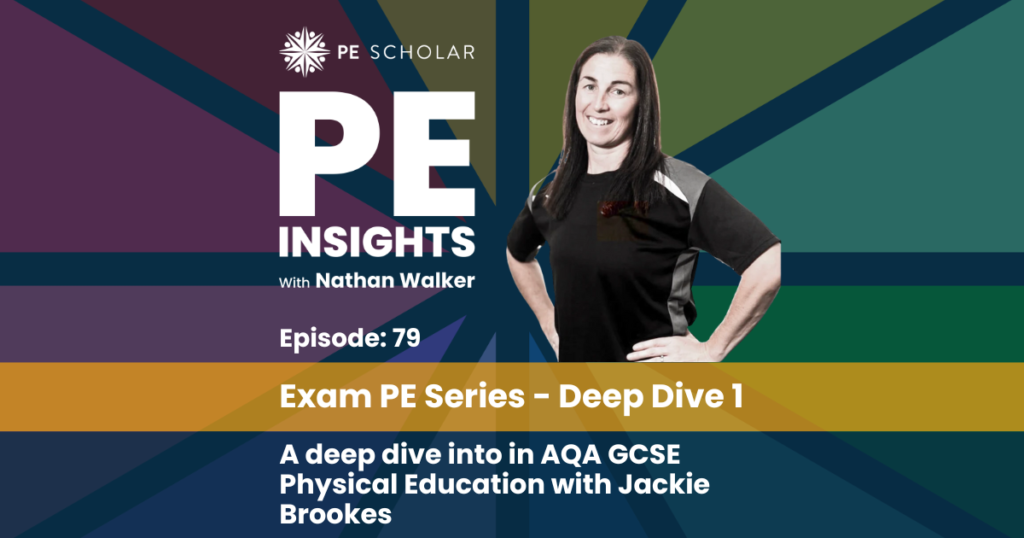
Jackie Brookes, a specialist in academic PE and the founder of PE Active, joins the podcast alongside Will Swaithes to discuss the often-challenging subject of examination PE. The conversation focuses specifically on the AQA GCSE specification, providing essential insight for trainees, early career teachers (ECTs) and leaders aiming to effectively teach and assess the academic component of Physical Education. The discussion highlights the critical need to master command words and apply complex content through practical, engaging methodologies.
The Challenge of Examination PE
Will introduced the segment by noting the struggle faced by trainee teachers who receive little support in navigating the highly nuanced specifications of examination PE. Jackie agreed, stating that her work with ECTs consistently revealed that they lacked the necessary insight and academic content knowledge, often feeling unequipped to support students in maximising their results.
Jackie’s personal journey was shaped by her realisation that she needed to immerse herself in the academic content and assessment specifics to teach effectively. She is a self-professed kinesthetic learner who advocates for delivering theory concepts through movement-oriented and active classroom methods (hence ‘PE Active’).
Deciphering the AQA Specification
Jackie views the AQA specification as highly prescriptive, which she considers a strength as it clearly outlines the required content. She emphasised the importance of the three Assessment Objectives (AOs), which are consistent across all awarding bodies:
- AO1: Knowledge (knowing the facts).
- AO2: Application (using knowledge in a scenario).
- AO3: Higher-Order Thinking Skills (analysis, evaluation, justification, discuss) – termed the “magic four” by Jackie.
A key feature of AQA is that the specification explicitly guides teachers on where to focus on AO3 skills, for instance, by requiring students to “justify why a fitness component is important in different sports.”
Command Words and Exam Technique
Both Jackie and Will stressed that mastering command words is essential for AQA success. Students must understand what the command word instructs them to do with the content. Jackie teaches a methodology for dissecting exam questions called B.U.C. (Box, Underline, Circle):
- Box the command word (e.g. analyse, evaluate).
- Underline the knowledge/topic area (e.g. long-term effects of exercise).
- Circle the sport or context (e.g. basketball).
The exams consist of two papers, each 1 hour 15 minutes long and worth 78 marks. They feature multiple-choice, short-answer questions (SAQs) and finish with a six- and a nine-mark extended answer question, which heavily tests AO3 skills. Paper 1 covers Applied Anatomy and Physiology and Physical Training, while Paper 2 covers Socio-Cultural Influences and Health, Fitness and Well-being (which some schools teach first due to its accessible nature).
Non-Examined Assessment (NEA) – The 40% Practical Component
The NEA accounts for 40% of the final grade, split into two areas:
- 30% Practical Performance: Requires students to be assessed in three activities (one team, one individual and one other). Each is marked out of 25, divided between skills (Part 1) and application in a competitive environment (Part 2).
- 10% Written Coursework (Analysis and Evaluation): This highly personalised task requires students to analyse their own performance, identifying two strengths (one skill, one fitness) and two weaknesses (one skill, one fitness). They then use evaluation skills to suggest relevant improvement strategies for the weaknesses. This coursework component directly hones the high-level AO3 skills learned in the classroom. Jackie cautioned that students should not bulk out this work with irrelevant information, such as descriptions of fitness tests.
Top Tips for Teachers
Jackie offered several top tips for successfully delivering the AQA specification:
- Use AQA Resources: Utilise the official website’s command word document and glossary of AO1 terms.
- Emphasise Practicality: Integrate theory into active classroom sessions. She advocates teaching content through the lens of AO3, ensuring that practical activities focus on the specific movements and concepts that students will be asked about in the final exam (e.g., planes and axes).
- Read Examiner’s Reports: These provide vital insights into why cohorts performed poorly on specific questions.
- Sit the Exam: Jackie controversially advised that teachers should sit the exam every year under exam conditions and attempt to mark their own paper to fully understand the mark scheme and the student experience.
- Broaden Examples: Use a wide breadth of sporting examples in the classroom, ensuring images reflect equality, diversity and inclusion.
The Future of GCSE PE
Jackie and Will discussed the potential renaming of GCSE PE to GCSE Sports Science or Studies. Jackie supports curriculum reform and suggests removing outdated content (such as body types). She strongly advocates for adding highly relevant and modern content, specifically the impact of menstrual cycles and hormones on female performance, as this is vital knowledge for all young people. She believes the name change needs to be scrutinised to ensure that the vital physical application element of the course is not lost.
Conclusion
The conversation reinforced that successful delivery of the AQA specification hinges on making the complex academic content engaging, practical and assessed with a clear understanding of the command words. By focusing on AO3 skills from the start, using active teaching methods and continually reflecting on the assessment requirements, teachers can ensure that academic PE prepares students effectively for the examination while simultaneously providing them with valuable higher-order thinking skills.
About the Guest
This episode is a conversation with Jackie Brookes, founder of PE Active who joins us to unpick the complexities of the AQA GCSE PE specification and explore how teachers can deliver academic PE with confidence, clarity and impact.
Listen
To listen to the full episode please follow these links to Spotify or Apple podcasts.

Responses