


Introduction
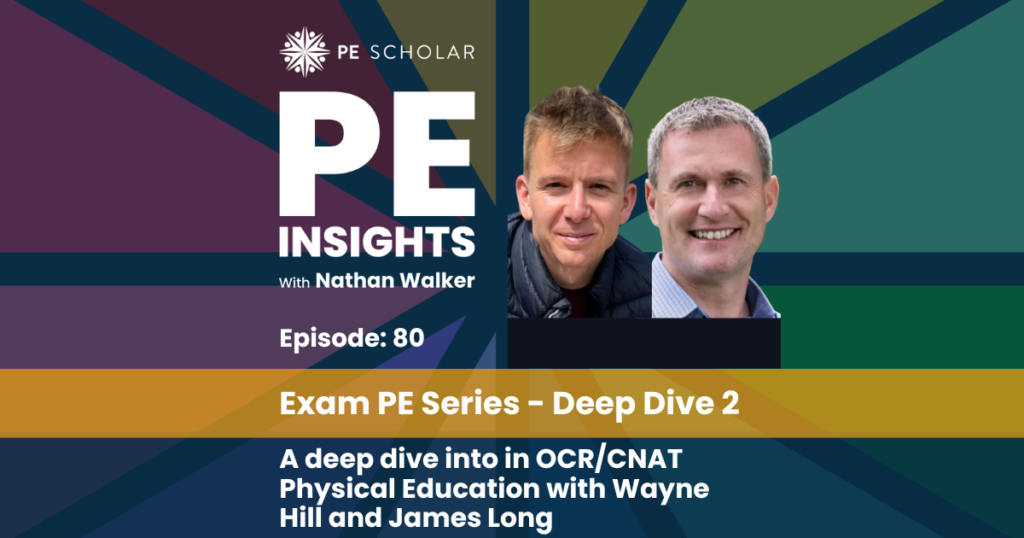
In this episode, the podcast delves into the specifics of the OCR GCSE Physical Education specification and the Cambridge National (CNAT) in Sport Studies. The guests, Wayne Hill and James Long, share their extensive experience teaching these courses across various settings, from inner-city London academies to independent schools and rural all-through schools in Somerset.
The conversation provides a comparative look at the two qualifications, offering vital advice for departments trying to decide which course best suits their students. It covers practical strategies for assessment, the nuances of the OCR GCSE PE “cluster moderation” model and how to effectively deliver coursework components to maximise student success.
Educational Journeys and Context
James began his career graduating in 2013 with a degree in sports coaching and PE. After working in higher education, he moved into secondary teaching at an academy in Greater London. This role involved working in a challenging setting with minimal facilities and space. Currently, James teaches in Somerset at an all-through school in Bridgwater. Despite the rural location, he notes the area has similar deprivation levels to his previous London school, presenting comparable teaching challenges.
Wayne retrained as a teacher in 2005 after spending his post-university years as a “professional beach bum” and water sports instructor. His first teaching post was at Colchester Royal Grammar School, where he spent 16 years and introduced the GCSE PE course. He has since moved to a small independent school, where he leads on GCSE and co-curricular PE, teaching students from Year 7 through to Year 13.
OCR GCSE PE: Highlights and Assessment Structure
Wayne, who focuses on the OCR GCSE, praises the specification for its logical and straightforward structure. He noted that when his department looked to change exam boards, they actually involved students in the decision-making process. The students overwhelmingly preferred the OCR specimen papers because of the two one-hour exam paper format and the style of questions, which required less extended writing compared to other boards like AQA.
Key features of the OCR GCSE include:
- Assessment: Two 60-minute papers (unless additional time is granted).
- Extended Writing: There is only one six-mark question (a synoptic question drawing on content from both papers and practical application), which students find more accessible than the longer essay questions found in other specifications.
- Marking Scales: The practical component is marked out of 20, which Wayne appreciates. He feels this wider mark range allows teachers to differentiate more accurately between a “good” student and a truly “national level” performer, utilising the full spectrum of marks.
Cambridge National (CNAT) Sport Studies
James provided insight into the Cambridge National (Level 1/2) course, specifically Sport Studies, which his school offers as an alternative. This vocational course is ideal for students who may struggle with the heavy theoretical exams of GCSE but excel in coursework and practical application.
The Sport Studies course consists of three units (previously four):
- Contemporary Issues in Sport (R184): The compulsory terminal exam unit.
- Performance and Leadership in Sports Activities (R185): A coursework-based unit where students are assessed on their own performance and their ability to lead others.
- Optional Unit (e.g., R187): James’s school chooses “Increasing Awareness of Outdoor and Adventurous Activities” rather than “Sport and the media”
James highlights the flexibility of the CNAT. Schools can finish the course early in the January exam series of Year 11, releasing students to focus on other subjects or revision. However, he acknowledges a challenge in identifying the right course for the right student at the start of Year 10, as some students capable of the GCSE end up on the CNAT track, where they make rapid progress but might have been better suited in the end to the GCSE pathway.
The Practical Component: Standardisation and Moderation
A significant portion of the discussion focused on the practical assessment and how it differs between the two courses.
For GCSE (Cluster Moderation): Wayne spoke highly of the cluster moderation model used by OCR GCSE. In this system, multiple schools meet at a single venue with their students to be moderated together.
- Pros: It “keeps everyone honest.” Teachers can see how their marking compares to other centres, ensuring a “20 out of 20” really is exceptional.
- Cons: It can be an intimidating experience for lower-ability students (e.g., those scoring 3 or 4 out of 20) have to perform in front of strangers from other schools.
- Strategy: Wayne advised that teachers must manage student expectations early. He explicitly explains that a mark of 14/20 is still equivalent to a Grade 7 or 8 (A grade), helping high-performing school athletes understand why they might not be receiving full marks if they are not competing at a national level.
For Cambridge Nationals: James explained that the practical assessment in CNAT is less prescriptive but still requires rigorous internal standardisation.
- Flexibility: Assessment does not have to occur on the school site. James gave an example of a student assessed in sailing by their cadet group; the external instructor provided video evidence and feedback which the school verified.
- Marking Criteria: The criteria can be somewhat vague (e.g., “comprehensively perform most skills”). James combats this by collaborating with local Heads of PE to hold inter-school fixtures, using these competitive opportunities to discuss and standardise grading for students across different mark bands.
Coursework Strategies (NEA)
Both guests shared their strategies for the written element of the Non-Examined Assessment (NEA), which involves analysing and evaluating performance.
GCSE NEA: Wayne and Will discussed the common pitfall of students analysing their own performance. Students are often reluctant to admit weaknesses for fear of being marked down.
- Recommendation: Students often perform better if they evaluate a peer. This removes the ego barrier and allows them to objectively identify strengths and weaknesses.
- Integration: Wayne teaches the underlying theory (fitness testing, methods of training) practically in Year 10. He collects the data then, and in Year 11, when the coursework window opens, students essentially “restart” the write-up using the data they have already generated, ensuring the 14-hour limit is used efficiently for application, not just data collection.
CNAT NEA: In the Sport Studies R185 unit, the coursework is self-reflective. James notes that this unit flips the thinking to the student: “This unit is about you.” Students must plan drills to address their own identified weaknesses and monitor their progress. This requires a shift in mindset for the R187 (Outdoor Adventure) unit, where the writing style changes to a “how-to” guide, requiring students to think about how to instruct others safely.
Top Tips for Success
The guests offered several “top tips” for teachers delivering these OCR specifications:
- Read Examiners’ Reports: Wayne emphasised that these reports are essential reading. They highlight exactly where students lost marks in previous years.
- Sit the Exam Yourself: Teachers were encouraged to sit the papers under timed conditions and mark them. This provides empathy for the student experience and a deeper understanding of the mark scheme.
- Explicit Teaching of Vocabulary: Wayne advises drilling key terms (like components of fitness) incessantly. He uses repetition, such as starting lessons with quick-fire recall on whiteboards, so that by the exam, recall is automatic.
- Start Paperwork Early: For CNATs specifically, James warned that the administrative burden is high. Falling behind on the extensive paperwork can penalise students who otherwise deserve good grades.
- Focus on Application: In coursework, students gain no marks for simply copying definitions from a textbook. Teachers must steer students immediately towards applying their knowledge to the specific sporting context.
Hopes for the Future
The episode concluded with a discussion on the future of PE qualifications. Both guests expressed a desire for a qualification that better matches the reality of students’ lives.
Wayne hoped for a course where the “title matches the delivery.” If a course is called Sport Science, it should be scientific; if it is PE, it should be holistic. He argued against the rigid requirement for competitive sport for all, suggesting a flexible model where students could choose modules—some might pursue a “physio” or science route, while others pursue a competitive performance route—within the same qualification structure.James echoed this call for adaptability, hoping for a system that recognises the diverse needs of different cohorts without penalising schools. He envisions a future where a department can tailor the course to a specific group of students—focusing heavily on theory or leadership if that suits their strengths—while still allowing them to achieve a robust and respected qualification.
About the Guests
This episode is a conversation with Wayne Hill and James Long, two experinced educators working across different OCR/Cambridge National pathways.
Listen
To listen to the full episode please follow these links to Spotify or Apple podcasts.

Responses