


Imagine being told at age 11 exactly where you’ll be at age 16, based on a single test score. For years, schools have relied upon flight paths as linear charts that predict a student’s future grades in a straight, upward line. Is your school or PE team still living in that parallel universe?
There’s one huge problem: Human learning doesn’t happen in straight lines. As anyone currently trying to master a new skill knows, the reality is far messier. Take my current obsession: kitesurfing. In the beginning, I rode a nice steep learning curve, transferring old skills from surfing and kite-flying to get an early win and onto my feet (on the board and in the water) within my first session. But then the plateau hit. Suddenly, I was face-planting in the surf, ‘body-dragging’ back to my board and marching back up the beach to find a kinder spot to set off on my stronger side. Just when I thought I’d cracked it, the wind shifted or the waves grew and I was back to the drawing board whilst a seasoned local cruised back and forth with ease.
The most painful part? Realising I had to ‘unlearn’ poor techniques to move forward. This is where learning doesn’t just stall; it regresses. It’s in these moments, the dip before the breakthrough, where the ‘flight path’ fails us. Without a teacher who understands that struggle needs to be part of the design, and role models to remind us that it is possible, it’s easy to give up. But if we accept that anything worth learning is inherently non-linear, we stop seeing the ‘dip’ as a failure and start seeing it as the process. When you add to the mix all the complexity of biological changes (including puberty and brain development) and social pressures, it is SO important that we reinforce with our students that:
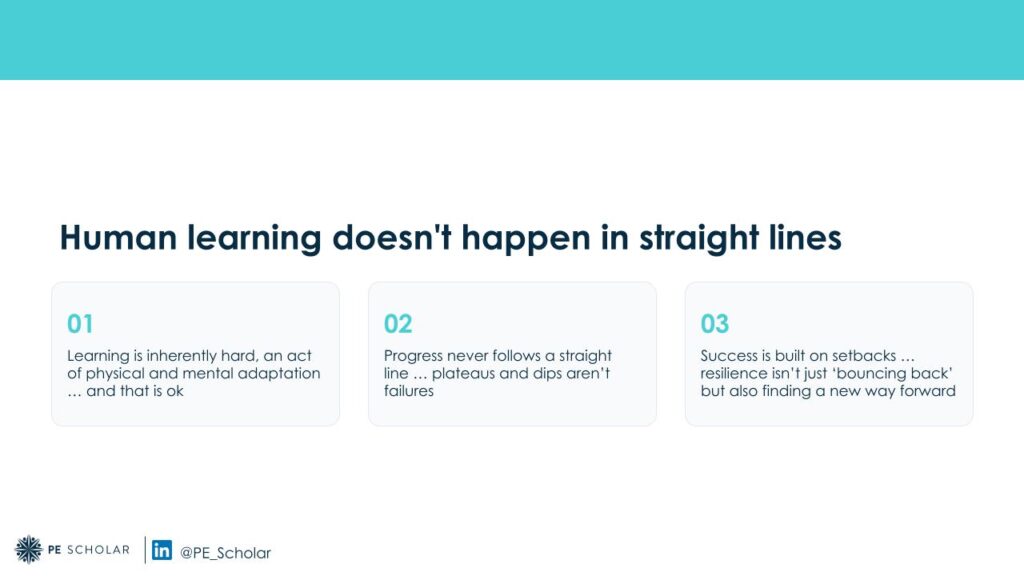
- Learning is inherently hard, an act of physical and mental adaptation … and that is ok
- Progress never follows a straight line … plateaus and dips aren’t failures
- Success is built on setbacks … resilience isn’t just ‘bouncing back’ but also finding a new way forward
1. The Myth of the Straight Line
We used to treat students like airplanes on autopilot. If you started at Point A, you should hit Point B by mid-year. But research shows this is statistically “nonsensical.”
As David Didau highlights in Making Good Progress? (2017), a look at the National Pupil Database reveals a startling truth: when we track students from age 11 to 16, only 9% actually stay on their predicted ‘linear’ path. The other 91% are busy learning in the real world with all the dips, plateaus and surges that data-driven flight paths simply can’t account for.
2. From Mechanics to Ecology
The shift we are seeing in education is a move from interactionism to Ecological Dynamics.
- Old View (Interactionism): The brain is a computer. Input data → Process → Output result
- New View (Ecological Dynamics): The student is an organism in an ecosystem who needs to learn how to adapt, not just memorise a “correct” technique, tactic or response
Instead of acting as a transmitter of info, we need to become Ecological Designers. We need to avoid giving lectures or whole class instruction and instead support confidence and motivation whilst we manipulate constraints (the task, the environment and the level of challenge) whilst being mindful of individual needs, traits, growth and development to let skills emerge naturally.
3. The Constraints-Led Secret
If learning isn’t linear, then our job isn’t to be “drill sergeants” following a rigid script. In Physical Education, our goal isn’t to produce a handful of elite athletes; it’s to ensure every child finds joy in movement and develops the social and emotional skills to navigate life.
Instead of demanding a single “correct” technique or rushing to give the answers, we must change the constraints to let the students discover for themselves:
- Task Constraints: Rather than just “playing the game,” we adapt the rules to foster connection. For example, “You can only score after every player on your team has touched the ball.” Suddenly, the task isn’t about the best player winning; it’s about communication, inclusion and teamwork
- Environmental Constraints: We change the “where” and “how” to build confidence. We might move a game from a formal pitch to a smaller, enclosed space or use different types of equipment (like a larger, softer ball). This removes the fear of failure and focuses on adaptability and exploration
- Individual Constraints: We recognise that every child brings a different toolkit (typically containing unhelpful baggage) to the lesson. One student might be navigating a growth spurt and feeling clumsy; another might be struggling with social anxiety. By adjusting our expectations to the individual, we ensure that success is measured by personal progress and self-awareness, not just a score on a board.
This shift in focus from replication (doing it “right”) to exploration (finding a way that works), ensures the PRICELESS intrapersonal (resilience, reflection etc) and interpersonal skills (empathy, collaboration etc) are developed along the way. We aren’t just teaching them to catch a ball; we’re teaching them how to flourish as humans.
4. Assessing Adaptability, Not Pace
Perhaps you are wondering, if we scrap the flight path, how do we measure success? Well, we look for Adaptability. We look for capability to select, apply and transfer ideas and skills to new and different scenarios.
True mastery isn’t being able to repeat a task perfectly in a vacuum; it’s being able to solve a problem when the conditions change. As physical educators, surely we are not looking for perfect execution of a lay-up as evidence of learning but instead a student’s capacity to take decision making, complex coordinated movement, interaction with others and a commitment to enjoy the process of making it happen in increasingly varied and demanding situations. Does that sound like something that adds value and you would like to be doing? But does it fit neatly into a spreadsheet or on a flight path?
As you move towards more of a mastery model, what attitudes, skills and knowledge do you value the most to build your curriculum around and invest depth over breadth and speed of learning.
The Bottom Line
As demonstrated by Kuhfeld and Soland in their paper on the learning curve (2021), if student growth in a relatively simple skill like reading isn’t linear then I would bet my kitesurfing gear that learning in physical education is far from linear and, meanwhile, if Ofsted haven’t been interested in our internal data tracking systems for 7+ years then why do they remain stubbornly commonplace in our schools?
The flight path was an industrial tool for a digital age. By embracing the messy, non-linear reality of learning, we stop asking students to conform to a chart and start helping them navigate their own complex world.
Responses