


Introduction and Background
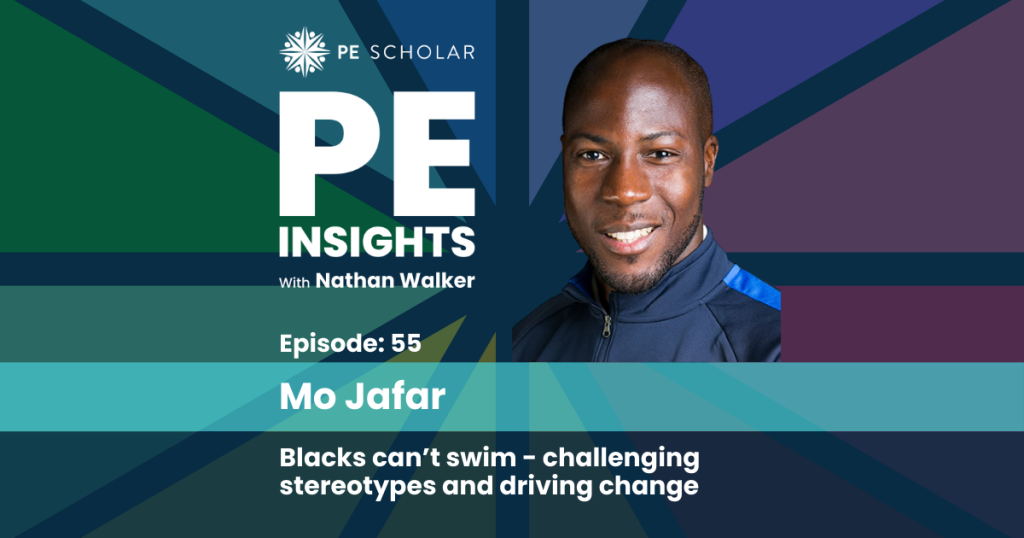
In this episode of the PE Insights podcast, host Nathan Walker welcomes academic and educator Mo Jafar to discuss physical education with a focus on swimming. Mo shares his journey from passionate PE student to experienced teacher and now university lecturer at UEL. His career includes coaching, teaching, and pastoral leadership, all of which have shaped his inclusive approach to PE.
Swimming and Social Equity
The main topic of conversation centres around Mo’s growing interest and research into swimming provision, particularly for Black and minority ethnic communities. Mo learned to swim as an adult, inspired by a university lecturer. His personal journey fuelled a professional commitment to tackling the inequalities in swimming access, especially in diverse areas like East London.
Involvement in ‘Blacks Can’t Swim’
Mo features in Blacks Can’t Swim: Rewind, a documentary aimed at challenging stereotypes and raising awareness about underrepresentation and barriers in swimming. He reflects on how the project broadened his understanding of the swimming landscape and highlighted both the enjoyment and the systemic exclusion faced by many young Black people.
Barriers to Swimming
Mo identifies several obstacles to participation: lack of access to facilities, generational fear, cost, cultural considerations (e.g. modesty and women-only sessions), and undervaluing swimming due to lack of exposure. He emphasises that swimming takes time to master and that young people need sustained support.

Research and Student Voice
Currently completing a Master’s in social sciences with social justice, Mo is researching how flotation aids like SwimFin impact water confidence and competence in diverse primary schools. His research prioritises student voice, particularly of those traditionally unheard, while recognising the value in all young people’s perspectives.
Current Challenges in School Swimming
The podcast highlights the persistent difficulties in delivering effective school swimming programmes. With around one in four children leaving primary school unable to swim—a statistic likely worse in practice—there is a clear and urgent need for reform. The issue is not a result of individual failings but systemic barriers, such as inconsistent delivery, insufficient time in the water, and a lack of rigorous assessment frameworks.
A Call for Evidence-Informed Practice
A key theme is the push towards evidence-informed assessment. Current methods often rely on basic pass/fail outcomes, like whether a child can swim 25 metres. Instead, Mo advocates for a broader evaluation of aquatic competencies (e.g. floating, water confidence, and safety skills), and the introduction of perceived competence scales developed with organisations such as ISEP and Canterbury Christ Church University. These tools empower pupils to reflect on their own abilities and enhance learning by aligning perception with reality, evidenced by near-identical self-assessments and teacher ratings in recent data.
Benefits of Early Perceived Competence Assessment
Collecting self-reported data before swimming sessions may significantly reduce assessment time, saving valuable lesson hours, especially vital in schools with only six-week programmes. This approach also supports greater student engagement and confidence, potentially increasing lifelong swimming participation.
Advocating for Play-Based and Flexible Pedagogies
The conversation draws clear distinctions between Learn to Swim and school-based swimming. Learn to Swim programmes often use game-based, student-centred methods, which promote enjoyment and retention. In contrast, school swimming often shifts too quickly to technique-focused instruction, disengaging students. Mo argues for play-based learning at all levels, including secondary, and stresses the need for adaptable, responsive teaching frameworks.
Looking Ahead
This research-informed project aspires to reshape school swimming by centring pupil voice, developing competence-based assessments, and promoting inclusive, engaging pedagogy. The long-term goal is not just skill acquisition but fostering a desire to return to the water, ultimately improving water safety and lifelong wellbeing.
Mantra for Life and PE
Mo’s guiding mantra is “some is better than none.” This perspective applies not only to life but also to physical education (PE). The idea promotes consistency and effort over perfection, reminding both educators and learners that partial progress is still meaningful progress.
What PE Should Leave Behind
Mo’s guiding mantra is “some is better than none.” This perspective applies not only to life but also to physical education (PE). The idea promotes consistency and effort over perfection, reminding both educators and learners that partial progress is still meaningful progress.
Rather than removing an element of PE itself, Mo advocates for removing the pressure for PE to conform to shifting educational trends. Often, whole-school agendas or top-down initiatives don’t align with the unique nature of physical education. PE, being rooted in movement and practical engagement, doesn’t always benefit from approaches designed for more academic subjects. For example, applying a rigid, linear curriculum may not suit PE, where movement and learning can be non-linear and experiential.
Advice for Aspiring PE Teachers
Future PE teachers are encouraged to seek varied and unfamiliar experiences. Mo shares a personal account of lacking knowledge in sports like cricket and basketball despite years of teaching, highlighting the importance of broadening one’s practical and theoretical foundation early on. Teaching unfamiliar sports can be daunting, but overcoming such gaps builds resilience and expertise.
A Single Word for PE
The one word young learners should associate with PE is “belonging.” PE should foster inclusion, autonomy, and a sense of community where all pupils feel valued and engaged.
About the Guest
This episode is a conversation with Mo Jafar, Senior Lecturer in Sport, PE and Development, University of East London.
Listen
To listen to the full episode please follow these links to Spotify or Apple Podcasts.

Responses