


Introduction
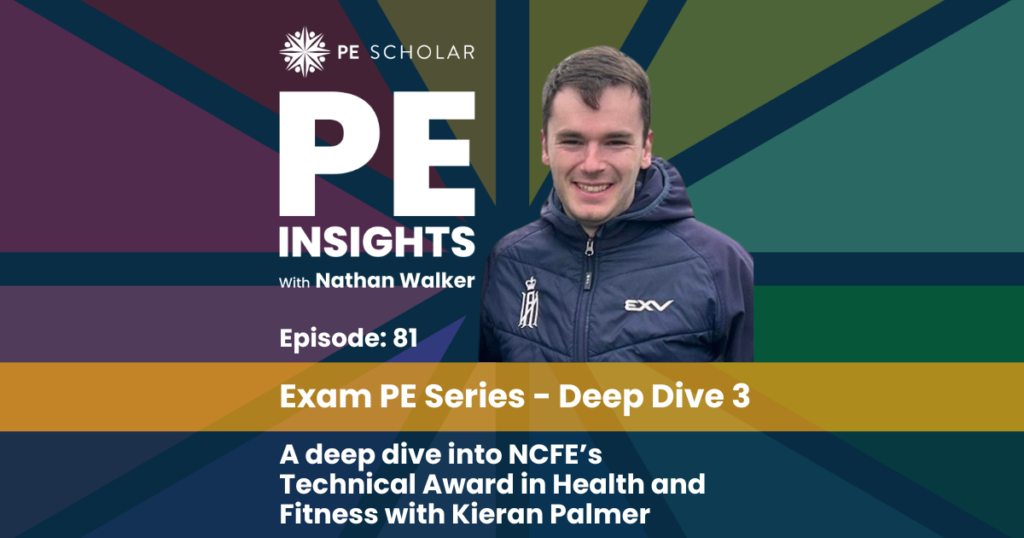
In this episode of the PE Insights podcast, host Nathan Walker and co-host Will Swaithes continue their mini-series on examination Physical Education (PE). They are joined by Kieran Palmer to explore the specifics of the NCFE Level 1/2 Technical Award in Health and Fitness. The conversation provides a deep dive into the structure, assessment and practical delivery of this vocational qualification, offering valuable insights for departments considering alternatives to traditional GCSE PE.
Educational Journey and Context
Kieran shares that he entered the PE teaching profession driven by a love for sport and a desire to make a positive difference to young people. Initially, his career involved teaching a traditional PE curriculum heavily focused on practical sports and GCSE PE. He later transitioned into teaching the NCFE Health and Fitness course, a more vocational route, which he delivered for three years. Interestingly, Kieran has most recently changed his career path to become a full-time mathematics teacher, but he retains a strong passion for PE and the NCFE specification.
Will Swaithes highlights a unique challenge faced by PE departments compared to other subjects like mathematics. While a Head of Maths simply chooses an exam board (like AQA, Edexcel or OCR) for the same GCSE qualification, PE leaders must navigate a complex landscape of traditional GCSEs alongside various vocational offerings, such as BTECs, Cambridge Nationals and the NCFE vCert.
Will champions the NCFE Health and Fitness qualification because it serves as an excellent alternative for students who may have lost their connection with traditional PE, or for whom sports science and competitive sports simply are not attractive. The course focuses purely on enabling young people to become healthier and more well-informed about their lifestyles.
The Appeal of the NCFE: Real-World Relevance
For Kieran, the most significant highlight of the NCFE specification is its relevance to young people’s actual lives. The course moves away from grading students based on how well they perform practically in a sport. Instead, it develops essential knowledge about living a healthy, active lifestyle.
Kieran notes that students learn practical, real-world applications that they will use outside of school, such as:
- How to plan a training session
- How different fitness components work
- The impact of lifestyle choices, such as smoking, alcohol consumption and diet, on physical performance
Because the course is strictly health and fitness-oriented, Kieran explains that no traditional sports are taught. There is no football, basketball or tennis within this qualification’s learning hours; the practical elements occur entirely in environments like a fitness suite or sports hall using circuit-based training. Of course schools will still have core PE where key stage 4 students get the normal diet of sport and physical activity opportunities.
Assessment Structure: Coursework (Synoptic Project)
The NCFE assessment is heavily weighted towards coursework, referred to as the Synoptic Project, which accounts for 60% of the final grade.
This coursework is completed at the end of the course. Kieran explains that his department teaches all the theoretical content in Year 10 and the beginning of Year 11. Around November or December of Year 11, the exam board releases the new synoptic project scenario.
The Scenario and Tasks: The scenario typically places the student in the role of a Personal Trainer (PT) working in a local gym with a new client. The client usually wants to improve two specific components of fitness (e.g. agility and muscular endurance). The students are then given 20 hours (+ 2 hours planning time) to complete five distinct tasks on a computer:
- Background Information: Conducting a PAR-Q (Physical Activity Readiness Questionnaire) and initial fitness testing.
- Principles of Training: Selecting appropriate training methods and justifying why they suit the client.
- Training Programme (Part 1): Designing a specific five-to-six-week training programme.
- Training Programme (Part 2): Applying principles of fitness within that programme.
- Evaluation: Conducting a post-fitness test scenario to evaluate whether the programme was successful.
Tracking and Administration: Kieran details how his school manages this 20-hour computer-based project. Each of the five tasks has a strict time limit (e.g. 3 hours for Task 1, 5 hours for Task 2). They utilise Google Docs and Google Sheets to track precisely when a student starts and finishes a task. Once the allocated time for a task is up, the live document is submitted and Kieran assesses which Assessment Objectives (AO1, AO2, AO3) have been met.
At the very end of the 20 hours, students are given a single one-hour feedback session to make quick improvements based on very limited feedback. If students are absent, they make up their exact hours during lunchtime or after school in a controlled environment without access to mobile phones.
Assessment Structure: The Written Exam
The remaining 40% of the qualification is assessed via a written exam, typically sat mid-June at the end of Year 11. The paper lasts for 90 minutes and is worth 80 marks.
The exam covers 3 main areas (that are articulated in the specification as 8 content areas), which are typically taught in order:
- Anatomy and Physiology: The cardiovascular system, respiratory system, the skeletal and muscular systems.
- Lifestyle Choices: The impacts of alcohol, smoking, diet and nutrition on health and fitness.
- Training: Training methods and principles.
The exam format begins with multiple-choice questions, moves into short-answer questions (1 to 2 marks) requiring students to identify or name a concept and progresses to 4 to 6-mark questions that require explanation and analysis (AO2 and AO3). The paper concludes with a single 8-mark extended writing question.
Pedagogy: Making Theory Practical
Despite the coursework being computer-based, Kieran strongly advocates for teaching the theory practically. In Year 10, his students received 3 hours of NCFE lessons a week: 2 hours in a classroom and 1 hour applying that theory practically.
For instance, when learning about principles of training, students would pair up with one acting as the PT and the other as the client then physically work through agility drills in the fitness suite. They would also practice asking lifestyle questions (e.g. “Do you smoke?”, “What is your work-life balance like?”) to understand how external factors impact a client’s performance.
To prepare for the demanding synoptic project, Kieran’s department ran a mock project in Year 10. They provide a scaled-down scenario (e.g. improving agility for a football attacker) allowing students to practice building a training programme and applying theory before facing the real assessment in Year 11.
Kieran’s absolute favourite topic to teach is anatomy and physiology. To avoid “death by PowerPoint” and to prevent students from switching off, he uses highly interactive methods. Instead of just using the workbooks provided by NCFE, he provides students with dry wipe markers to draw the heart and its components directly onto the classroom tables. He also uses relay races where students run up and stick labels of bones and muscles onto a partner acting as the skeletal system. While these methods take longer to plan, Kieran notes that the engagement, enthusiasm and retention of knowledge make it entirely worthwhile.
He also emphasises using real-world hooks to bring the classroom theory to life. When discussing diet and diabetes, he shows a five-minute video on Henry Slade, the England international rugby player who manages diabetes, proving to students that these conditions affect elite athletes too.
Common Learner Struggles and Misconceptions
Kieran highlights a few specific areas where students tend to struggle within the NCFE course:
- Physiology: While students generally excel at training methods because it is taught so practically, they often struggle to understand how the cardiovascular and respiratory systems work together.
- Coursework Decisions: In the coursework, students sometimes struggle to select the most optimal training method. While they might choose a correct method (like bodyweight circuits for muscular strength), they often fail to realise they could combine it with a more effective method available to them, such as using the school’s fitness suite weights.
- Social Media vs. Specification: There is occasionally a clash between the “facts” students consume on platforms like TikTok and the specific knowledge required by the exam board. For example, students must explicitly state the NHS guideline of “60 minutes of activity a day” to gain a mark; simply providing general health advice seen online is insufficient.
Top Tips for New NCFE Teachers
For teachers new to delivering the NCFE Health and Fitness qualification, Kieran offers five key pieces of advice:
- Learn the Specification: Print it off, read it thoroughly and identify any gaps in your own subject knowledge. Understanding how all the components tie together makes teaching the course much easier.
- Make it Practical: Do not be afraid to step away from the slide decks. Ask colleagues for ideas on how to deliver theoretical concepts actively, as applied learning yields better student responses.
- Scaffold the Coursework: Heavily support students through the coursework process. Break tasks down, model examples on the board and never assume that just because you have taught a topic, the students inherently know how to apply it to a 20-hour project.
- Utilise Peer Learning: Students learn a great deal from each other, especially in Year 10 and 11 when they are starting to make independent lifestyle choices (like going to the gym in the evening).
- Link to Real-Life Careers: Continuously connect the content back to real-world professions such as personal training, dietetics and nutrition to maintain high engagement.
Furthermore, Kieran highly recommends using the support provided by NCFE. He notes that the exam board is highly responsive; teachers can email, phone or jump on Teams calls with NCFE tutors to check their coursework administration and ensure they are doing everything “by the book.”
Reflections and Hopes for the Future
Reflecting on his time teaching the course, Kieran notes one major change he would implement if he were to teach it again: introducing a past paper at the end of Year 10. While his department used exit tickets every lesson, he feels an end-of-year mock exam merging past paper questions would better demonstrate learning over time and expose long-term misconceptions. This would allow teachers to address gaps effectively before the final six-to-seven-week revision period in Year 11.
Looking to the future of PE qualifications and potential curriculum reforms (targeted for 2028-2030), Kieran hopes core PE continues its positive shift towards teaching life skills such as communication, resilience and teamwork rather than exclusively focusing on isolated sports skills like a basketball layup.
For the NCFE qualification itself, Will and Kieran brainstormed potential future additions to the specification to keep it highly relevant. They suggest it would be highly beneficial to include modern lifestyle factors, such as the impacts of vaping (which is increasing among young people) and the realities of dietary supplements and creatine. Additionally, both agreed that introducing psychological elements, such as theories of motivation and skill acquisition, would round out the qualification by helping students understand not just how to train, but why they behave the way they do and how to maintain lifelong motivation.
Conclusion
The conversation with Kieran Palmer underscores the NCFE Health and Fitness qualification as a robust, highly relevant alternative to traditional GCSE PE. By replacing sports performance with a deep dive into lifelong health, lifestyle choices and practical fitness planning, the course appeals to a broad range of learners. With its heavy coursework focus and real-world application, it offers students the tangible knowledge necessary to lead physically active and healthy lives long after they leave the school environment.
About the Guests
This episode is a conversation with Wayne Hill and James Long, two experinced educators working across different OCR/Cambridge National pathways.
Listen
To listen to the full episode please follow these links to Spotify or Apple podcasts.

Responses