



Why Pride matters?
Pride Month is a global celebration of the lesbian, gay, bisexual and transgender (LGBT+) community. It is held in June to commemorate the Stonewall Uprising of 1969, which sparked a more visible and organised LGBT+ rights movement. It is a time to recognise and celebrate the progress made towards equality, whilst raising awareness of the ongoing issues faced by the LGBT+ community.
It provides schools with an opportunity to reinforce the importance of inclusivity, acceptance, and respect for all individuals, regardless of sexual orientation or gender identity. For Physical Education (PE) departments, Pride Month offers a chance to reflect on how they ensure that PE is a safe and supportive space where every student feels seen, valued, and empowered to participate fully. By being LGBT+ allies, PE teachers can model acceptance, challenge discrimination, and foster a culture of belonging, helping to ensure that physical activity and sport are welcoming for everyone.
Growing Up LGBTQIA+
The term used to describe the LGBT+ community has evolved over time to be more inclusive of all identities with regard to sexuality and gender identities. In the 1980’s, LGB referred to lesbian, gay and bisexual people. In the 1990’s, the term was extended to LGBT to include the transgender community and more latterly “Q” (queer or questioning), “I” (intersex), “A” (asexual) and “+” to include all other people that do not feel that they fall neatly into the labels as previously mentioned.
Young people face a wide range of challenges growing up, many of which impact on their relationship with physical activity, PE and sport. However, young people that identify as LGBT+ are burdened with additional stressors as a direct result of their sexual or gender identities. In 2021, the charity Just Like Us released the findings of their research in a report called “Growing up LGBT+ The impact of school, home and coronavirus on LGBT+ young people”. Some of the key findings are:
| 42% of LGBT+ school pupils have been bullied in the past year, double the number of non-LGBT+ pupils (21%). Only 33% of LGBT+ pupils say there is a clear process for reporting anti-LGBT+ bullying in their school. LGBT+ pupils are three times more likely to experience sexual harassment compared to their non-LGBT+ peers). 48% have had little to zero positive messaging about being LGBT+ at school in the last 12 months. LGBT young people are three times more likely to self-harm and twice as likely to have depression, anxiety and panic attacks, as well as to be lonely and worry about their mental health on a daily basis. |
Despite these shocking findings, only 35% of pupils questioned said that their school celebrates Pride, School Diversity Week and/or LGBT+ History Month. This is particularly poignant as pupils in schools with strong positive messaging about being LGBT+ were found to have drastically improved wellbeing and feel safer – regardless of whether they are LGBT+ or not. Therefore, positive messaging about being LGBT+ drastically improves all pupils’ sense of safety in school and PE Departments can play a key role in achieving this.
PE departments are uniquely positioned within the education landscape, often exerting significant cultural influence with schools and other institutions. However, the conflation between PE and sport (in particular elite sport) can have many knock-on effects, including on the sense of belonging and safety that young LGBT+ people feel within PE.
“Whilst there is a counter narrative that sport is now a welcoming and inclusive environment for LGBTQ+ people (Anderson et al., 2016; Gaston et al., 2018; Magrath, 2017), the current evidence, including large-scale, quantitative, international research with LGBTQ+ people, largely supports Shaw’s (2019) description that “sport is inherently homophobic” (p. 247) and Sartore-Baldwin’s (2013) description of sport as a “heterosexist institution” (p. 129) which continues to be used to reinforce traditional gender roles and binaries.” (Denison, Beavan and Jeanes, 2020).
Research has also found that discriminatory attitudes and behaviours discourage young LGBT+ people from playing sport. Greenspan, Griffith and Watson’s (2019) analysis of LGBTQ+ Youth’s Experiences and Engagement in Physical Activity found that LGBT youth avoided physical activity settings due to feeling unsafe and uncomfortable. They also found stronger evidence to support the notion that gay males were targeted more than females and trans people. However, Denison, Bevan and Jeanes (2019) highlighted that women and girls who play traditionally male sports are often assumed to be lesbians and experience discrimination regardless of their sexuality in addition to the systemic inequality experienced by women and girls in sport.
Xiang et al (2023) make more stark conclusions that “Sport is perceived as an arena of hegemonic masculinity, perpetuating men’s social dominance and the social subordination of women and gay men”. The rejection, stereotyping, discrimination and violence experienced by LGBT+ individuals in sporting contexts has been consistently recognised through numerous research studies. This is reflected in young people who fear rejection by their teammates and discrimination by coaches and officials. As such, it is not surprising that LGBT+ were found to be less likely to participate in sports than their heterosexual peers (Xiang et al, 2023).
There has been much debate about the (traditional) sports performance model of PE and more recent physical literacy informed or concept based approaches to delivering the curriculum. Retaining a sports performance model risks replicating the impact on the LGBT+ community that this research has shone a light on, making it harder to deliver a fully inclusive model.
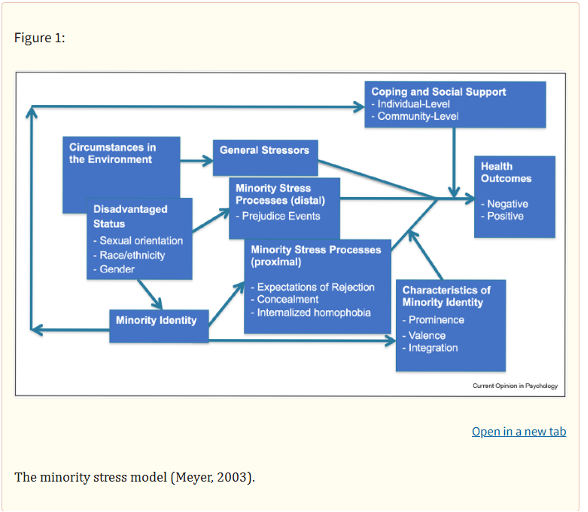
Minority stress is distinguished from general stress—stress that all people may experience—by its origin in prejudice and stigma. Thus, a stressor, such as losing one’s job, could be a general stressor or a minority stressor depending on whether it was motivated by prejudice against sexual and gender minority people as opposed to, for example, economic downturns that impact all people regardless of sexual and gender identity.
Meyer [2] described both distal and proximal stress processes. Distal stressors include stressors that originate from people or institutions that impact the LGBT person. These include discriminatory policies and laws [7] acute major life events (e.g., losing a job, being victimized by violence) [8], chronic stressors (e.g., living in poverty) [9], more minor, “everyday” experiences of discrimination or microaggressions (e.g., being treated unfairly or with disrespect) [10], or even non-events—expected positive experiences or events that were thwarted due to stigma and prejudice [11].
Proximal stressors arise from a socialisation process in which sexual and gender minority people learn to reject themselves for being LGBT (internalised stigma) [[12], [13]], develop expectations to be stigmatised due to awareness of prevailing social stigma (expectations of rejection) [14], and/or hide their LGBT identity as a way to protect themselves against distal minority stressors (identity concealment) [15]. Concealment may be protective in some environments, but it also limits access to social support and affirmation, complicating its role in minority stress theory [15].
Collectively, these minority stressors constitute the excess stress burden that places sexual and gender minority people at greater risk for negative health outcomes compared with cisgender straight people. Against these stressors, there are individual- and group-level coping mechanisms that can reduce the negative impact of minority stress. Thus, the overall health impact in the minority stress model is determined by the negative impact of stressful experiences and the ameliorative impact of coping, social support, and resilience.
“Minority stress theory (MST; Meyer, 2003) is one of the most frequently used theoretical models for understanding the mental health disparities that exist for lesbian, gay, bisexual, transgender, and queer (LGBTQ+) individuals compared to heterosexuals” (Rivas Koehl, Rivas Koehl and McNeil Smith, 2023). The model identifies two types of stress processes that impact people as a direct result of their LGBT+ identity – distal and proximal stressors.
In a PE context, distal stressors could include incidents of discriminatory comments and behaviours from peers, which might be more prevalent in PE than in other aspects of school life, due to the links PE has with sport as previously discussed. These are in addition to more general distal stressors that could include every day incidents of discrimination or micro-aggressions or policies and laws that discriminate against the LGBT+ community.
Proximal stressors would include the expectation of rejection, which is heightened by the links to homophobia prevalent in sports. 1 in 5 students questioned in the Growing up LGBT+ research heard negative language used about LGBT+ people on a daily basis. Combined with a fear of reactions from peers and staff, it can lead to concealment of their LGBT+ identity, particularly in a PE context. This in turn can lead to internalised stigma, where they learn to reject themselves for being LGBT as a result of the impact on the proximal and distal stressors.
We have read about the impact of widespread homophobia in sport (even in youth sport) and the masculinisation of certain sports including rugby and football that dominate PE curriculums in a wide number of schools across the UK. Davies (2023) explored the link between adolescent masculinity and homophobic aggression within school settings. This study goes some way to explaining why there may be increased levels of homophobia within the PE context as it was found that some young boys use homophobic name-calling to help enforce their own masculinity among their peers.
Taking action
Considering this troubling research, combined with the unique position of PE (particularly male) staff, it is essential that we are visible and strong allies for the LGBT+ community. The PE Scholar team have been consistent in their view that when we strive for PE to mean Positive Experiences for every child, it benefits everyone. Whether we are making PE more accessible to students with special educational needs and disabilities (SEND), students with specific religious beliefs, girls, disadvantaged young people or members of the LGBT+ community, we can promote a sense of belonging and safety for all students.
I have previously written about the 5 A’s of allyship, with respect to supporting gender diverse students in PE. This model can be extended to the wider LGBT+ community and it is my strong belief that it should be standardised across schools all-year round and not just during pride celebrations.
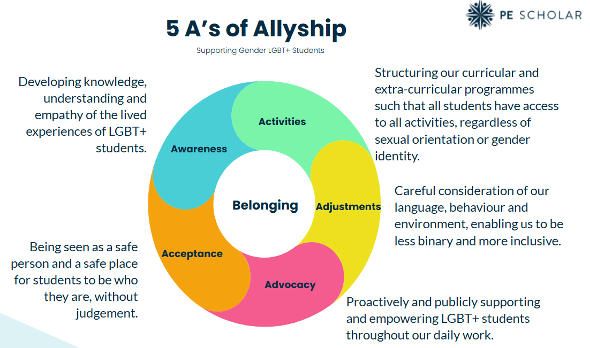
Organising a whole school event with a clear message that shows solidarity for support for LGBT supports the advocacy, activities, acceptance and awareness of the 5 A’s. A “Rainbow Run” (in the form of a colour run) can be a great way to mark pride month in support of the LGBT+ community. It can also be used to promote equality and inclusion of protected characteristics beyond the LGBT+ community, sending a clear message that everyone is welcome and that the school does not stand for any form of prejudice or discrimination to anyone.
If you are interested in finding out more about how to organise and run a Rainbow Run (or similar inclusive event), a full set of resources are available here.
- Get SLT support / agreement in principle
- Plan a route and personnel requirements
- Set a date
- Source and order your colour (and glasses)
- Assess the risk
- Inform all stakeholders (staff, pupils and parents)
- Assembly and tutor activities
- On the day
Growing up LGBT+ is challenging. Growing up LGBT+ in PE and school sport presents its own set of unique challenges that can have a profound impact on the short, medium and long term impact of a young person’s relationship with physical activity. To help address all of the inequalities and challenges that the LGBT+ young people face, PE departments should be proactive, loud and proud in their visible support of the LGBT+ community.
If you work in a school, consider these questions…
- How do all of your students (LGBT+ and non-LGBT+) know that your PE department is a safe place to be their authentic selves in?
- Do your PE staff (and wider staff) challenge any forms of discriminatory behaviours or language?
- Do your PE staff model inclusive language and behaviours, mindful of the potential impact that their own sporting experiences may have on these?
- What can you and your staff do to be more visible in their allyship for the LGBT+ students (and staff) in your school?
References
- Davies, Ffion Heulwen (2023) Exploring the link between adolescent masculinity and homophobic aggression. University of Southampton, Doctoral Thesis, 115pp.
- Denison, E., Bevan, N., & Jeanes, R. (2020). Reviewing evidence of LGBTQ+ discrimination and exclusion in sport. Sport Management Review, 24(3), 389–409. https://doi.org/10.1016/j.smr.2020.09.003
- Greenspan, S.B., Griffith, C. & Watson, R.J. (2019) LGBTQ+ Youth’s Experiences and Engagement in Physical Activity: A Comprehensive Content Analysis. Adolescent Res Rev 4, 169–185. https://doi.org/10.1007/s40894-019-00110-4
- Rivas-Koehl, M., Rivas-Koehl D. & McNeil Smith S. (2023) The temporal intersectional minority stress model: Reimagining minority stress theory. Journal of Family Theory & Review. Volume 15, Issue 4 706-726. https://doi.org/10.1111/jftr.12529
- Meng Xiang, Kim Geok Soh, Yingying Xu, Seyedali Ahrari, Noor Syamilah Zakaria (2023) Experiences of LGBTQ student-athletes in college sports: A meta-ethnography, Heliyon, Volume 9, Issue 6, https://doi.org/10.1016/j.heliyon.2023.e16832
- Meyer, I. H. (2003). Prejudice, social stress, and mental health in lesbian, gay, and bisexual populations: Conceptual issues and research evidence. Psychological Bulletin, 129(5), 674–697. https://doi.org/10.1037/0033-2909.129.5.674
- Shaw, S. (2018). The chaos of inclusion? Examining anti-homophobia policy development in New Zealand sport. Sport Management Review, 22(2), 247–262. https://doi.org/10.1016/j.smr.2018.04.001
- The impact of school, home and coronavirus on LGBT+ young people. Published by Just Like Us. www.justlikeus.org.uk [email protected] Registered charity number 1165194 © Just Like Us, June 2021 Research administered by Cibyl, an independent student market research consultancy in the UK and Ireland and a Group GTI business. www.cibyl.com [email protected] Written by Rachael Milsom, GTI Designed by Maya Little, GTI.
.
Responses