


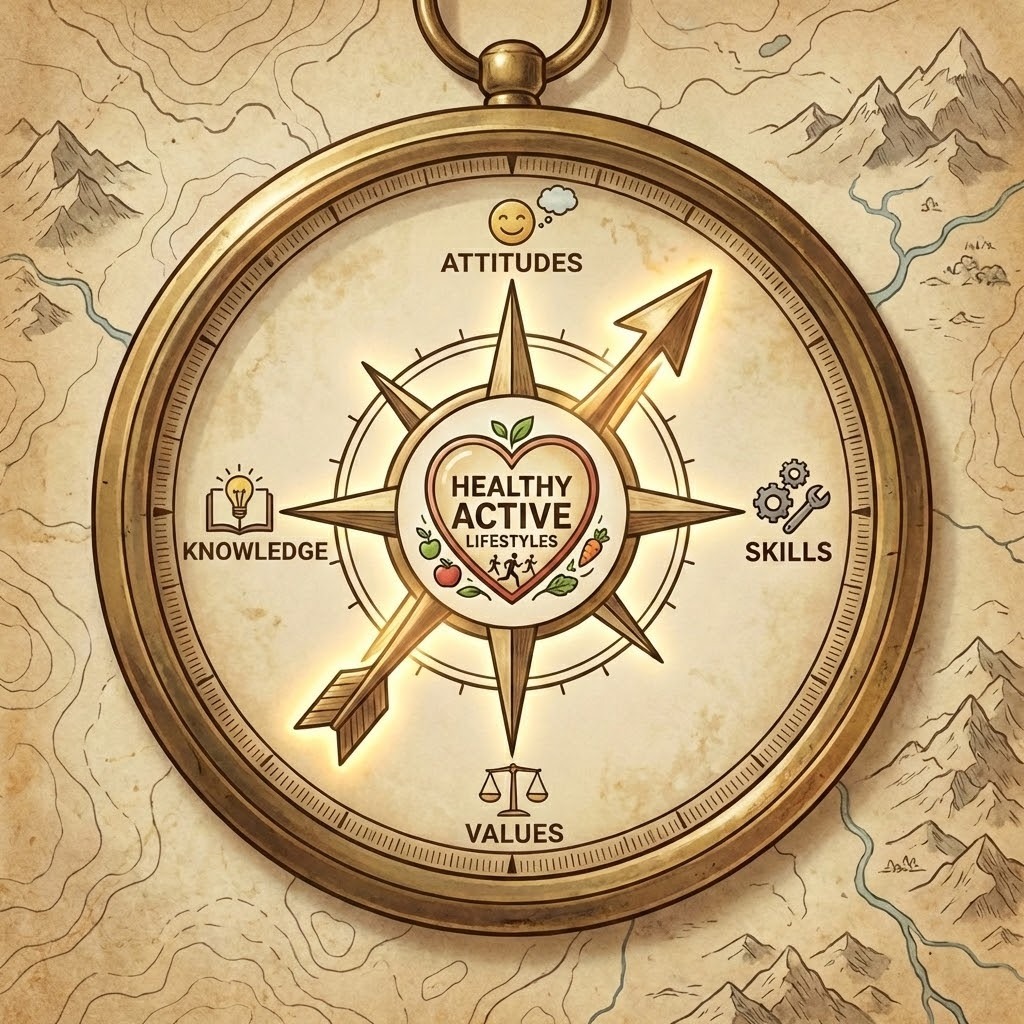
We’ve all been there: standing on a windswept field, clipboard in hand, obsessing over whether Year 9 can demonstrate effective use of space or the correct technique for a specific skill. We tell ourselves we’re building healthy active lifestyles but, if we’re honest, are we just grading how well a student can mimic a technique in a closed-practice drill that has no relevance and minimal transfer to their real world?
The reality … you can have the best technique in the world, but if you don’t have the confidence to step onto the pitch or the motivation to get off the sofa, that technique is essentially a parked Ferrari with no fuel.
The “Knowledge-Rich” Trap
In the current educational climate, we are obsessed with “knowledge-rich” curricula. We love declarative knowledge (knowing that a warm-up increases heart rate) and procedural knowledge (knowing how to perform a lay-up). These are easy to tick off a spreadsheet but how well do they transfer to life beyond the lesson and how much closer do they really get students to living a healthy, active and happy life.
However, as the OECD Learning Compass 2030 points out, true competency requires more than just skills and knowledge; it also requires essential attitudes and values. In PE terms, this is the affective domain. It’s the “feeling” side of movement. If we ignore the affective domain because it feels too subjective to assess, we aren’t just failing to meet modern standards, we’re failing to drive the long-term behaviour change we claim to value most.
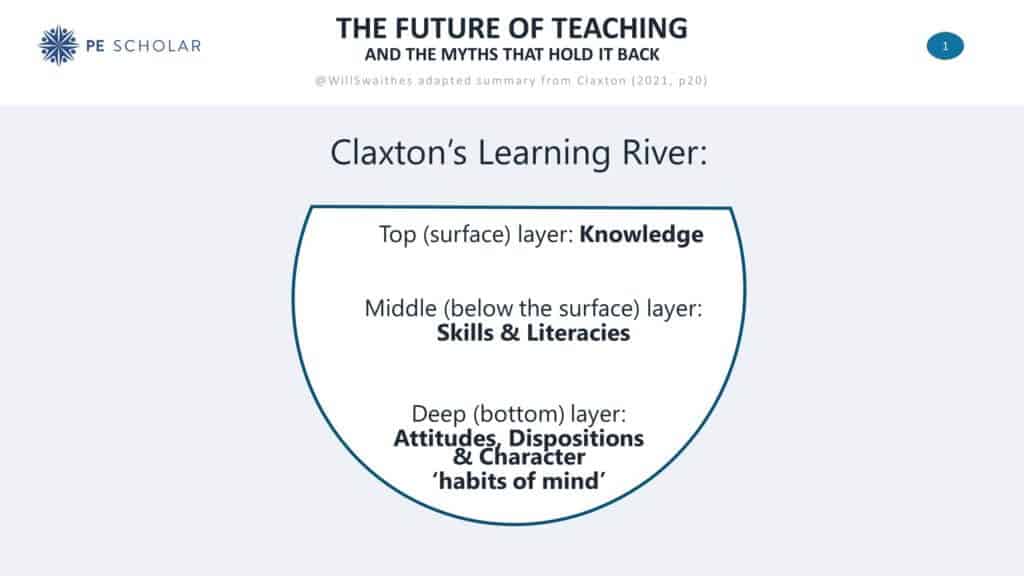
Guy Claxton’s Learning River
It is also helpful to draw on the work of Guy Claxton and recognise how surface level learning (e.g. knowing the teaching points for a set shot in basketball) is easy to see but of far less value to young people whereas the deeper learning (attitudes, dispositions and character development) are much harder to influence and consequently need greater commitment. Read more on this here.
Reflecting on relational approaches
Outdoor relational education is a holistic pedagogical approach that rejects the idea of the outdoors as a mere backdrop for human activity. Instead, it views the natural world as an active participant (a co-teacher) in the learning process. It tends to take on a “whole of body” approach in which the cognitive, affective and physical all play important roles, while also emphasising the importance of some form of dialogue with the natural environment. This is not a new idea. In indigenous contexts, this approach has been deeply ingrained for many generations (Berkes, 2017) and in Western contexts we can go back at least 150 years (Whittaker, 2014). More recently, Gravett et al. (Gravett, 2024) discuss relational pedagogies from a posthuman perspective. They consider the creation of space through forms of education that centre on relationality within a broader network of human–nonhuman-material relations, to be critical. If this is all getting a bit deep and you are wondering how it is relevant to you and your teaching, perhaps the easiest analogy is to appreciate that we are increasingly viewing sports as vehicles for learning in PE and we are becoming more focused on how students learn and what they learn through those vehicles but it is also essential to consider their individual relationshops with those vehicles and the environment around them. The vehicle (e.g. football) is not just getting you somewhere (e.g. more copetent at foot-eye coordination, outwitting opponents, creating space and managing conflict to work more effectively as a team) but it is also essential that we reflect on how young people feel about that vehicle. Would they rather travel in a Ferrari or a Fiat and who has influenced them to think and percieve the different vehicles the way they do? Parents? Peers? Social media? Us, their teachers? What things could be done to make the journey more enoyable (in the case of cars that could be heated seats or adaptive cruise control whereas in PE it may be more about small sided games, the opportunity to co-create the experience or modify the rules or equipment to make it more exciting) and the destination more valuable (do they have the same ambitions for learning in, through and about PE as you do)?
Flipping the Script: 5 Tips to Prioritise the Person Over the Performance
If you’re ready to move away from a focus on sporting performance and towards embedding a lifelong movement culture, here are five ways to get started:
1. Reframe What “Success” Looks Like
If the only way to win in your lesson is to be the fastest or most technically correct, you’ve already lost more than half the room. Start rewarding the intent rather than the outcome.
- The Shift: Instead of “Great goal,” try “I loved how you spotted that space and had the confidence to take the shot”
- Why it works: It reinforces the psychological behaviours (decision-making and bravery) that are transferable to any sport or activity
2. Embrace the OECD “Agency” Concept
The OECD Learning Compass reminds us of the importance of student agency. PE is often the most top-down subject in school. Break that cycle by giving students a seat at the table.
- The Shift: Let students choose their level of challenge or even the way they demonstrate a skill (e.g. “You can show me you understand defensive positioning in a 3v3 game or by coaching your peers for 5 minutes”)
- Why it works: Autonomy is a massive driver of intrinsic motivation
3. Focus on “Assessment for Affect”
We’ve spent decades assessing the physical. It’s time to assess the feeling. Use simple, qualitative markers to check the pulse of the class’s confidence.
- The Shift: Use RPE for Confidence (Rate of Perceived Empathy/Effort) by asking students: “On a scale of 1-10, how confident or well supported did you feel trying that new skill?”
- Why it works: It signals to the students that their internal state matters just as much as their physical output
4. Teach the “Why” Before the “How”
We often jump straight into the how (teaching technique) but for a student who lacks motivation, the how is irrelevant if they don’t value the why.
- The Shift: Start lessons with the “Affective Hook” and instead of “Today we are doing the long jump” try “Today we are exploring how to generate maximum power and showing resilience by sticking at a challenging task”
- Why it works: By connecting the movement to a feeling or a real-world benefit that goes way beyond accurate replication of a technique
5. De-escalate the “Performance Pressure”
High-stakes environments kill confidence for those who aren’t already “sporty” (i.e. those who have been lucky enough to have had lots of exposure to sport beyond school already). Create a low-stakes, high-support culture where mistakes are seen as data, not disasters.

- The Shift: Implement “Glow and Grow” peer feedback that focuses specifically on effort and resilience. “I saw you get frustrated when you missed that catch, but you stayed in the game and that’s a huge win for your resilience today”
- Why it works: It builds a safety net that allows students to take the risks necessary for growth
6. Create a “Dialogue with the Space“
Consider what we have briefly discussed about relational education and help your students embrace the different and channging environments that they get to experience in PE.
- The Shift: Instead of trying to control the lesson environment, use the unpredictability of the outdoors to build resilience and reflect on the experience of overcoming obstacles (e.g. weather, disruptions to the programme, each other etc).
- Why it works: It aligns with the “Wild Pedagogies” touchstone of challenging ideas of control. If a student can find confidence in an unpredictable outdoor setting, their self-efficacy becomes much more robust than if it were built in a sterilised, closed-practice drill.
The Bottom Line
Shifting toward the affective domain isn’t “soft” teaching, it’s smart teaching. If we want our students to be active in 2040, they don’t need a perfect basketball layup or badminton overhead clear in 2026; they need the self-efficacy to try something new and the motivation to keep showing up to get better.
Let’s stop building athletes for a season and start building movers for a lifetime.
Responses