


By Lee Sullivan
Introduction
As a parent, PE teacher, and advocate for positive sporting experiences, I’ve had the privilege of watching my children grow in their involvement in sports through swimming, tennis, and football out-of-school clubs. These experiences have been full of learning opportunities, not just for them, but for me as well. In this blog, I want to share my personal insights and reflections on these sessions and how they have shaped my understanding of what makes a good coaching environment for children. I will present the ENGAGE framework—a set of simple but powerful principles designed to support youth coaches.
The Responsibility of a Coach
Coaching children goes far beyond simply teaching skills—it’s about creating positive experiences that nurture a child’s love for sport and physical activity. It’s important to remember that no coach or volunteer ever sets out to create negative experiences. In fact, many coaches are giving up their own time because they genuinely care about the development and well-being of young children and sharing with them the sport that they love.
A coach’s responsibility is not just to foster competition or focus on the outcome of a game, especially at a young age. While winning can certainly be enjoyable and an important part of competition, it should not be the primary goal in the earlier stages of participation. At young ages, children need opportunities to explore, play, and develop their skills in a supportive, fun, and engaging environment.
The true responsibility of the coach is to create an environment where children feel encouraged to try new things, make mistakes, and learn at their own pace, all while building confidence and a positive relationship with the sport or activity.
What Led Me to This Blog?
To understand why I felt a framework for youth coaches was needed, I would like to share three experiences I have had with my children in out of school sports sessions. These are not criticisms of the coaches, but observations of how well-meaning coaching can sometimes unintentionally create less-than-ideal experiences.
Experience One: Tennis
I took my (at the time) 6-year-old daughter to her first tennis session. The coach was kind and enthusiastic, but the focus was on teaching an overhead serve—a complex skill that a 6-year-old child will find extremely challenging. The children were made to wait in long queues behind cones, each child running up to the net to hit the ball (which was often poorly fed), and then returning to the back of the line. My daughter, frustrated with the lack of success and engagement, quickly decided tennis was “boring” and didn’t want to go back.
Experience Two: Swimming
Both of my children attend swimming lessons, yet much of the lesson consists of them sitting by the side of the pool, shivering, waiting for their turn. Occasionally, they are asked to exit the pool to watch a demonstration on technique, which leaves them cold and disengaged. These lessons tend to focus heavily on technique but without sufficient variation or interactive activities, they feel monotonous and uninspiring for the children. Swimming lessons are a non-negotiable in our house; however, just because swimming is an essential life skill it doesn’t mean it should be a tedious experience for children.
Experience Three: Football
My 5-year-old son attended a football session run by a local volunteer. It started off well, with fun activities where each child had a ball. But it quickly turned into a series of drills with long queues, where children stood by, waiting for their turn. The session concluded with a full game in which my son didn’t touch the ball once. He was standing there, feeling disconnected from the action, which led to tears and a request to go home. To make matters worse, some parents on the sidelines shouted instructions, treating the kids like professional players, which they simply couldn’t understand.
While these experiences were not ideal, it’s important to note that my children have also been fortunate to work with some brilliant coaches. These coaches have a clear understanding of what it means to truly engage children in sport. These positive experiences have shown me just how powerful the right approach can be in inspiring young children and nurturing a lifelong love for physical activity.
The ENGAGE Framework
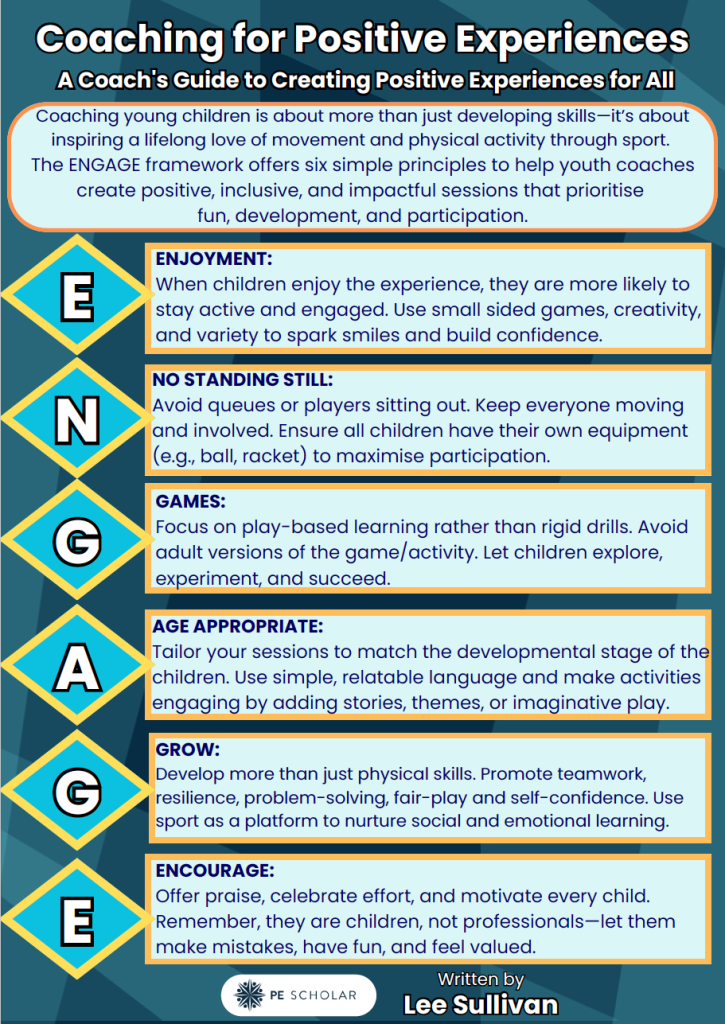
I created the ENGAGE framework with the hope that readers of this blog, or anyone who comes across it, will share it with the youth coaches or sports clubs they are connected to. The ENGAGE framework is a one-page resource designed to be a clear, concise, and practical guide for any coach or volunteer working with young children.
My goal in creating this was to provide a simple tool that encourages coaches to pause and reflect on the way they plan and deliver their sessions. The 6 principles of ENGAGE are a reminder that the most impactful coaching is about fostering positive experiences that will inspire children to stay active, grow in confidence, and develop a lasting love for movement and physical activity through sport.
E – Enjoyment
When coaching young children, the experience should always be fun and exciting. Enjoyment should be at the core of every session because when children have fun, they are more likely to stay engaged and feel excited to return. By incorporating storytelling and creative themes into your sessions, you can spark their imagination and make movement feel like an adventure. These themes not only make the activities more engaging, but they also help children connect with the experience in a meaningful way. Using small sided games, creativity, and variety keeps the sessions lively, encourages exploration, and boosts confidence.
N – No Standing Still
No one enjoys queuing, especially young children. So, keeping children in long queues, having players sit out or watch when they are ‘out’ or while others take their turns is a sure way to lose their interest. Young children need constant movement and involvement to stay engaged. By ensuring every child has their own equipment, like a ball or racket, you maximise their involvement and learning, giving them more time to practise. Activities should be designed to keep everyone on the move, with minimal downtime, so every child is active and engaged throughout the session.
G – Games
While drills can be useful for developing specific skills, children are more likely to enjoy learning and improve faster through play-based activities. Focus on small-sided games (to maximise involvement) or fun challenges that replicate real-game situations, where they can learn by doing. The adult versions of sports, with their rigid rules and high-pressure outcomes, are often not suitable for children and can actually lead to frustration and disengagement. When the focus shifts too early to competition and perfection, it can take away the joy and motivation that initially drew children to play in the first place. Play is a natural way for children to learn, so prioritise games that allow them to experiment, succeed, and enjoy the process.
A – Age Appropriate
Coaches should always ensure that activities are tailored to the children’s age and developmental stage. What works for adults often isn’t suitable for younger kids. Using simple language that they can understand, alongside age-appropriate sport-specific terminology, is key to ensuring they don’t feel overwhelmed or confused. Remember, these are young children, not professional athletes.
G – Grow
Coaching isn’t just about teaching physical skills—it’s about fostering growth in all aspects of a child’s development. Through sport, children can learn valuable life skills such as teamwork, resilience, problem-solving, and self-confidence. Coaches should use sport as a platform for social and emotional learning, helping children develop important skills that extend beyond the session. Providing opportunities for children to work together, communicate, lead, overcome a challenge and reflect on their progress will support growth beyond purely the physical.
E – Encourage
Children thrive when they feel supported and valued. Encouragement is a powerful tool for building self-esteem and motivating young children to try their best. Always celebrate effort, not just outcomes. Remember, they are still learning, and mistakes are a natural part of the process. Letting children know that making mistakes is okay, and that effort is just as important as success, creates a safe and supportive environment where they can have fun and learn without fear of failure.
Conclusion
Reflecting on the experiences I’ve shared, I’ve learned that coaching children is not just about teaching them to kick a ball or swim a length—it’s about creating an environment where they feel confident, motivated, and eager to participate. The ENGAGE framework offers a clear, easy-to-follow guide that can help youth coaches avoid the pitfalls I’ve experienced with my children.
As a coach, whether you’re a volunteer, a parent, or a PE teacher, it’s important to remember that your role is not just to teach skills, but to nurture a love for movement, growth, and teamwork. By embracing the ENGAGE framework, I hope you can create sessions that are not only fun but also foster the kind of positive, lasting impact that all young children deserve.
Responses