


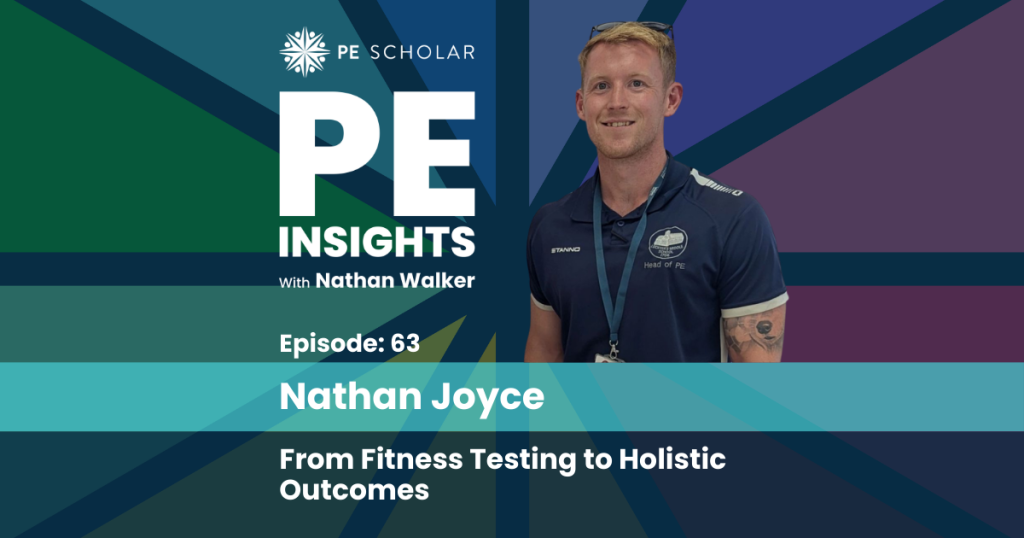
In this episode, Nathan Joyce, Head of PE at Lockers Middle School (Years 5–8), discusses the radical curriculum transformation he initiated 10 months into his role, moving away from destructive assessment practices toward a holistic, pupil-centred approach.
The Crisis of Fitness Testing
Upon starting, Nathan identified a significant issue: students lacked excitement for PE, citing difficulties changing and a general lack of understanding of the subject’s purpose. His initial survey of the pupils revealed the root of the problem:
- Assessment Method: The school’s summative assessment involved two weeks of intensive fitness testing (Beep Test, Agility, Sit and Reach).
- Student Fear: 80% of students found the testing “totally scary and petrifying,” identifying it as the number one reason they feared PE.
- Parental Feedback: This quantitative, norm-referenced testing made it difficult to provide meaningful feedback to parents, particularly when active students achieved low grades in PE.
Nathan determined that this approach incorrectly defined PE solely as the ability to move effectively at speed and with agility, failing to capture the subject’s true value.
Implementation of Head, Heart & Hands
Motivated by his pursuit of a National Professional Qualification in Leading Teaching and guided by the need for meaningful experiences, Nathan implemented a Head, Heart, Hands (3H) curriculum model.
| Domain | Focus |
| Head | Cognitive elements, understanding. |
| Heart | Affective elements, determination, how we feel, how we treat others. |
| Hands | Physical elements, skill mastery. |
Strategy for Change
Recognising the risks of rapid change, Nathan approached the overhaul using guidance that advises against overwhelming staff:
- Trial Programme: He conducted a trial programme with Years 5 and 7, communicating the vision via letters to parents.
- Staff Buy-in: He invited staff to observe his teaching to understand how to gauge the Heart element in lessons. Staff subsequently adopted the 3H model gradually, initially implementing it in only a few lessons.
- Refinement: The initial application, which attempted to cover 3H in every element of the lesson, was found to be too “long-winded”. They refined this to three “break points” in the lesson where 3H success criteria were explicitly addressed.
Lesson Delivery and Assessment
Nathan aims to hit all three domains in every lesson, making the 3H model the success criteria and assessment focus.
- Focus on Feeling: When checking for understanding, questions dive beyond skill execution, asking students: “How has that made you feel?” or “What could we do to encourage others to get involved?” when a leadership opportunity is given.
- Progressive Challenge: Questions become progressively more challenging from Year 5 to Year 8:
- Year 5 (Heart): Focus is on small tasks; questions explore immediate feelings: “Did you at any point feel any pressure? What did you do to overcome that pressure?”.
- Year 8 (Heart): Focus is on larger contexts (bigger-sided games, leadership); questions are more open: “How did you organise this? What were the challenges that you were faced at that time?”.
- Curriculum Structure: While currently operating six-lesson blocks of activities (e.g. football), Nathan is exploring moving to a conceptual model (e.g. six weeks of attacking principles) that could use different activities to teach the same objective and focus more heavily on the Heart domain.
Future Vision and Reporting Challenges
Nathan is currently facing the challenge of reporting this holistic learning back to parents. While he has completed the first cycle of summative assessments, the feedback is currently quantitative, which he acknowledges contradicts the holistic vision of the 3H model.
- Pathway Model: He is keen to move towards a pathway model of assessment and provide more detailed feedback.
- Future Goals: In the next 10 months, Nathan aspires for every student to have a “natural love of PE,” for staff to embrace reflection, and for the department to implement the roadmap of learning built on objectives that are flexible across activities.
- Consistency Challenge: Acknowledging the middle school context (Years 5 and 6 are very young), consistency in routines and equipment remains a challenge, which is often easier to manage when activities remain consistent.
Quickfire Questions and Professional Insight
Nathan’s responses reflect his commitment to inclusivity and student development:
| Category | Response Details |
| Non-Negotiables | Every student must feel included, valued, and challenged. This is achieved by creating a positive environment, quick early wins, and breaking down complex skills into manageable chunks. |
| Mantra | “Move with purpose, play with heart, and leave with confidence.” (This aligns closely with the Head, Heart, Hands domains). |
| Removal from PE | Fitness testing used as a method for summative assessment in core PE. |
| Advice for New Teachers | Celebrate the small wins (e.g., a student smiling for the first time) to ensure self-care and long-term vision. |
| One Word for PE | Joyful and Empowering. Empowering because students should want to share what they learned (“Let me show you”). |
Conclusion
Nathan highlights that his training encouraged him to be open to everything and adaptable to different teaching models, allowing him to find his own philosophy.
About the Guest
This episode is a conversation with Nathan Joyce, Head of Physical Education at a middle school catering for Years 5-8.
Listen
To listen to the full episode please follow these links to Spotify or Apple podcasts.

Responses