


Leading Physical Education (PE) in a primary setting is a significant responsibility, but we know it often comes with a to-do list that feels impossible to finish. It is a role that requires you to be a strategist, a mentor, a vocal advocate, a living encyclopedia on the worlds of sport, health, fitness and physical activity, a guru on behaviour change and a logistics specialist able to book coaches, schedule spaces and respond to the weather in real time … all while often having very little non-contact time.
To move the needle, we must shift our focus from managing the day-to-day to leading for impact and sustainable improvements. Grounded in the Meaningful PE framework and the pursuit of Physical Literacy, here are 10 top tips to help you transform movement in your school.
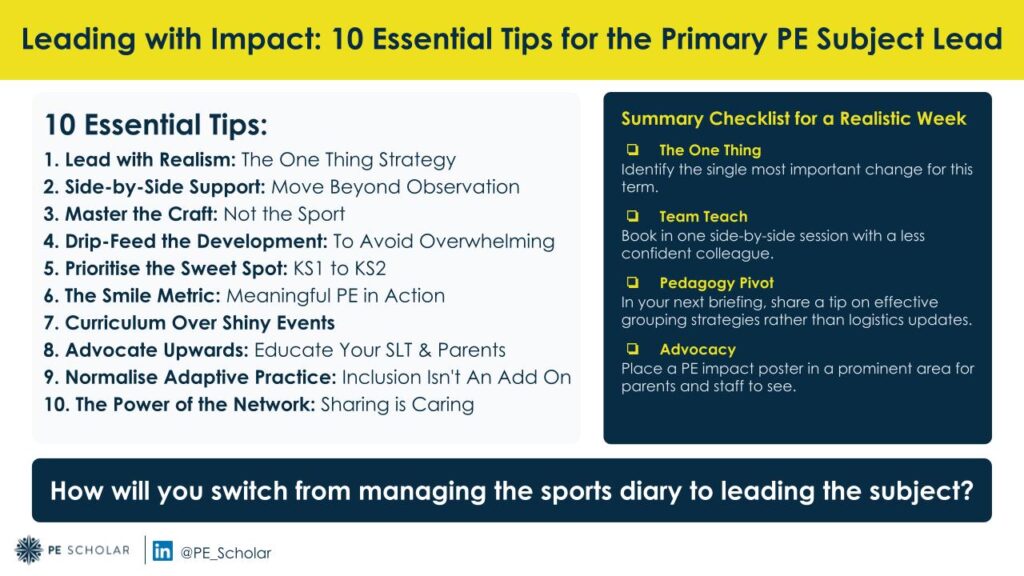
1. Lead with Realism: The One Thing Strategy
Many of us are leading PE alongside other responsibilities. Avoid the trap of trying to “fix” everything at once. Pick one high-impact area first and focus on that. Perhaps it is improving the transition from KS1 (Years 1-2) to KS2 (Years 3-6) or giving all teachers the confidence to apply the STEP principle in any activity context. Success breeds success; once you have one win, the momentum will build. This approach prevents burnout and keeps your goals achievable.
2. Side-by-Side Support: Move Beyond Observation
While role modelling is great, team teaching is the gold standard for building generalist teacher confidence.
- Collaborative Coaching: Instead of a colleague just watching you, plan a session together. You take the lead on the technical movement and they lead on the grouping or questioning.
- Shared Ownership: This side-by-side approach reduces the performance anxiety many generalist teachers feel in the sports hall.
3. Master the Craft, not the Sport
A common barrier for primary teachers is the fear that they don’t know the rules of cricket or can’t play netball. We need to reassure them that high-quality teaching is high-quality teaching, regardless of the setting.
- Pedagogy First: Encourage staff to focus on their existing strengths like behaviour management, clear instructions and effective questioning rather than sport-specific technicalities.
- Transferable Skills: If colleagues can teach a great science enquiry, they can teach a great PE lesson focused on problem-solving and motor competence.
4. Drip-Feed the Development
Avoid the big bang CPD approach where staff are overwhelmed with a three-hour intensive session and then left to get on with it.
- Bitesize Ideas: Try drip-feeding one practical tip or game variation in each staff meeting.
- Low Stakes: A Game of the Month or a new way to use the STEP principle (Space, Task, Equipment, People) is far more likely to be implemented than a dense manual of sports rules, pedagogical approaches or research-informed ideas.
5. Prioritise the Sweet Spot (KS1 to KS2)
Research suggests that the end of KS1 and the start of KS2 is a critical sweet spot for impact. If we haven’t hooked children by age 7 or 8, they are significantly more likely to disengage later on.
- Early Intervention: Focus your best resources here to ensure every child builds a positive relationship with movement before the engagement and activity dip often seen in Year 5 and 6.
6. The Smile Metric: Meaningful PE in Action
One of the quickest indicators of a successful lesson is the level of excitable engagement.
- Success is a Smile: Fun isn’t a bonus; it is a vital pedagogical ingredient and the gatekeeper to learning. If children are showing delight (a core pillar of Meaningful PE), they are building the motivation required for a positive lifelong connection with and commitment to physical activity beyond the school gates.
7. Curriculum Over Shiny Events
It is tempting to focus on one-off festivals or performance events. However, these often only serve the pupils who are already “sporty” (a term that is unhelpful and we would like to outlaw but that is a topic for another day).
- The Nudge: Put your energy into the crumbling curriculum, i.e. the daily lessons that every child experiences. Fixing the core curriculum ensures that PE is fit for purpose and appropriate for every child, not just those already lucky enough to have been exposed to positive sport and movement experiences beyond school.
8. Advocate Upwards: Educate Your SLT and Parents
Many parents (and some senior leaders) may have had negative experiences of PE and view it as a nice to have rather than a need to have.
- The Why: Frame PE as an essential vehicle for wellbeing and cognitive focus. Use our PE fact sheets as advocacy posters to visually demonstrate that for some pupils, PE is their only time to move in a week.
- Community Culture: Engage families in what you do and why it matters, helping them move away from the sporty vs. not sporty binary.
9. Normalise Adaptive Practice
Inclusion is not an extra task; it is the cornerstone of High-Quality PE.
- Inclusive Design: Use the Inclusion and Adaptive Practice Toolkit to ensure all staff feel confident making small, impactful tweaks. When a teacher knows how to adapt a task for a SEND pupil, their overall confidence on the school field sky-rockets.
10. The Power of the Network
Don’t lead in isolation. Reach out to other PE leads in your local cluster or trust.
- Magpie Best Practice: Sharing a what worked story or a simple assessment sheet can save hours of work. Being part of a wider community like PE Scholar reminds you that you are part of a movement, not just a person with a clipboard.
Summary Checklist for a Realistic Week:
- [ ] The One Thing: Identify the single most important change for this term.
- [ ] Team Teach: Book in one side-by-side session with a less confident colleague.
- [ ] Pedagogy Pivot: In your next briefing, share a tip on effective grouping strategies rather than an update on logistics for a sports competition.
- [ ] Advocacy: Place a PE impact poster in a prominent area for parents and staff to see.
Effective leadership is about empowering others. By focusing on the craft of teaching and the joy of movement, you create a sustainable culture where every teacher feels like a PE teacher and every child feels they belong.For a deeper dive into practical strategies for building staff confidence, please visit our High-Quality PE resources and community.
Responses