


A guest blog by Dr Will Patz, Head of Early Years and Lower Primary PE at Dulwich College in Singapore exploring the Compassionate Systsmes Framework and how he is using it to rethink physical education to be about more than just movement.
What if Physical Education (PE) was not just about running laps, scoring goals, or doing push-ups, but about growing the whole individual who cares for themselves, for others, and for the world?
For too long, PE has battled a reputation problem over many years (Kirk, 2010; Mainsbridge et al., 2024). It is often seen as the ‘break from learning’, a time to burn off energy before heading back to the ‘real work’ of school (Redelius et al., 2015). But what if we reframed PE not as a break from learning but as a breakthrough for learning?
At its best, PE is one of the most powerful spaces for shaping empathy, systems thinking, personal agency, and social responsibility (Martinek and Hellison, 2016; McLean, Robertson and Salmon, 2025). That is where the Compassionate Systems Framework comes in.
What is the Compassionate Systems Framework?
Developed at MIT and now being used in schools across the world (Systems Awareness, 2025), the Compassionate Systems Framework equips young people to:
- Understand themselves and their emotions
- Recognise interdependence within communities
- Take informed action in complex systems
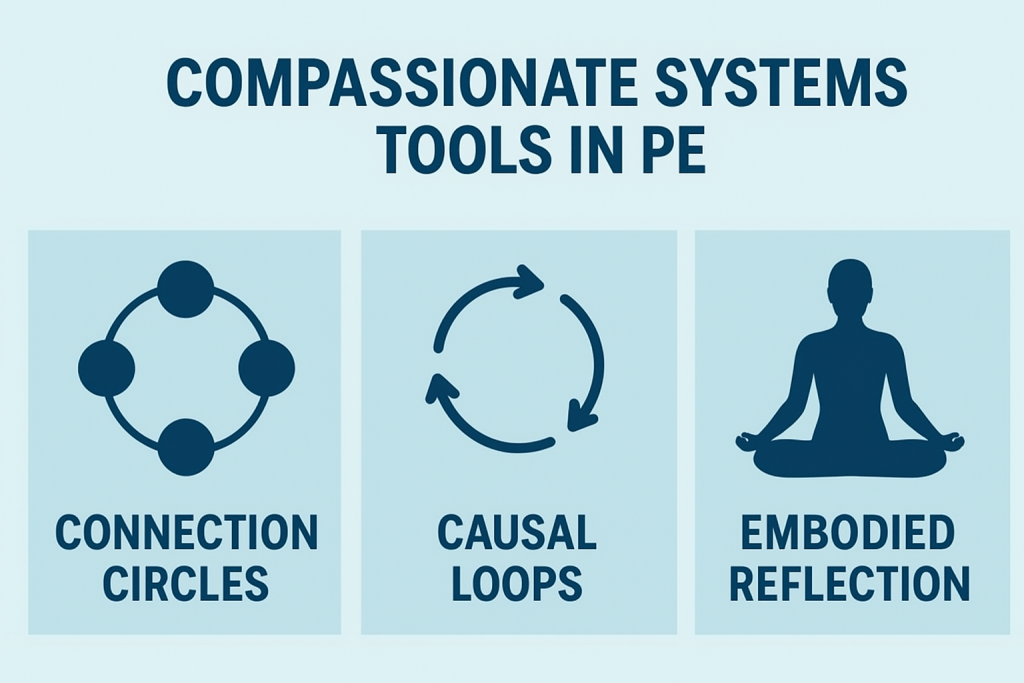
It uses pedagogical tools like connection circles, causal loops, and embodied reflection to help students see how personal choices ripple through broader systems, whether that is in a classroom, a team, or even the climate.
What does this have to do with PE?
PE is already about systems: the body as a system, teams as systems, ecosystems for movement, and the rules, rhythms, and relationships of play. The problem is, we often teach it as if it were just about isolated physical skills.
By aligning PE pedagogy with the Compassionate Systems Framework, we begin to ask:
- How do students feel about their movement experiences?
- What emotions or stories sit beneath competitive behaviour?
- How do relationships, cultures, and environments influence the games we play?
- How can PE contribute to a more sustainable, just, and connected world?
Rethinking PE Pedagogy: From Control to Compassion
Instead of focusing only on instruction and performance, a compassionate systems pedagogy values:
- Reflection and Connection
Students reflect on how movement feels in their body, what it means to them culturally, or how their choices affect others in a game.
- Tools for Understanding Systems
By using visual tools (like causal loops), students explore how a PE class works: What builds trust? What are the implications of increased competition? What encourages inclusion?
- Shared Responsibility
Students help co-create class norms, resolve conflicts, and adapt games to be more inclusive or sustainable.
- Real-World Relevance
Movement experiences connect to wider issues: How can we move with the environment, not just in it? What can we learn about climate change through sport? What activities or games teach us about equity or resilience?
What Could This Look Like In Practice
- An Early Years teacher narrates a mindful movement story that helps children self-regulate and explore emotions in motion.
- A Year 2 class uses a connection circle to explore how their feelings impact teamwork in a cooperative game.
- A Year 5 class maps the feedback loops between rest, effort, hydration, and performance in athletics.
- A Year 9 class adapts a competitive game to reflect their values of fairness and cultural respect, integrating student voice into lesson design.
Why It Matters
What are the most valuable skills you can give learners in and through your physical education programme? In a world facing climate anxiety, social unrest, and youth mental health crises, PE is one of the few spaces students can experience embodied hope. Compassionate systems thinking in PE:
- Builds empathy alongside agility
- Teaches emotional literacy alongside motor skills
- Promotes action rooted in care, not just competition
It is not about abandoning physical development or physical challenge, it is about expanding the field. PE can be joyful and ethical, fast-paced and reflective, physical and philosophical. Through deliberate and creative planning, it is possible to achieve this despite the constraints and limitations often faced by PE as a subject and the educators responsible for delivering it.
PE for the Future
It is time to stop asking whether PE is ‘important’ and start asking: What kind of world are we preparing children to move in?
My own exploration of the CSF began with a recognition that traditional perceptions of PE (i.e. fitness, skills, competition) only go so far in engaging students and providing a holistic learning experience. Students were moving (sometimes but not always well) but were they learning how to use movement as a way to connect with themselves, others, and the wider world? The CSF provided a language and set of tools to make that visible, and it has become a bridge between PE and the broader aims of the IB curriculum, drawing on systems thinking, and social and emotional learning.
In practice, this looks very different from the stereotype of PE. For example, in Year 2, students might use a connection circle to explore how emotions like frustration or joy ripple through a team game, helping them visualise how feelings influence collaboration. By Year 5, they might map feedback loops between rest, hydration, and performance in athletics, shifting their attention from ‘winning’ to understanding how their choices impact wellbeing. In Year 9, students co-design competitive activities that reflect their values (e.g. fairness and respect), recognising that how we play together says as much about us as what we achieve.
What is working is how these tools open space for student voice and personal reflection. I have observed students becoming more resilient when faced with setbacks in games, and showing greater empathy in peer interactions. What remains challenging is finding time in busy lessons to slow down for these conversations. Yet when we do, the impact is lasting and can often spill into other subjects.
The potential in adopting the CSF is much bigger than one subject. If PE, a space so often associated with judgement and comparison, can become a site of compassion and systems thinking, then any subject can. The arts, sciences, and mathematics could all benefit from tools that help students see connections, recognise emotions, and act with greater awareness. In that sense, PE is not just catching up with the future of education, it could lead the way for others to follow.
Reference List
Kirk (2010). Physical Education Futures. Routledge.
Mainsbridge, C.P., Iannucci, C., Pill, S., et al. (2024) Is there education in physical education? A narrative systematic review of research in physical education and learning. Sport in Society, pp. 1–25. doi:10.1080/17430437.2024.2368628.
Martinek, T. and Hellison, D. (2016) Teaching Personal and Social Responsibility: Past, Present and Future. Journal of Physical Education, Recreation & Dance, 87 (5): 9–13. doi:10.1080/07303084.2016.1157382.
McLean, S., Robertson, S. and Salmon, P.M. (2025) Complexity and systems thinking in sport. Journal of Sports Sciences. 43 (1) pp. 1–5. doi:10.1080/02640414.2024.2388428.
Redelius, K., Quennerstedt, M. and Ohman, M. (2015) Communicating aims and learning goals in physical education: part of a subject for learning? Sport, Education and Society, 20 (5): 641–655. doi:10.1080/13573322.2014.987745.
Systems Awareness (2025). https://systemsawareness.org/. [Accessed 15 August 2025]
Responses