


Throughout my career as a physical educator, I have been deeply motivated by a single question: “How can we make physical education meaningful, engaging, and transformative for every student?”
Early in my teaching journey in both the UK and the US, I witnessed firsthand the limitations of traditional ‘one-size-fits-all’ PE programmes. Students were often measured only by their ability in conventional sports, which left many disengaged or overlooked. As an educator with Autism and ADHD, these experiences were not just an observation, but a lived experience to the ignored and devalued possibilities of all learners. In a space of sanctuary where my neurodivergent abilities thrived through high energy, innovation, and ability to see patterns in dynamic environments, it highlighted even more so the importance of a PE journey that advocates for all. These critical incidents, seeing talented students disengage and others struggle with self-confidence, sparked my commitment to rethink how we structure PE across all ages and beyond.
‘Physical Education is the most complex learning subject that encompasses the body and mind in one.’
This is often my response to justifying my love for the subject of Physical Education, in that response begs the question of what does “talent” look like in such a complex learning environment? For me, talent in PE is the development and expression of the whole person through physical activity and movement exploration. Talent within PE is shown through social interaction, emotional regulation, cultural expression, cognitive growth, and physical development. PE is not just about teaching skills; it is about shaping learners who understand their bodies, recognise success in multiple forms, and embrace the joy of movement.
“Within Mathematics, 2+2 is always 4; in English, an adjective is always a describing word; in science, the formula of water is always H2O. Yet, in PE, how many possibilities are there of throwing an object? The answer is endless.”
Physical, Thinking, Emotional, Social, and Cultural Me
For this talent to be envisioned, a teacher must think beyond the physical and into wider domains. A way that I approached this was expanding ME in PE into Physical, Thinking, Emotional, Social, and Cultural Me. Within this approach talent is multidimensional and evolves across the three stages of the curriculum. Talent is developmental and context-dependent; it’s not fixed or purely physical. It encompasses skills as a whole person such as:
- Physical: coordination, agility, skill execution
- Cognitive: decision-making, strategy, reflection
- Social: leadership, teamwork, communication
- Emotional: resilience, perseverance, self-regulation
- Cultural: cultural awareness, inclusion, and values
Talent is nurtured through inclusive, scaffolded learning rather than only identifying “naturally gifted” students.
| Stage / Grade | Talent Indicators | Real-Life Examples | Assessment & Observation Ideas |
| Primary / Elementary (K–5) | – Curiosity & enthusiasm for movement- Rapid acquisition of fundamental movement skills (running, jumping, throwing, catching, balancing)- Early cooperation & social leadership- Persistence & problem-solving | – Student experiments with different ways to jump over obstacles- Leads a small group in a partner throwing challenge- Engages willingly in group games even if skill is low | – Observation checklists for FMS- Peer feedback on cooperation- Journals or reflections on what they tried or learned- Teacher notes on persistence & engagement |
| Middle / Lower High (6–10) | – Tactical understanding of game concepts- Leadership & teamwork in hybrid models (TGFU, Sport Education)- Creativity & cultural engagement in movement- Emotional regulation & problem-solving under pressure | – Recognises gaps in defense in basketball and communicates to teammates- Leads a group dance with cultural awareness- Suggests strategy adjustments in a small-sided game | – Game performance rubrics (decision-making, positioning)- Peer and self-assessment of teamwork & leadership- Reflective logs on strategy and cultural insights- Video analysis of in-game choices |
| Upper High (11–12) | – High-level sport-specific technical skills- Health literacy, fitness awareness, and wellness habits- Self-directed learning, goal-setting, and reflection- Transfer of skills across sports & life contexts | – Designs own positional drills in rugby- Tracks fitness and nutrition goals- Uses game footage to analyse tactics- Demonstrates “Growth mentality” and mental toughness in competition | – Personalised performance portfolios- Self- and teacher-assessment of skills & habits- Fitness and wellness tracking logs- Reflective essays or presentations on learning & transfer |
One critical incident that shaped my thinking occurred during an observation of an experienced teacher in a Year 4 PE lesson. While some children excelled in basic hitting and object control games, others struggled to even handle an object or hit confidently. I noticed that these children became disengaged, avoiding participation and often sat out during activities. Observing this, I realised that a singular focus on conventional sports left many students neglected. Similarly, in middle school/KS3, I taught a football unit where several students had excellent technical skills but no understanding of positioning or teamwork. Without structured guidance in tactical thinking and cooperative play, their games were chaotic, frustrating, and in their view, unsuccessful.
Thematic → Conceptual → Specialist
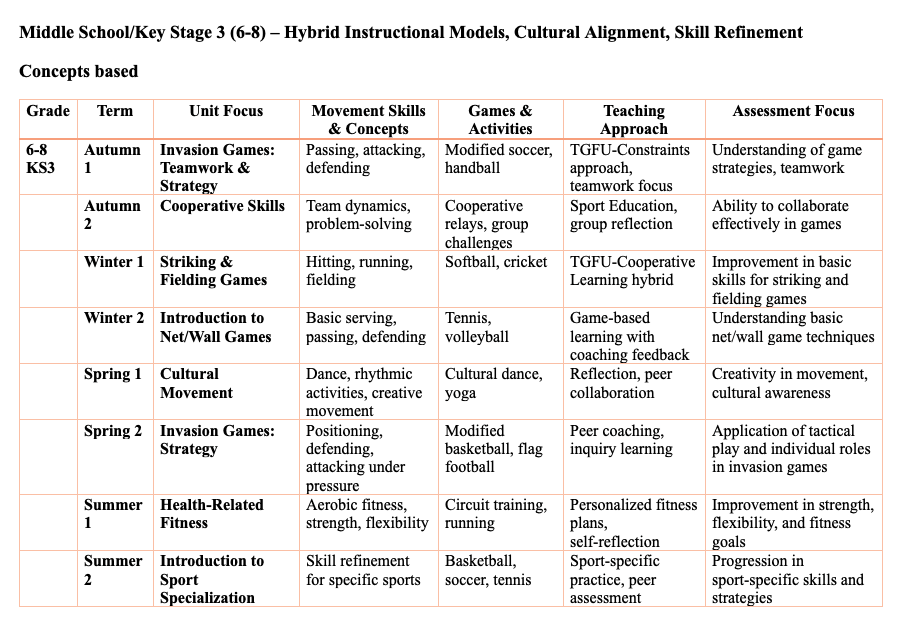
Through years of teaching, mentoring, and research, I recognised that students develop physically, cognitively, socially, and emotionally at different rates. This insight led me to develop a three-stage K-12 PE curriculum: Thematic → Conceptual → Specialist:
- Primary KS1-2/Elementary (K-5): A Thematic play-based approach that develops fundamental movement skills, cooperative behaviours, and social-emotional competencies. Activities such as obstacle courses, cooperative relays, and simple invasion or striking games allow children to explore, experiment, and develop confidence in movement.
For example, I ran an “Animal Movement Obstacle Course” where students hopped like frogs, crawled like bears, and balanced on “logs” marked on the floor. Not only did this enhance locomotor and balance skills, but it also encouraged students to cheer for each other and problem-solve together. Another memorable unit involved “Partner Throwing and Catching Challenges,” where students experimented with different ball types and distances, fostering hand-eye coordination and persistence in a playful, low-stakes environment.
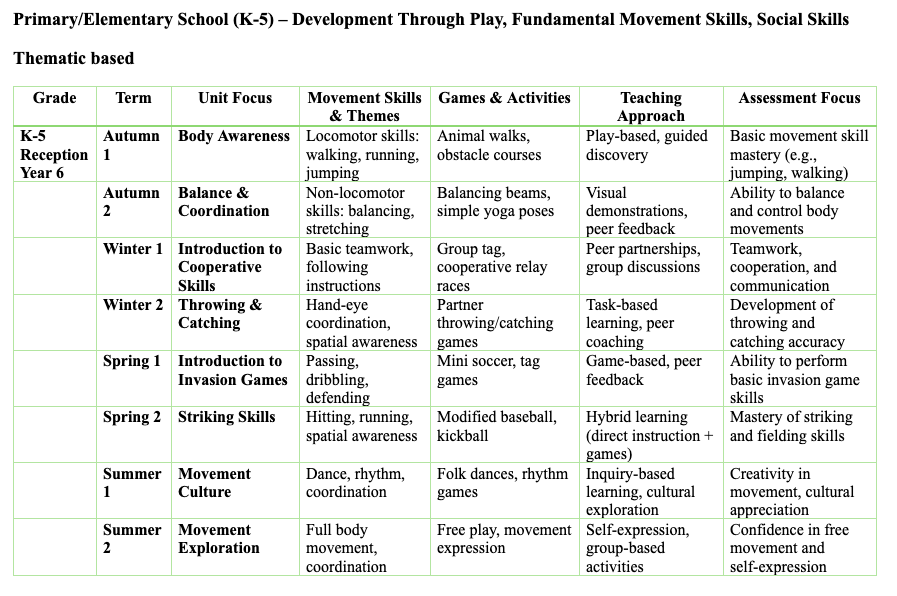
- Middle/Lower High School (6-10) (KS3): Through Conceptual learning environments, students refine skills through hybrid instructional models such as combining Teaching Games for Understanding (TGFU), Sport Education, and cultural relevance. Units focus on tactical understanding, cooperative problem-solving, and engagement in diverse activities. Here, students start linking skill acquisition to decision-making and strategic thinking in authentic game contexts.
An important part of the conceptual approach is to understand that it is not techniques or skills taught, but the use of skills to develop movement concepts such as on/off-the-ball skills, transitions, limiting scoring, denying space, applying pressure, creating scoring opportunities, maintaining possession, using width and depth, varying shot selection, sending to space, covering space, reacting to stimuli, problem solving, creating rhythmic sequences, coaching, leadership, personal health, body development, feedback, and cultural awareness. These skills must be nested not in sports but movement concepts such as invasion games, strike and field, cooperative skills, cultural movement, health-related fitness, and later introducing sport specialisation.
In a modified basketball unit, I introduced “Freeze & Rewind” sessions where gameplay paused, and students analysed passing decisions, spacing, and defensive alignment. These moments of reflection allowed them to understand strategy rather than just execute drills. Another example: in a cultural dance unit, students researched and performed traditional dances from around the world, such as Tai Chi movements and Hip Hop. This not only developed movement literacy but connected learning to culture and history, highlighting PE’s broader educational value.
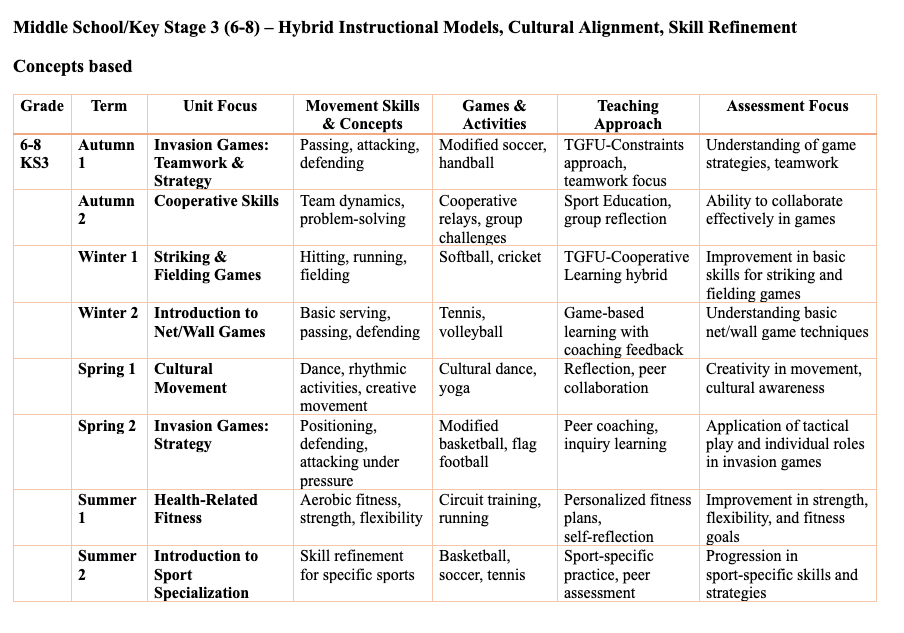
- Upper High School KS4/5 (11-12): A specialist, habit-based curriculum supports personalised learning, focusing on sport-specific skills, health-related fitness, nutrition, and lifelong wellness habits. Students learn to self-regulate, track progress, and adopt routines that extend beyond school into their adult lives.
I implemented self-directed fitness portfolios where students tracked strength, flexibility, and cardiovascular progress, coupled with nutrition reflections and goal setting. In one case, a student struggling with endurance developed a personalised interval-running plan, which improved not only fitness but also confidence and self-discipline. In sport-specific lessons, such as rugby, students focused on personal development goals such as technical skills like outside-foot passing, scanning for defensive gaps, and “red-head vs. blue-head” mental strategies to identify how emotional responses can affect performance from a state of reactiveness to calmness, learning to remain calm and process decisions under pressure. Students developed collaborative sessions personal to their chosen areas and provided coaching and feedback to others.
Critical to this evolution was a reflective process: observing student responses, gathering feedback, and interrogating my own assumptions about PE. I learned that true physical education cannot be reduced to skill drills or competitive games alone; it must integrate social, emotional, cultural, and cognitive domains, fostering holistic development while respecting cultural and individual differences.This reflection invites a critical question for all educators:
How often do you examine your own assumptions about PE, and in what ways could intentionally integrating social, emotional, cultural, and cognitive domains transform your students’ engagement, learning, and overall development?
Developing this curriculum map also taught me the value of iteration, humility, and flexibility. Not every model works in every context; success comes from aligning pedagogy with local culture, student needs, and available resources. Early in my career, I recall introducing a new invasion games unit exactly as it was outlined in a model curriculum I had studied. I followed the activities and progressions meticulously, expecting students to engage in structured tactical play. Instead, many became frustrated and disengaged because the activities did not match their skill levels or cultural experiences. I realised I had prioritised the model over the students, and that was a hard but necessary lesson.
In another instance, I attempted to implement a Sport Education unit without sufficient scaffolding for leadership roles. Students struggled with collaboration and decision-making, and I felt unprepared to support them effectively. These moments were humbling, they reminded me that even with the best intentions, my assumptions, biases, and blind spots as a teacher could limit student learning.
Rather than rigidly sticking to the specifications of a new model, I learned that a multi-model, flexible approach is far more effective. Being willing to adapt on the fly, to pause and reflect, and to listen to students’ feedback is crucial. I also came to appreciate that teachers need structured support to adopt hybrid and personalised approaches successfully, making professional development, mentoring, and peer collaboration essential for sustainable implementation. By sharing these vulnerabilities, I hope other educators recognise that mistakes are not failures, they are opportunities to grow, reflect, and improve pedagogy for the benefit of students.
Next steps for implementation
Next steps involve both systemic and personal action:
Systemic: Pilot the curriculum in diverse school contexts, collect qualitative and quantitative data on student engagement, learning outcomes, and teacher fidelity, and refine units based on findings. Develop teacher guides, professional development workshops, and assessment tools to support effective adoption.
Curriculum Evolution: Continue integrating hybrid instructional models, culturally responsive content, and technology for performance tracking and reflective practice. Expand beyond traditional sports to include adventure education, mindfulness in movement, and outdoor experiential learning.
Personal Next Steps: I plan to implement a pilot in my current teaching context, collecting direct student feedback and using video analysis to monitor skill progression and engagement. I aim to publish a detailed case study of these implementations to contribute to PE scholarship and provide a model for other educators. I also intend to mentor PE teachers in adopting hybrid and holistic approaches, sharing my insights on reflective teaching, culturally responsive pedagogy, and habit-based learning strategies.
Reflecting on this journey, I see the curriculum not just as a roadmap, but as a commitment to every student’s growth and lifelong engagement in physical activity. I am struck by how much observation, reflection, and intentional adaptation have shaped my approach. The three-stage curriculum is more than a roadmap; it represents a commitment to every student’s growth, engagement, and lifelong connection to physical activity. The process of observing, adapting, and reflecting has reinforced my belief that physical education is the only subject that simultaneously develops physical literacy, cognitive skills, social-emotional competence, and lifelong wellness habits. By implementing this curriculum, I hope to inspire other educators to view PE not as a single lesson or sport, but as a continuous, holistic journey of movement, learning, and personal development. My hope is that it sparks conversation, innovation, and evidence-based practice among PE professionals, inspiring others to see physical education not as a single lesson or sport, but as a lifelong journey of movement, wellness, and learning.
By Jack Harvey
Health and Physical Education Teacher/Adjunct Professor/Rugby Coach
Boston, MA, USA.
About Jack Harvey
Jack Harvey is an experienced physical educator, coach, and researcher with a strong international background in pedagogy and sport. He earned a First-class Honours BA in Physical Education from the University of Wolverhampton (UK), a Postgraduate Certificate of Education with Qualified Teacher Status from the University of Warwick, and a Master of Science in Physical Education Advanced Pedagogy at Springfield College(USA). Jack has taught PE and Health and wellness across all ages spanning 2-18 years and higher education, and is a certified World Rugby Coach. He has served in diverse roles, including Senior PE Coach and Mentor in the UK, Teacher of PE at Ormiston SWB Academy, PEHE Teaching Fellow and Adjunct Professor at Springfield College, Adjunct Professor at Regis College, and Assistant Rugby Coach at Springfield College and Lincoln-Sudbury Regional High School, after 15 years of playing experience in the West Midlands, UK. Jack’s work spans curriculum design, hybrid pedagogical models, inclusive PE practices, and athlete-centred coaching, integrating social-emotional development, culture-building, and game-based learning. His research focuses on creativity in PE, hybrid teaching models, and mentoring, reflecting a commitment to advancing holistic, student-centred physical education.
Responses