



Welcome to the fourth instalment in our comprehensive blog series designed to support teachers in guiding their students through PE GCSE exam revision. As educators, you play a crucial role in preparing your students for academic success, and we’re here to provide you with effective strategies to enhance your teaching.
Our series began with exam preparation tips, offering insights on how to help students set up productive study schedules and create conducive learning environments.
We then focused on reviewing content, providing structured approaches to breaking down key topics and concepts essential for the exams.
Last week, we discovered active learning and revision techniques to make your lessons and students’ revision more engaging and impactful.
In today’s insight, to ensure your students can effectively apply their knowledge, we will discuss how to use past papers and construct answers.
Applying knowledge
In the journey toward PE GCSE exam success, applying knowledge using mark schemes is an invaluable strategy. By familiarising students with the expectations and structure of exam questions, you empower them to understand what examiners are looking for and how to frame their answers effectively. This method not only clarifies assessment criteria but also enhances students’ confidence and precision in tackling written exams.
Analyse and evaluate content
If we refer back to the passive/active learning triangle discussed in last week’s insight on active revision, provided again in Figure 1 below, as well as the information processing model from the week before, we can see that optimum learning and recall happens when students can analyse, define, create and evaluate content.
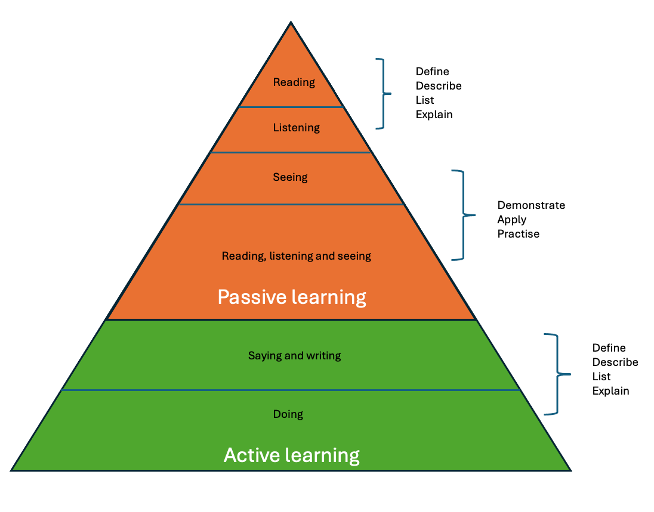
Figure 1: Active versus passive learning, adapted from Dale (1946)
To some extent, they have already practised defining and creating through the active revision phase of the revision cycle.
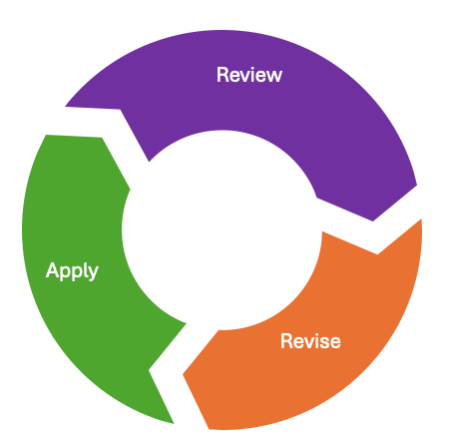
Figure 2: the revision cycle
But to retain at least 90% of their learning they need to apply it, by extracting meaning and using it to make decisions and solve problems.
Past exam papers
At this point of the revision cycle, students will use past exam papers to practise application of content.
This phase is where the Assessment Objectives (AOs) come into play. During the planning stages, you will already have explored the exam paper with your students and the weighting of AOs in the different sections.
The answers earning more points will require students to:
AO1 Demonstrate their knowledge
AO2 Apply their knowledge
AO3 Analyse and evaluate using their knowledge
Students will need to recognise when they are being asked to fulfil each AO. This involves looking at the language used in the question. Help your students to become familiar with this by going through past exam papers/questions and using Box Underline Circle (BUC).
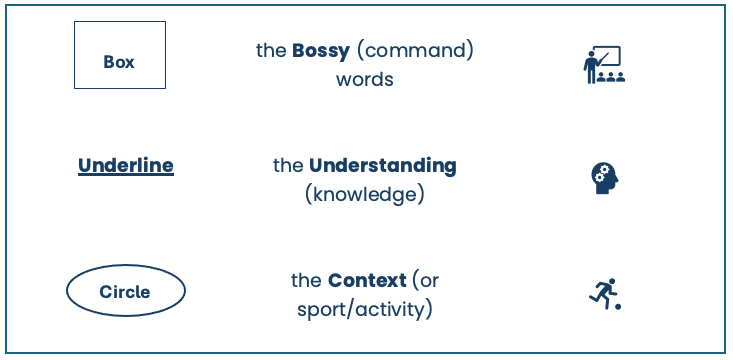
Structuring their answers
For questions that require all AOs, students can use the PEEL (Point, Evidence, Explain, Link) method. So, they will:
Point – introduce their point using basic knowledge (AO1)
Evidence – bring in further knowledge to apply to the context (AO1 & 2)
Explain – why it is relevant in this context, what else might be relevant, what isn’t, whether they agree/disagree etc. (AO1, 2 & 3)
Students may go back and forth between Evidence/Explain a few times to make their point.
Link – finish with a sentence that concludes and answers the question.
Self and peer assessment
Students should use the mark scheme to self and peer assess.
They should also look at examples of ‘what a good one looks like’ (WAGOLL) as well as ‘what a bad one looks like’ (WABOLL)
They can colour code marking to highlight the different AOs

Conclusion
Integrating mark schemes into your teaching helps students practise applying their knowledge in a focused and strategic manner. This approach demystifies the exam process, reduces anxiety, and fosters a deeper comprehension of key concepts.
As PE teachers, leveraging mark schemes will not only boost your students’ performance in the exam but will also cultivate their critical thinking and analytical skills. Embrace this powerful tool to ensure your students are well-prepared, confident, and poised for success in their PE GCSE exam.
Next in the series
Next week, we’ll focus on wellbeing strategies, emphasising the importance of your students maintaining a healthy balance during the revision period.
Read more
For further ideas on demonstrating how to structure answers, access our short courses here
Search our bank of teaching resources for further ideas on assessment
Responses