


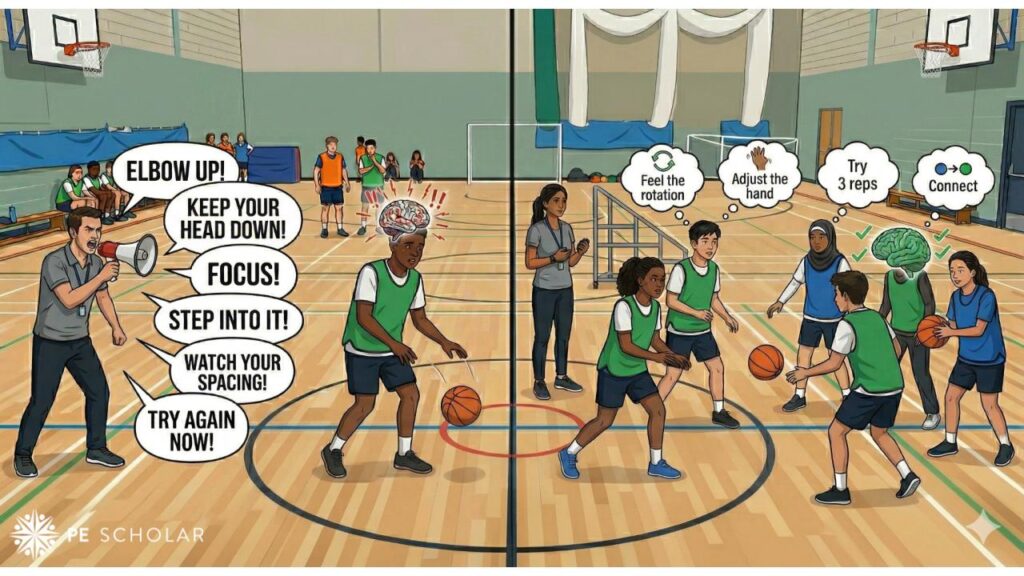
As PE teachers, we often equate “good teaching” with maximum feedback and correction of misconceptions. I have enjoyed visiting my trainee teachers over the last couple of months and noticed a lot of great feedback happening but it has left me wondering:
- How and when do we provide the most valuable feedback?
- Are there times when less is more or we should leave students to struggle for longer?
- What steps can we take to remove the reliance on teacher input?
So often PE teachers move from group to group, offering a constant stream of cues: “Keep your knees bent!” “Step into the ball!” “Find space!” “Good shot!” “Great effort!” We feel that if we aren’t talking, we aren’t teaching. But research into motor learning and cognitive science suggests something counterintuitive: The more feedback we give, the less our students might actually be learning.
In his recent analysis of “The Forgotten Desirable Difficulty,” educational psychologist Paul Kirschner highlights a hard truth for educators: Reduced feedback is a requirement for long-term retention.
The Performance vs. Learning Trap
The biggest hurdle in PE is distinguishing between performance (how a student looks during the lesson) and learning (the permanent change in ability that stays with them next week).
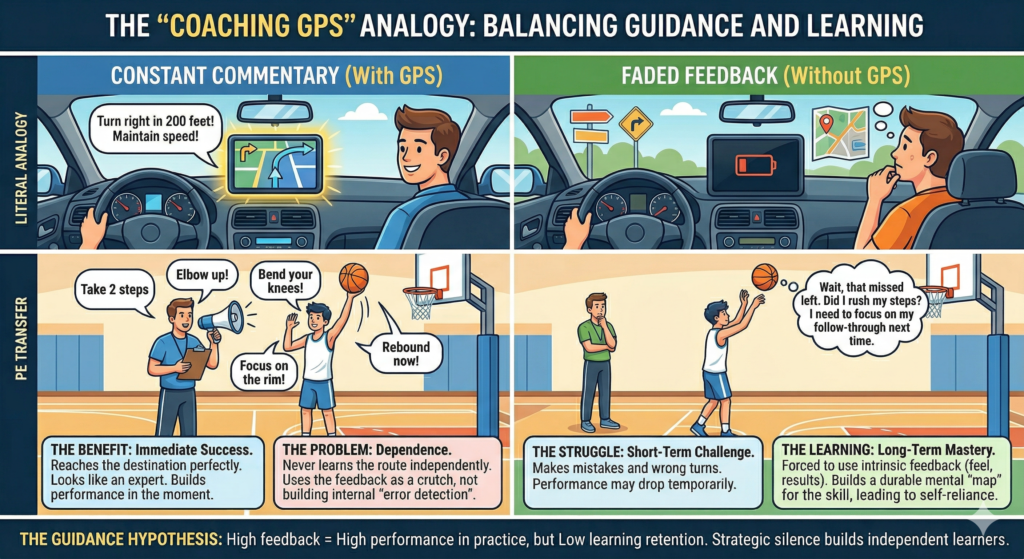
When we give constant, immediate feedback, performance looks great. The student adjusts their technique because you just told them to or gets into a better position because you pointed it out. However, this creates what researchers call the Guidance Hypothesis. By providing a “crutch” of constant correction, we prevent the student from developing their own internal “error-detection” mechanisms.
If the teacher/coach always provides the external brain, the student never learns to process their own intrinsic feedback to understand the “feel” of the movement, the sound of the strike, or the visual result of the flight. As a consequence, what do they actually learn?
A nice analogy for this is google maps. If you use it for your GPS, you will reach your destination and look like an expert driver but if you use it every time you drive somewhere you will never actually learn the way. Worse still, as you make mistakes it continually recalibrates the route and although it takes you much longer to get there you don’t realise how lost you were along the way!
1. Feedback as a Scaffold (That Must Be Removed)
In education, we talk a lot about scaffolding. We provide support to help a student reach a goal they couldn’t achieve alone. But the most important part of a scaffold is that it is temporary.
If you leave the scaffolding up forever, the building never has to support its own weight. In PE, our verbal feedback is that scaffold. If we don’t intentionally fade our feedback, the student becomes feedback dependent. They can perform the skill in isolation when you are reminding them how, but never make the transition to think, act and adapt for themselves.
2. Managing Cognitive Overload
Movement is cognitively expensive. When a student is trying to navigate a 3v2 overlap in rugby or execute a complex floor routine in gymnastics, their Working Memory is already near capacity.
Every time we shout a technical instruction mid-play, we risk causing Cognitive Overload. The student has to stop processing the environment (e.g. where they are relative to teammates, opposition and on the try line) to process your verbal data (e.g. run straight). By reducing our feedback, we lower the noise and allow students to focus on the most critical environmental cues and to think for themselves.
3. Increasing Student Autonomy
Reducing feedback is an act of trust. It shifts the student from a passive recipient of instructions to an active problem-solver.
When we remain silent after a missed shot, we create a learning opportunity. In that silence, students are forced to ask themselves: “Why did that miss?” This is the birth of Self-Regulation. We aren’t just teaching them to throw a ball; we are teaching them how to learn and how to solve their own problems. However, if we don’t provide support and guidance initially, students can quickly disengage or waste too much time exploring possible solutions or grooving an incorrect technique or habit… and we all know how hard it is to unlearn a bad habit or modify poor technique.
How to Practice “Intentional Silence”
If you want to move away from being a commentary box teacher, try these 3 strategies:
- Faded Feedback: Provide frequent feedback when a student first learns a skill, but intentionally reduce it as they improve. By the end of the unit, you should be a silent observer.
- Summary Feedback: Instead of commenting on every attempt, let the student perform five repetitions in silence. Afterwards, provide one piece of feedback that addresses the trend of those five attempts but ideally ask what they thought first.
- Bandwidth Feedback: Only intervene if the student’s mistake falls outside a certain bandwidth of safety or fundamental technique. If they are mostly right, let them figure it out for themselves or with the support of their peers.
- The Ask, Don’t Tell Rule: Instead of saying “You didn’t follow through,” ask “Where did your hand end up after that shot?” This forces them to look inward for the answer.
The Bottom Line
Our job isn’t to make our students look like experts today. Our job is to ensure they can perform like experts tomorrow when we aren’t there to help them and more importantly to become motivated to keep learning, adapting and transferring their knowledge to new and different situations in their futures. By providing too much support for too long, how are you preparing students to thrive on their own?
As Kirschner notes, “desirable difficulties” make practice harder and more frustrating in the short term, but they make learning deeper and more durable in the long term. This week, try to say 20% less. You might be surprised at how much more your students actually hear.
Responses