



In teaching, as in all fields, ideas and methods evolve. But change is challenging, especially in education, where established practices often feel like a reliable foundation. I perpetually find myself reflecting on this within PE, where a certain range of approaches and methods continue to dominate. Many of these approaches may have made sense when they were first introduced, yet some may now be outdated, akin to the belief that Pluto is still a planet—a belief many held until the International Astronomical Union reclassified it in 2006. For those of us who haven’t reviewed our understanding of the solar system since then, Pluto remains part of the planetary lineup, illustrating how we tend to hold on to what we first learned.
There’s a lesson here for PE: without regular reflection and adaptation, our practices may lag behind current understanding. In PE, this can mean relying on familiar pedagogies and assessment strategies that the wider educational community has questioned, if not fully debunked, for years. If we truly believe in the positive impact of PE on young people’s lives, we need to accept that updating our methods is essential—not unlike how we expect medical professionals to stay current for the sake of their patients, or a solicitor to be aware of the impact of new legislation on legal proceedings.
Mark Bowler (Debates in Physical Education, 2019; p.180) argued that PE’s struggle to achieve its aims is partly due to some teachers’ “refusal to get changed” regarding their approaches. Now, within the Curriculum for Wales, PE teachers are required to “get changed” to ensure that the Health and Well-being Area of Learning and Experience (AOLE)—which advocates and demands a holistic approach focusing on physical, social, cognitive, and emotional learning—is realised. Yet old habits die hard, and the drum for change is getting beaten thin. Many departments still prioritise activities and content over individual student needs, measuring success by how “busy, happy, and good” (Quennerstedt, Landi & Casey, 2024) students seem, instead of evaluating whether meaningful learning is taking place. Some may view this as criticism, but I prefer to see it as being because PE teachers are often not granted the access to appropriate professional capacity to plan, trial, and review change.

The Challenges of Change
The Curriculum for Wales emerged as a response to flaws in the previous National Curriculum, advocating for more flexibility, responsiveness, and relevance. But in PE, defining a common set of goals remains challenging. I recognise that departments can be pulled in many directions—some by policy, others by pressure to perform in specific ways or maintain longstanding reputations. I understand this reluctance to change; stepping away from familiar approaches can be daunting, especially when tradition and external expectations weigh heavily on us as educators.
Listening to Grant Huddleston discuss professional development on the PE Insights Podcast struck a chord with me. For many PE teachers, personal development is often hindered by a system that doesn’t cater to our specific needs. Most whole-school INSET training focuses on general teaching strategies, or “organisational” developments, which don’t always translate well in a PE context. We’re then asked to demonstrate these strategies, which can sometimes feel like ticking a box. Even when PE-specific CPD is available, it often centres on coaching skills in particular sports, neglecting the deeper pedagogical strategies that could enhance holistic learning. Consequently, the activity or sport becomes the goal, rather than a means to achieve broader educational ends that perhaps we set out, or even presume, to achieve.
Unlearning Practice with Purpose
I often wonder how many people, across professions, are unaware that their methods no longer align with or impact the goals they hope to achieve? How many of us recognise the need for change in the way we perform our roles but feel unprepared or anxious to step away from the familiar? I acknowledge these challenges because I constantly experience them too; previously, I have written about how brutal it can be to slip back down into the learning pit, especially when you think you have it all figured out. Adapting to meet the holistic aims of the Curriculum for Wales has been no small feat. It’s demanded that I critically scrutinise and question my practices, research and refine new ones, and trust that these changes will better serve my students’ growth—not just as competent movers with a positive relationship with physical activity, but as well-rounded individuals who embody the Four Purposes of the Curriculum for Wales. Unlearning, I’m finding, is hard work, but I know it’s essential if I want to help my students flourish. As a teacher, it would be foolish to suggest my learning has ended – if anything it is just beginning (again).
Coombs et al. (2013) proposed that “the capability to unlearn is important as the inability to give up or abandon knowledge, values, beliefs and/or practices can produce a rigidity in thinking and acting and can create a blinkered outlook.” The authors further recognise that in any organisation or profession, the failure to examine established organisational norms, values, practices, and knowledge can lead to what are known as “competency traps,” where once-useful skills and approaches become outdated because they are never questioned, adapted, or discarded. Through “individual experiences” such as recognising that a certain activity was irrelevant to my students, or “change events” such as the absorption of PE into the Health and Wellbeing AOLE where assessment, curriculum and pedagogy is expected to change, all manner of behavioural and cognitive learning needs to be considered whether relevant moving forward. Unlearning some components of these does not mean discarding them completely, but it does mean choosing, purposely, to put them to one side to give time and effort to something different. Vitally, it means accepting that there is struggle ahead and being comfortable with that. For that reason, I have chosen to adopt the enthusiastic mindset of an ECT – “re-entering” the profession with new ideas and an optimism that these can translate into a curriculum that is a viable and impactful alternative to traditional approaches (Hordvik et al. 2024), whilst navigating the personal limitations (individual factors, biological factors and social factors) (Salum, 2024) to the unlearning process that I might experience on the way.
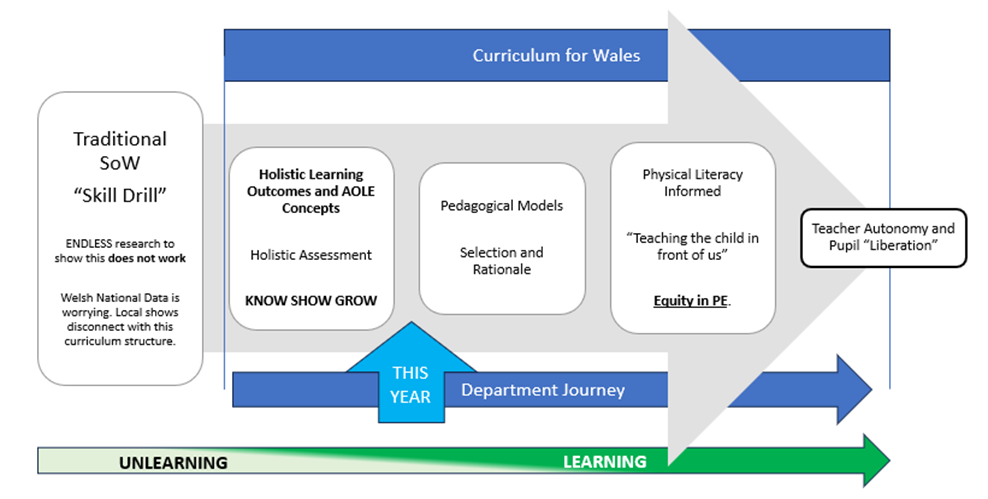
Evans (2022) eloquently explains why the approaches taken by the Curriculum for Wales may prove problematic for teachers. Many PE teachers are “passive consumers” of curriculum content, repackaging what they’ve seen and learned through their own experiences, which primarily is seen through a sports-dominant lens. However, Evans suggests that for the education workforce to make good on the intent of the Curriculum for Wales, teachers need to transition to “proactive producers” of not only content, but diverse learning experiences. Evans (2023) is critical as to whether this is something that will be possible on a nationwide scale because teachers’ readiness to engage in transformational practices, along with their capacity to implement these changes effectively, depends largely on their existing knowledge base and the experiences shaped by their initial training and ongoing professional development (which I discussed earlier is not often transformational for pedagogy or assessment).
Again, Evans (2023) makes an important statement which strengthens why I believe progress in PE in the context of Wales might need to start with professional ‘unlearning’. He argues that (p. 5) instead of empowering teachers, the C4W has “de-skilled” many, and that without fault, they “have gone from a position of strength, based on many years’ experience of teaching in a certain way in line with a particular curricular framework, to one of relative weakness.” With that understood, a national training framework for PE teachers should be considered.
As PE teachers operating within the C4W framework, it’s evident we need new skills to be able to enact what is being asked of us. But before we develop new skills, it might be an idea to place aside some ‘older’ ones (for now), and give new approaches our full attention.
References
Coombs CR, Hislop D, Holland J, Bosley SLC, Manful E. Exploring types of individual unlearning by local health-care managers: an original empirical approach. Health Serv Deliv Res 2013;1(2).
Evans, G. (2022). Back to the future? Reflections on three phases of education policy reform in Wales and their implications for teachers. Journal of Educational Change, 23(3), 371-396. doi:10.1007/10833-021-09422-6
Evans, G. (2023): A new dawn or false hope? Exploring the early implementation of Curriculum for Wales, Education Inquiry, DOI:10.1080/20004508.2023.2297506
Salum, M. (2024). Learning to unlearn for transformative learning, an epistemological view. International Journal of Human Sciences Research, 4(4), pp.2–11.
Quennerstedt, M. Landi, D. and Casey, A. (2024) Busier, Happier, and Good(er) – 40 Years on from ‘Busy, Happy, and Good’ as Success in Teaching Physical Education, Quest, DOI: 10.1080/00336297.2024.2393624
Responses