


The Athletic Skills Model (ASM), authored by René Wormhoudt, Geert Savelsbergh, Jan Willem Teunissen and Keith Davids, sets out to reframe the way we think about movement development across childhood and adolescence. Although the model originates in high-performance sport, its emphasis on breadth, variation and long-term development resonates strongly with the aims of Physical Education in most schools. To support busy teachers, this review offers an extended overview of the key ideas and examples, with reflections on why elements of the model could be informative for curriculum design and teaching practice.
Part I – Foundations of the ASM
Chapter 1 – The Basics of the Athletic Skills Model
The book begins with a diagnosis that will feel familiar to many school-based practitioners: today’s generation of children are moving less, playing less and experiencing fewer diverse movement challenges than those who grew up with street play, open spaces and unstructured games. The authors call this “basal movement poverty”; a decline in fundamental physical experiences that once provided the foundations for coordinated, adaptable movement. For schools, this description is particularly relevant. Many teachers recognise that students arrive in Year 7 with uneven physical literacy, and the ASM strives to give language to the phenomenon.
To counter this decline, the ASM emphasises multilateral development through a broad exposure to different movement environments, sports, rhythms and challenges. The chapter opens with stories from elite performers such as Jane Sixsmith and Jordan Spieth, both of whom attribute aspects of their sporting success to their varied childhood play. Sixsmith’s early experiences in dance, gymnastics and athletics shaped her spatial awareness and balance; Spieth’s background in basketball and baseball influenced his decision-making and hand-eye coordination. These narratives support the ASM’s notion that movement breadth is a developmental asset rather than a distraction.
The authors contrast this with the increasingly common trend of early specialisation. Brian Grasso’s analogy captures it neatly: expecting a child to play only one sport is like letting them “only study maths.” The result may be narrow excellence but at the expense of adaptability, problem-solving and long-term engagement. For schools, this raises questions about curriculum breadth, meaningful exposure and the role of PE in counterbalancing the narrowing influence of clubs and talent pathways.
The ASM builds its case through scientific evidence. The Olympian Report (Hill et al., 2002), which analysed more than 800 U.S. Olympians, found that most participated in multiple sports up to at least age 14. Those with broader backgrounds tended to have healthier careers and lower dropout rates. This aligns closely with what many teachers observe anecdotally: students who have tried a variety of physical activities often demonstrate greater confidence and a willingness to experiment with new tasks.
A significant section of the chapter discusses mind–body integration. The model rejects the separation of physical and cognitive development; instead it argues that movement enriches neural pathways and supports concentration, emotional regulation and learning. The expression “Fit, vaardig en verstandig!” (“fit, skilful and smart”) captures the belief that physical literacy and academic development are intertwined. This is particularly pertinent for PE departments striving to communicate their academic contribution within whole-school priorities.
The chapter closes with an engaging historical exploration of multilateral training in Eastern Europe during the mid-twentieth century. Coaches such as Bompa, Matveyev and Verkhoshansky developed long-term approaches in which young athletes participated in a wide variety of sports before refining specialism later. Their findings (longer careers, reduced injury and higher peak performance) are used to frame the ASM, not as an invention but as a re-articulation of principles that have long supported athletic development.
Chapter 2 – Talent Development
Chapter 2 examines the concept of talent, challenging the belief that success is determined solely by genetics. “Genetic constraints on performance also have an indirect influence on psychosocial qualities,” the authors write, emphasising that personality, environment, opportunity and motivation shape progress as much as physical attributes. For teachers, this balanced view can be a helpful antidote to deterministic assumptions about “naturally sporty” pupils.
Two contrasting case studies illustrate the range of developmental pathways. Tiger Woods represents highly structured early specialisation, with thousands of hours of golf practice from a very young age. While this produced exceptional technical proficiency, the chapter also highlights the psychological pressures associated with such singular focus. Boudewijn Zenden’s journey, by contrast, reflects ASM principles: his early judo experience shaped his body awareness and balance, later transferring into football. His reflection that he would not have developed his footballing abilities without judo offers a concrete example of what the model means by donor sports contributing to later specialisation.
The chapter expands into neuroscience, emphasising that skill learning is an adaptive neural process. Van Cranenburgh describes how practice establishes and strengthens “memory tracks,” both during activity and rest. The prefrontal cortex, which is responsible for planning, decision-making and self-regulation, matures well into a person’s twenties. The implication for schools is clear: young people require supportive, structured environments where mistakes are treated as part of learning rather than evidence of poor ability.
Movement is also shown to influence cognition. Studies cited in the chapter suggest that children with more regular physical activity often show improved academic outcomes. In the current educational landscape, where PE time can come under scrutiny, these connections are important to articulate within dialogue about curriculum value. In England particularly, the discussion of “PE as a core subject” continues.
Several models of talent development are compared. Bloom’s stages outline early playful engagement, followed by structured practice. Ericsson’s well-known “10,000 hours” model emphasises deliberate practice but is critiqued in the book for undervaluing exploration and risking monotony. Côté’s focus on deliberate play aligns most closely with ASM thinking, reinforcing the educational importance of enjoyment and autonomy. Bernstein’s notion of “repetition without repetition” (also discussed here) captures the complexity of movement learning: every attempt differs slightly, and it is that variability that refines skill. This resonates strongly with modern PE settings, where teachers might aim to design rich tasks rather than rehearse a single technical template.
Chapter 3 – Training Adolescents
Chapter 3 turns to adolescence, a period described as a “rollercoaster” of emotional, physical and social change. The authors emphasise that between 14 and 17, many young people prioritise peer acceptance, sometimes appearing “insecure, defensive and vulnerable.” This reminder is helpful for teachers navigating the social dynamics of group lessons.
A central argument of the chapter is that training, or teaching, should follow biological age rather than chronological age. The “relative age effect,” familiar in youth sport, is used to illustrate the consequences of comparing pupils at different maturational stages. The ASM proposes three developmental phases aligned to Peak Height Velocity (PHV) and Peak Weight Velocity (PWV):
- P1: preparation for accelerated growth,
- P2: rapid development and vulnerability,
- P3: consolidation and refinement.
The usefulness for schools is not in adopting formal PHV measurement but in appreciating the unevenness of maturation. Some pupils in Year 9 may move with the composure of young adults; others may still be adjusting to new limb lengths and strength ratios. The chapter encourages teachers to consider coordination challenges during growth spurts, monitoring for overload and underload.
Posture, nutrition and sleep are also addressed. The ASM suggests that adolescents should “sit straight as if you have a book on your head,” reinforcing neutral alignment and core stability. Adequate calcium, vitamin D and sleep (at least 8.5 hours) are flagged as essential for growth and recovery. In a school context, these messages can be integrated into routines, warm-ups and pastoral discussions. The impact a teacher might have on a student’s sleep and nutrition, however, is something we can only aspire to have beyond solidifying a healthy understanding.
The chapter concludes by cautioning against treating adolescents as “little adults.” Training loads and expectations must account for fluctuating physical and emotional capacity. This reminder sits comfortably within school PE practice, where developmental appropriateness and inclusion underpin curriculum intent.
Chapter 4 – Goal-Directed Motor Learning
The final chapter of Part I turns to how movement is actually learned. It challenges simplistic interpretations of practice, emphasising that learning is not a linear accumulation of hours but an interactive process shaped by context, perception and feedback.
The classic three-phase model (Fitts & Posner) is described: learners progress from verbal-cognitive to associative and finally autonomous stages. The authors caution, however, that complete automaticity can limit adaptability in dynamic sports. This perspective is particularly relevant to PE lessons, where situations shift and pupils must respond to new information rather than repeat rehearsed patterns.
Implicit learning is presented as a powerful pedagogical tool. Methods such as errorless learning, analogy learning and differential learning encourage pupils to explore solutions rather than rely on verbal rules. Coach Henk Gemser’s comment that “children have to learn to have the guts to make mistakes” captures a philosophy that feels consistent with creative PE practice. The model emphasises that small manipulations of space, equipment or task constraints can elicit new forms of movement without the need for technical instruction.
Research on attentional focus (Wulf) is also explored. External focus – thinking about the effect of movement rather than the movement itself – tends to improve performance. Examples include dart players focusing on the board rather than their arm, or swimmers focusing on water displacement rather than stroke mechanics. Teachers may recognise the difference between saying “push the floor away” versus “straighten your elbows.”
Karl Newell’s constraints-led framework provides a unifying thread, reminding readers that learning emerges from the interaction of task, environment and performer. For PE teachers, this validates the design of small-sided games, modified equipment and variable practice as legitimate and effective teaching strategies.
Closing Thoughts on Part I
The first four chapters offer a compelling blend of science, case studies and practical implications. For teachers, the ASM is not necessarily presented as the answer to curriculum design, but it could inform approaches that value variety, exploration and developmental appropriateness. The emphasis on long-term movement intelligence, rather than early performance, resonates strongly with the aims of school PE.
Part II – The Athletic Skills Model in Detail
The Concentric Skills-Based Programme
Part II introduces the ASM as a structured framework for movement development. The authors highlight the careers of Usain Bolt, Laura Trott and divers such as Shi Tingmao to illustrate how broad early experiences can transfer into later specialisation. Bolt’s early cricket and football background, for instance, shaped his rhythm, coordination and spatial judgement; Trott’s work across multiple cycling disciplines reinforced her endurance and technical control.
The chapter defines five types of transfer:
1. Movement transfer (shared biomechanics),
2. Perceptual transfer (shared reading of play),
3. Conceptual transfer (shared tactical structures),
4. Physiological transfer (fitness qualities),
5. Competence transfer (psychological and social skills).
Each form of transfer reinforces the ASM’s belief that movement experiences overlap rather than exist in isolation. For schools, this offers an alternative to tightly siloed units of work. A curriculum built around movement families rather than discrete sports could better support progression in physical literacy.
The ASM introduces three core building blocks:
- Basic Movement Skills (BMS),
- Coordinative Abilities (CA), and
- Conditions of Movement (COM).
These building blocks are applied flexibly, adjusting to developmental level and context. Although the language may feel technical at times, the underlying principle is simple: create movers who are skilful, confident and adaptable.
Chapter 5 – Building Block 1: Basic Movement Skills
Basic Movement Skills (BMS) are the structural foundation of the ASM. The authors identify ten clusters of movement that underpin almost all sporting actions:
- Balancing and falling
- Romping and fighting
- Moving and locomotion
- Jumping and landing
- Rolling and turning
- Throwing, catching, hitting and aiming
- Kicking and shooting
- Climbing and scrambling
- Swinging
- Music in motion
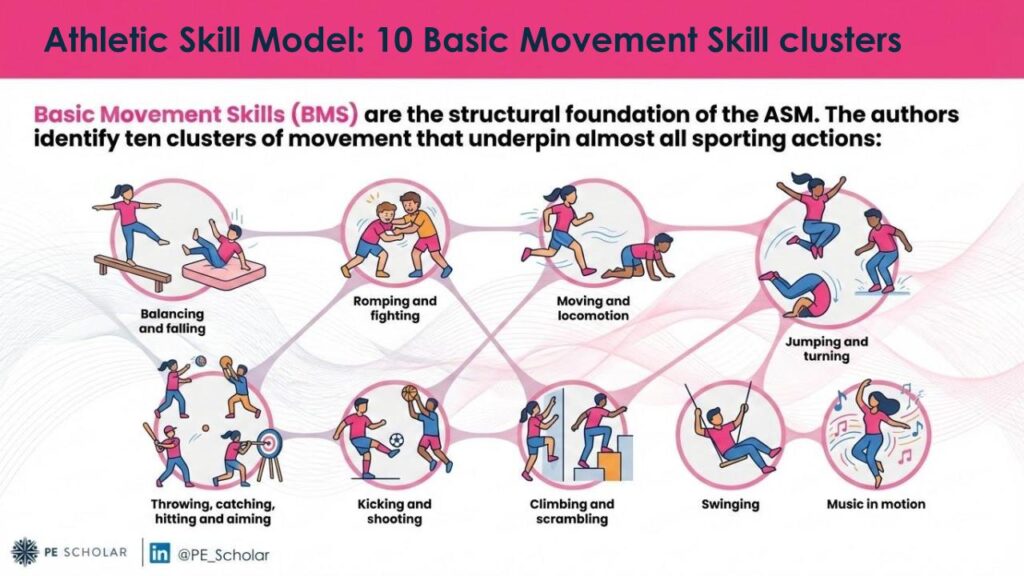
The taxonomy is broad and deliberately inclusive. For teachers, this could encourage a shift from teaching sports in isolation to ensuring that pupils repeatedly experience these ten movement categories across key stages. It also invites a reconsideration of what “progress” looks like: not perfect technical execution, but the development of adaptable, transferable movement foundations (see blog about moderate competence).
The chapter explains that BMS emerge through play, exploration and exposure. Motor milestones are presented not as strict targets, but as typical developmental pathways. Movement opportunities during early childhood such as climbing, rolling, crawling and balancing are shown to influence neural development as much as physical competence. This connection between movement and brain development underlines the educational significance of early-years and primary PE.
The ASM introduces the concentric model, illustrating how each BMS connects to related forms of movement in both donor and target sports. Novak Djokovic’s early skiing, for instance, enhanced his balance and agility, later strengthening his tennis footwork. The model suggests that strategic variation and not random activity supports the development of transferable capabilities.
The ASM Continuum builds on this idea by placing sports on a spectrum from sport-specific to sport-supporting. For teachers, this continuum may help to conceptualise how diverse activities such as climbing, gymnastics or dance can play a legitimate role in preparing pupils for a variety of movement contexts. The book summarises this with the phrase: “A good mover becomes an all-round athlete. The all-round athlete becomes a specialist.”
The chapter concludes with practical examples of how BMS can be integrated into short training or lesson segments, ensuring that movement variety is embedded systematically rather than occasionally.
Chapter 6 – Building Block 2: Coordinative Abilities
Coordinative Abilities (CA) form the second building block, representing the control and organisation of movement. The ASM identifies eight key abilities:
- adaptability
- balance
- falling ability
- coupling
- kinetic differentiation
- spatial orientation
- reaction ability
- rhythmic ability
The chapter stresses that coordination develops rapidly between ages 6 and 13, representing a sensitive window for learning. Many teachers will recognise this: pupils in these years often show rapid improvements in agility, accuracy and spatial awareness when provided with varied task constraints.
Adaptability, described as the capacity to adjust movement under changing conditions, is presented as central. Variation, rather than repetition, is the primary method for cultivating adaptability. This has immediate relevance for PE lessons, where invasion games, uneven surfaces, modified equipment and unstructured play can act as natural variability sources.
Balance receives detailed attention, subdivided into supporting, gliding, rolling, rotational and air balance. Each is trainable through specific movement contexts. Activities such as gymnastics, ice skating, parkour or slacklining are all referenced as valuable environments for developing balance. The focus on balance as a dynamic, multi-contextual ability aligns well with curriculum models that incorporate aesthetic activities alongside games.
Falling ability is framed as both protective and liberating. When children know how to fall safely, they are less fearful and more willing to take risks. This is an important consideration for building confidence in PE and movement more generally.
Coupling ability, the synchronisation of limbs and trunk, is seen in actions ranging from throwing to jumping. Examples from Johan Cruijff and Kobe Bryant illustrate how early diverse sport experiences strengthen coupling. Encouraging multi-limb coordination in younger years could therefore support later skill refinement.
Kinetic differentiation, the fine-tuning of force and timing, often develops through play with objects, tools or varied loads. This links naturally to striking and throwing games frequently taught in primary PE.
Spatial orientation and reaction ability are highlighted as key traits for team sports. The authors note that fatigue affects reaction quality which is a useful reminder for teachers planning game-based activities.
Rhythmic ability bridges the physical and cognitive aspects of movement. The book makes a compelling argument for integrating music, dance and rhythm-based tasks; not as optional enrichment but as essential components of motor development. Many PE curricula already incorporate dance, and this chapter offers a strong developmental justification for that inclusion.
Overall, Chapter 6 presents coordination as a network of interdependent abilities rather than isolated skills. The message that movement intelligence thrives on varied, playful experiences could be highly relevant for schools aiming to build broad, meaningful physical literacy.
Chapter 7 – Building Block 3: Conditions of Movement
The third building block, Conditions of Movement (COM), comprises five physical performance qualities:
- agility
- stability
- flexibility
- power
- endurance
These qualities draw on BMS and CA, with their emphasis shifting as children grow. Before peak height velocity (APHV), training naturally intertwines these conditions with basic movement and coordination. After APHV, pupils can increasingly handle structured, targeted training.
Agility is described as the ability to change direction or speed with efficiency and responsiveness. It emerges from the interaction of coordination, perceptual skills and physical qualities such as strength and speed. The ASM discourages excessive technical instruction in favour of varied, playful movement contexts. Barefoot play is highlighted for its contribution to proprioception and foot strength. This is something that could influence how schools think about appropriate footwear for certain activities.
Stability encompasses posture, core control and the ability to maintain equilibrium under both static and dynamic conditions. The Athletic Stance (AS) is introduced as a fundamental position for many sports. Teachers may find it a useful reference when helping pupils understand alignment and readiness. Importantly, stability training is shown to benefit from variability; trampolines, uneven surfaces and moving platforms can all challenge the body in productive ways when used thoughtfully.
Flexibility is treated not as an isolated quality but as part of functional movement. It is influenced by age, sex and developmental stage. The book discourages extensive static stretching before activity, instead advocating dynamic mobilisation and integrated strength–mobility exercises. For schools where stretching routines can sometimes become ritualistic, this may prompt reconsideration.
Power is framed as the coordinated expression of force. The chapter emphasises that power must sit on a foundation of stability and good movement patterns. Appropriate exercises include jumps, throws and accelerations, introduced progressively and matched to developmental readiness.
Strength is presented as a safe and important component of youth development when delivered appropriately. The authors emphasise that children can perform strength training, provided it focuses on motor control, technique, variety and supervision. High-load maximal lifting is discouraged for young athletes. This balanced perspective supports what many schools already practise under the banner of functional strength.
Plyometrics enhance reactive ability through exploiting the stretch–shortening cycle. The book outlines clear safety considerations, stressing movement quality over volume. Teachers may recognise elements of this in skipping, bounding and rebounding tasks already embedded in curricula.
Endurance, often associated with continuous running, is reframed as a product of coordination and movement economy as much as cardiovascular capacity. The chapter highlights that children naturally develop aerobic capacity through play, but structured high-intensity anaerobic training is more effective after APHV.
Recovery rounds out the discussion, reminding educators that adaptation requires rest, sleep, hydration and careful management of training load. This aligns with whole-school approaches to wellbeing.
Overall Reflection
Across its chapters, The Athletic Skills Model offers a comprehensive and theoretically grounded perspective on movement development. For teachers, the value lies not in adopting the model wholesale, but in drawing on ideas that could enrich curriculum design, pedagogy and assessment. The emphasis on variation, playful exploration and developmental sensitivity aligns with many contemporary aims of PE: to develop confident, skilful movers who enjoy physical activity and have the capacity to participate for life.
The ASM challenges educators to reconsider how lessons are structured, how skills are sequenced and how movement breadth supports long-term learning. While written partly for coaches in elite settings, this book provides numerous insights that could inform school practice. Whether applied directly or simply used to stimulate reflection, the ASM offers a compelling lens for rethinking Physical Education in ways that place the learner and their long-term development at the centre.
Further Reading – Final Chapters.
The final chapters of the book look at the ASM in practice and present case studies where the model has been implemented (both programmes at Ajax FC). The chapters offer some practical advice and movements that are incorporated within the model that develop the Basic Movement Skills (BMS), Coordinative Abilities (CA), and Conditions of Movement (COM). Readers of the book would be better served reading these chapters themselves as a concise review may have been interpreted as a “check list” – this is something I am keen to avoid.
I am not an expert in the ASM, but digesting the context of these chapters as written by the authors would help PE leaders understand how the model might contribute towards high quality provision in their settings.
Responses