



The government’s Curriculum and Assessment Review, led by Professor Becky Francis, has published its Final Report with recommendations for reforms across England’s education system from Key Stage 1 (KS1) to age 19. This culminates a body of work that was commissioned in July 2024, produced an interim report in March 2025 and now signals the start of an exciting time of curriculum evolution that we look forward to contributing towards and helping schools interpret ready for full implementation from September 2028.
The headlines followed by our early reflections on the specific impact on physical education are as follows and we hope to have more to share in the coming months, to include a keynote session at our National Head of PE Conference on 5th February and a Member’s Monthly Meet Up on Wednesday 4th February at 4pm (link already provided in weekly newsletter).
The review aims to achieve “high standards for all” by addressing barriers in the current system, particularly for students from disadvantaged backgrounds and those with SEND as “the socio-economic gap in relation to educational attainment remains stubbornly wide, and young people with special educational needs and disabilities (SEND) make less progress than their peers”. This reinforces what we are seeing in the new Ofsted Inspection Framework (see our summary and access our course here).
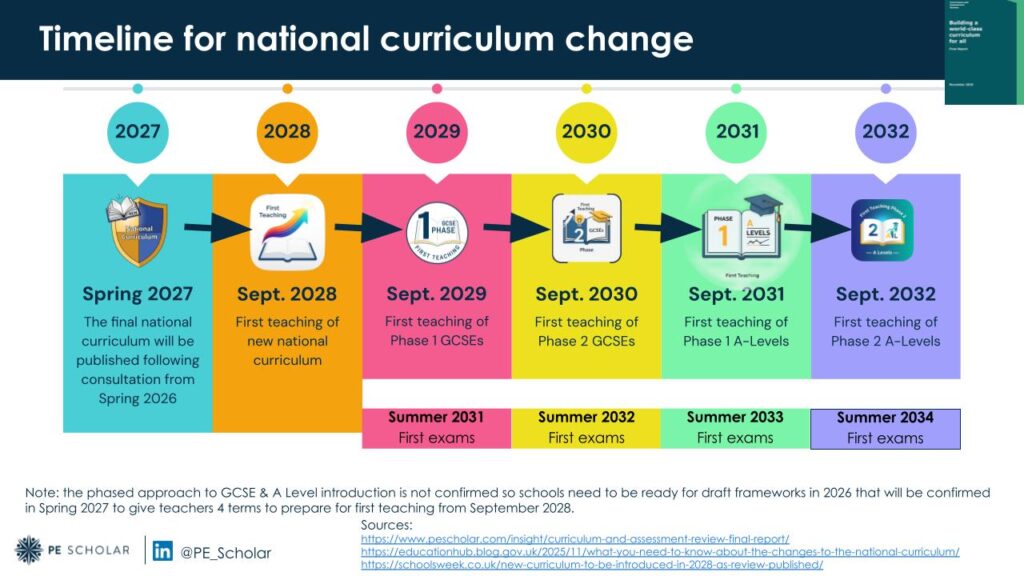
The overall approach is one of “evolution, not revolution”. The plan is for the new curriculum to be officially published by Spring 2027 and implemented for first teaching from September 2028.
Key System-Wide and Accountability Changes
- Oracy focus: introduce an oracy framework to support practice and complement existing Reading and Writing frameworks
- Knowledge-rich and skills focused: retain the knowledge-rich approach and ensure skills are developed in a way that is appropriate for each subject.
- Curriculum coherence: careful consideration of vertical core concepts and horizontal coherence for subjects to prioritise.
- Scrapping the EBacc: The Review recommends removing the English Baccalaureate (EBacc) performance measure and its associated headline accountability measures. This is intended to stop restricting subject choice and recognise the value of other subjects like the arts.
- Reforming Progress 8: The report recommends retaining the structure of Progress 8, but renaming the “EBacc bucket” to “Academic Breadth”.
- Reducing Exam Volume: The Review calls for a reduction in overall GCSE exam time by at least 10% (saving about three hours per student) and a design principle to prioritise the volume of assessment.
- Year 8 Diagnostic Tests: Introduce diagnostic tests in Maths and English in Year 8 to help teachers identify and address knowledge gaps early in Key Stage 3. These tests are intended as a tool for teachers and should not be used as performance measures to judge schools.
- More extensive changes to 16-19 qualifications: Whilst A Levels provide a successful routeway into university and T Levels have introduced a new technical route, these options are not appropriate for all students so a new pathway of V Levels has been recommended.
- Enrichment benchmarks: “Whilst the national curriculum will retain its “ambitious entitlement for all, schools must have space to go beyond it to provide innovative practice, locally tailored content, and enrichment activities that help to ensure young people thrive in education and later life”.
- Improved transition: maintaining the momentum into Key Stage 3 to enable success at Key Stage 4, especially critical in Maths and English.
- Digital Curriculum: The new national curriculum will be digital to help teachers with sequencing their curriculum and seeing links between phases and subjects.
Subject-Specific Reforms
- English & Literacy: Review primary Grammar, Punctuation and Spelling (GPS) content and testing to focus more on writing application and composition rather than purely theoretical grammar constructs. The current GPS test should be replaced with an amended test.
- Citizenship: Introduce a statutory measure for Citizenship classes at primary school. This curriculum should include elements of financial and media literacy (e.g. how to spot fake news and misinformation), as well as law and democracy.
- Science: Introduce an entitlement for any student to take Triple Science (separate Biology, Chemistry, and Physics GCSEs). The curriculum content, particularly at GCSE, should be streamlined to focus on fundamental scientific concepts and must explicitly include climate change and sustainability.
- Computing: Replace the current GCSE Computer Science with a broader GCSE in Computing that covers digital technology and the application of data, including the use of Artificial Intelligence (AI).
- Religious Education (RE): RE should eventually be moved into the national curriculum. The DfE should invite a task and finish group, independent of faith/secular interests, to co-create a draft curriculum. The statutory requirement for RE study in school sixth forms should be removed.
- Diversity in Content: Update Programmes of Study to include stronger representation of the diversity of modern society to allow more children to see themselves reflected in the curriculum.
16-19 Education and Progression
- New Level 3 Pathway: Introduce a revised third pathway at Level 3, based on new V-Levels, to sit alongside A-Levels (academic) and T-Levels (technical). This is intended to support a broader or mixed level 3 pathway for a wider cohort of learners.
- Level 1 and 2 Pathways: Introduce two separate pathways at Level 2 (an occupational pathway and a pathway to Level 3).
- Oracy and Life Skills: Publish a new oracy framework to help young people become more confident and effective speakers. The overall vision is for young people to leave school equipped with essential knowledge and skills for life and work.
Source: https://www.gov.uk/government/groups/curriculum-and-assessment-review
For Physical Education (PE), the report highlights the subject’s importance, current challenges and proposes several reforms to enhance its quality, clarity and inclusivity.
Physical Education (PE) in the Curriculum Review
Status and Importance
- Status: PE is a statutory foundation subject for all pupils from Key Stage 1 (KS1) to Key Stage 4 (KS4).
- Value: Regular physical activity is associated with improved learning, attainment and better mental health, contributing to cardiovascular fitness and healthy weight. A secure grounding in PE helps develop the skills and confidence necessary for children to be physically active, which reduces the risk of long-term health issues. Schools are strongly encouraged to deliver a minimum of 2 hours of PE per week.
- Examination uptake: PE must be taught to all at Key Stage 4 but some will also choose to take a qualification in it. Take-up of GCSE PE was 19% in 2009/10 and 11% in 2024/25 whilst Sports Studies was 7% in 2015/16 and 11% in 2024/25. A Level PE entries made up 3% of all A Level entries in 2009/10 and 2% in 2023/24.
Challenges and Current Issues
- Teaching Time and Quality: While schools are encouraged to provide a minimum of two hours of PE per week, evidence suggests this often drops off as students enter Key Stage 4. PE provision is inconsistent in quality nationally.
- Curriculum Ambition: Ofsted found that the PE curriculum in many schools does not match the ambition of the national curriculum and activities like dance or outdoor adventurous activities are either taught poorly or not at all.
- Focus on Competition: The current purpose of study is criticised for having too much emphasis on competitive sport, which may be limiting participation for some students, making England an international outlier.
- Theoretical Shift: The GCSE PE qualification is sometimes prioritised over non-examined compulsory PE, leading to concerns that teaching time is diverted away from physical activity toward theoretical content (e.g. anatomy and physiology) to better prepare students for the exam.
- Inclusivity and SEND: Students with Special Educational Needs and Disabilities (SEND) are under-represented in PE qualification uptake. The current GCSE PE activity list is seen as restricting opportunities for students with disabilities, with only eight “specialist” activities out of 58.
Key Recommendations for PE
The review makes the following recommendations for Physical Education:
- Redraft the Purpose of Study: The purpose of compulsory PE should be redrafted to reflect its role in pupils’ holistic development and emphasise its physical, social, cognitive and emotional benefits, while retaining the importance of competitive sports.
- Clarity and Structure: The aims of PE should be redrafted to be clearer and more coherent at each key stage. A precise, scaffolded approach to the content and attainment targets should be introduced in the Programmes of Study.
- Renaming the Qualification: GCSE PE should be renamed (e.g. to GCSE Sports Science or GCSE Sports Studies) to clearly distinguish it from mandatory core PE, ensuring that the mandatory curriculum focuses primarily on physical activity.
- Inclusivity Review: The GCSE PE activity list should be reviewed to make it more inclusive for all students, particularly those with SEND.
- Specific Activity Review: The guidance within the Programmes of Study should be reviewed for specific activities such as dance, swimming and outdoor activity, ensuring they are sufficiently specific to support quality teaching.
Specifics on Dance
- Curriculum Content: Dance is a statutory part of the PE Programmes of Study from KS1 to KS4. It is frequently criticised for being poorly taught or not taught to all pupils and the lack of detail in the PE Programme of Study hinders the development of a clear Dance curriculum.
- Qualifications: GCSE Dance is considered to have too much emphasis on theoretical content and written evidence and insufficient focus on practical performance.
- Recommendations: The review recommends:
- Reviewing how the PE Programmes of Study refer to Dance to ensure sufficient specificity to support high-quality teaching and progression.
- Reviewing the subject content and assessment methods for GCSE Dance to better reflect it as a creative discipline and ensure the qualification is inclusive.
You may also be interested in the DfE’s own response to the CAR which can be found here. It highlights the importance of Physical Education (PE) for holistic development and sets out key steps to strengthen its provision:
- New Core Enrichment Entitlement
The government is setting out a new core enrichment entitlement to ensure all children have equitable access to activities that complement the academic curriculum, with sport and physical activity being one of the key categories. This is intended to give students more time for activities like sport, plays and work experience alongside core subjects.
- Addressing Curriculum Squeeze
The government recognises that high-stakes exams and existing accountability measures (like the EBacc, which is now to be ended) have sometimes “severely squeezed” the time available for mandatory, non-assessed subjects like PE, Citizenship and RSE. The reforms aim to reduce exam burdens and course content in subjects like History and Science to give pupils more time for these non-assessed mandatory subjects.
- Clarifying Ambitions and Standards
- High-Quality PE is Vital: The government is a strong advocate for the benefits of PE, noting it develops character, resilience, leadership and teamworking skills, and is vital for providing fundamental practical knowledge and skills needed for a healthy lifestyle.
- Encouraging 2 Hours per Week: The government encourages schools to deliver a minimum of 2 hours of high-quality PE per week during curriculum time and ensure equality of access to PE and extra-curricular school sport.
- Alignment with National Strategy: This aligns with the ambition set out in the School Sport and Activity Action Plan (SSAAP), which aims to ensure every child meets the Chief Medical Officers’ recommended guidelines of 60 minutes of moderate to vigorous physical activity a day.
- Curriculum Design and Future Focus
- Knowledge and Competence: The ambition for the PE curriculum is to inspire all pupils to succeed, become physically confident and be taught safe, efficient and intelligent movement. The curriculum should clearly define the knowledge needed to “get better” at the subject, categorised into areas like motor competence, rules/strategies/tactics and healthy participation.
- Inclusivity and SEND: Schools are reminded that their PE curriculum must match the breadth and ambition of the national curriculum for all pupils, including careful sequencing of Dance and Outdoor Adventurous Activities (OAA) and effective support for pupils with SEND.
The government’s response supports the intent of making PE a valued and accessible subject by freeing up timetable space and setting a specific enrichment entitlement.
Reflections from the team at PE Scholar
We know that the government intends on confirming its team of curriculum drafters who will be involved in writing the next iteration of the national curriculum for physical education (NCPE) later this month and we hope to play our part in contributing to this process over the next 18 months as a community and, importantly, extending the opportunity to comment and contribute to our network. In the meantime, if you are an experienced teacher, examiner or moderator of examination PE/sport at level 2 or 3 then please consider this opportunity.
“The release of the Curriculum and Assessment Review marks the first comprehensive analysis of how Physical Education (PE) and Dance might be reformed to meet the needs of all learners in contemporary education. The Review identifies significant issues in the quality and inclusivity of PE provision, a decline in engagement at Key Stage 4 and the underrepresentation of dance and other non-competitive activities. It calls for a clearer purpose, more coherent progression across key stages and a stronger focus on the holistic benefits of physical activity. I am particularly delighted to see the emphasis on inclusion and holistic development which is perfectly aligned with the progress we have made in recent years within the field of physical literacy informed physical education. As such the concept of physical literacy provides a valuable framework for supporting curriculum reform. By emphasising the development of motivation, confidence, physical competence and understanding to participate in movement throughout life, physical literacy can underpin a more inclusive, balanced, holistic and engaging curriculum for both PE and Dance. The next phase of curriculum design for PE and Dance is crucial in the creation of a curriculum that truly meets the needs of young people and helps them to nurture a positive and meaningful relationship with movement and physical activity. An exciting next chapter on the horizon for PE and Dance” (Professor Liz Durden-Myers)
“I welcome the changes afoot for Physical Education and more broadly in what has been recommended in the CAR Report. I feel many schools have already started to evolve their core PE curriculum to be more fit for purpose for today’s children and a new national curriculum will make this a reality for all children in all schools. With so many schools failing to offer 2 hours of core PE for all pupils in all key stages I am keen to see this become more than a “strong encouragement” and wonder if we need to go further in terms of an intervention in supporting our most in need children towards meeting the CMO guidelines? Perhaps the new enrichment benchmarks will help with this. Since my first visit to DfE offices a little over a decade ago, I have been championing the need to change the name of GCSE PE as the current qualification is far more of a reflection of sports science or even performance sport which is misaligned to the outcomes we want for all children from core PE. Changes to the activity list and broader NEA elements of qualifications in our subject need to be carefully considered to be robust, inclusive, varied enough to meet the needs and motivations of our diverse learners and mindful of teacher workload. I would love to see less of a complex landscape of level 2 and 3 qualifications from different awarding organisations that all have their individual strengths but ultimately leave many secondary PE leads confused, overwhelmed and continually chopping and changing to try to find a better fit for their cohorts.” (Will Swaithes)
[…] major barriers inhibiting curriculum reform identified by the practitioners were time and facilities. This barrier was particularly prevalent […]