



The release of the Curriculum and Assessment Review marks the first comprehensive analysis of how Physical Education (PE) and Dance might be reformed to meet the needs of all learners in contemporary education. The Review identifies significant issues in the quality and inclusivity of PE provision, a decline in engagement at Key Stage 4, and the underrepresentation of dance and other non-competitive activities. It calls for a clearer purpose, more coherent progression across key stages, and a stronger focus on the holistic benefits of physical activity.
Within this context, the concept of physical literacy provides a valuable framework for reform. By emphasising the development of motivation, confidence, physical competence, and understanding to participate in movement throughout life, physical literacy can underpin a more inclusive, balanced, holistic and engaging curriculum for both PE and Dance.
What is Physical Literacy?
Physical literacy is more than just physical competence, it’s about developing the motivation, confidence, physical competence, knowledge, and understanding to value and take responsibility for engaging in physical activities for life (IPLA, 2017).
Similarly, the Sport England consensus statement (Sport England, 2023) describes physical literacy “as our relationship with movement and physical activity”.
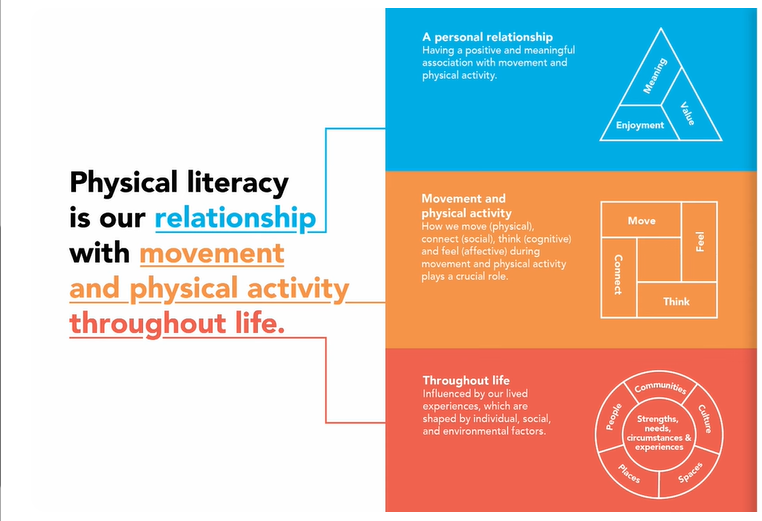
Physical literacy aligns closely with the holistic development that the Review calls for, including an emphasis on growth and development across the physical, social, cognitive, and emotional domains of learning.
How could Physical Literacy support reforms in PE
| Issue Identified in the Review | How Physical Literacy Addresses or Supports It |
| Too much focus on competitive sport | Physical literacy promotes inclusive, lifelong engagement rather than competition-only participation. It values all forms of movement (e.g., dance, outdoor activity) equally, which could rebalance the range of activities offered within PE towards a more balanced curriculum offer. |
| Declining engagement at Key Stage 4 | By nurturing motivation and confidence through meaningful, enjoyable activities, physical literacy helps sustain participation as students age, not just those who excel at competitive sport. Physical literacy also helps to elevate the importance of movement and physical activity as an essential part of holistic wellbeing and flourishing. |
| Variation in PE quality and lack of clarity in aims | Physical literacy could form the underpinning framework of the new curriculum providing teachers with a coherent developmental holistic and evidence informed framework. Incorporating holistic development and progression across the domains of learning from KS1–4. |
| Non-specialist teachers lacking confidence | Training and professional development through a physical literacy lens emphasising teaching physical education for holistic development and engagement, not just technical skill, will help to de-couple PE as synonymous with sport and empower non-specialists to deliver high-quality PE. |
| Low inclusivity (e.g., SEND participation) | Physical literacy is inherently inclusive, it recognises diverse movement and physical activity journeys and focuses on individual improvement and meaningful participation rather than performance or social comparison. |
| Disconnect between theory and practice in GCSE PE | A renaming of the GCSE PE to GCSE Sport Science or Sport Studies is a welcomed suggestion allowing for a clear distinction between developing sustained engagement and participation and a relationship with movement and physical activity (physical literacy) and the study of sport, movement, anatomy… as a theoretical discipline. |
How could Physical Literacy Support Reforms in Dance
| Dance Reform Area | How Physical Literacy Supports It |
| Dance underrepresented and poorly taught in PE | Physical literacy reframes dance as a fundamental movement form, developing body awareness, rhythm, balance, expression, and collaboration. This raises its profile within PE. |
| Lack of teacher confidence | A physical literacy informed approach emphasises teaching movement meaningfully, not technical perfection, or minutes of MVPA. Instead it supports teachers to engage students creatively and inclusively in meaningful opportunities to develop their relationship with movement and physical activity. |
| Need for progression and clarity in KS1–3 | Physical literacy offers a developmental framework, from simple movement exploration to expressive choreography providing the scaffolding missing from current programmes. It can also support the holistic development of pupils across all learning domains. |
| Low GCSE Dance take-up due to perceived theory-heavy content | Physical literacy highlights learning through doing, it would encourage assessment reform to reflect practical creativity, expression, and understanding through movement. |
| Limited access and equity | Because physical literacy values all forms of movement equally, it would legitimise dance as a core component of being physically educated, not an optional “extra” for certain groups. |
How Physical Literacy Could Be Embedded into the Proposed Reforms
To support and enhance the Review’s recommendations, physical literacy could underpin:
- The revised “Purpose of Study” for PE
Include language about developing confidence, motivation, physical competence, and understanding to participate in physical activity for life. - Scaffolded Key Stage Aims
Use physical literacy as a framework to specify what developing “competence” and “confidence” look like from KS1–4, in different contexts (e.g., dance, games, outdoor activities, swimming). - Inclusive Curriculum Design
Adopt physical literacy’s core principle of every child moving meaningfully (for them) to ensure inclusivity for SEND and all pupils. - Teacher Professional Development
Frame PE teacher training and professional development around fostering motivation and enjoyment of movement as well as skill acquisition, empowering non-specialists to teach PE including a range of activities. - Assessment
Develop formative assessment tools that capture and reflect on growth across the cognitive, social, physical and emotional domains of learning, to better align with the holistic intent of the reforms.
Physical Literacy as the Conceptual Foundation
Physical literacy provides the unifying philosophy that connects the Review’s ambitions for PE and Dance, balancing competition with inclusivity, physical competence with creativity, and skill with motivation.
If the Government were to use physical literacy as the guiding principle for rewriting the purpose, aims, and progression of PE and Dance, it would:
- Support lifelong engagement in physical activity.
- Encourage inclusivity and equity across all groups.
- Bridge the gap between PE and Performing Arts.
- Enhance teacher confidence and curriculum coherence.
- Reflect on international best practice (OECD and UNESCO both promote physical literacy as a core goal of modern PE).
Conclusion
Physical literacy provides a unifying framework for the proposed reforms to Physical Education (PE) and Dance by promoting a holistic view of physical development that integrates physical, social, cognitive, and emotional domains of learning. Grounded in the development of confidence, motivation, competence, and understanding to engage in movement for life, physical literacy directly supports the Review’s ambition to broaden the purpose of PE beyond competitive sport.
Embedding physical literacy into the revised Programmes of Study would ensure that all pupils experience meaningful, inclusive, and progressive opportunities, where activities such as dance, swimming, and outdoor pursuits are valued equally alongside other activity areas and sport.
It would also strengthen teacher confidence, enhance curriculum coherence across key stages, aid smooth transitions between stages and phases, and promote sustained participation by making physical activity personally relevant and rewarding. In this way, physical literacy offers the conceptual and pedagogical foundation needed to achieve the Review’s goals of improving quality, equity, and lifelong engagement in physical activity.
[…] To read more about how physical literacy could inform the future PE and Dance curriculum please clic…. […]