


Introduction
Dr Josie Perry is a chartered sport psychologist and the Director of Performance in Mind, as well as the author of six books. Josie’s professional journey highlights the significance of inclusivity, as she observes that athletes often lack an identity as such if they had negative school experiences, particularly when school sport focused entirely on team games. Josie emphasises that incorporating more varied activities in physical education (PE) helps individuals maintain an identity as someone who can be active and moving.
Neurodiversity and Athletic Performance
Josie was motivated to write her book, ADHD in Sport, after noticing that many athletes exhibiting high levels of performance anxiety and emotional dysregulation also showed ADHD traits. She noted that perfectionism is likely linked to ADHD. Neurodiversity was not part of her training 12 years ago, highlighting a gap that the book aims to fill.
For children with ADHD, physical activity is incredibly helpful as it can provide missing dopamine, aid focus, improve cognitive abilities and assist with emotional regulation. While physical activity is beneficial, Josie notes there is little research on overcoming specific barriers ADHD brings to sport. However, ADHD strengths, such as the ability to see patterns, hyperfocus, creativity and having a “speedy brain,” can actually contribute to success in sport. This potential is critical, especially since children with ADHD often experience severely impacted self-esteem due to constant reprimands (a child with ADHD is likely to have been told off 20,000 more times by age 10 than neurotypical peers).
Tailoring Motivation and Practice
Josie explains that motivation differs greatly across neurotypes, necessitating adaptable teaching styles:
- Autistic children are motivated by safety, thriving on routines and comfort, and needing detailed information about any planned changes.
- Neurotypical children are often motivated by importance and consequence (e.g. training intensely to beat a rival team).
- ADHD athletes are motivated by challenge and novelty; if an activity is boring, engagement will drop. This can be difficult in repetitive sports like swimming, although Adam Peaty bucks that rule.
To address the tension between students who need novelty and those who need routine, Josie suggests providing ample information beforehand (e.g. sending out a quiz about the upcoming session in the morning). Practical strategies include offering demonstrations, using peer buddies to aid focus and involving students in setting up equipment. For emotional regulation, some coaches use “coin therapy,” where individuals budget 100 daily energy coins to manage activities and prevent burnout from hyperfocus.
Focusing on Inputs and Identity
Josie stresses the importance of fostering positive self-talk, which can be difficult due to the “incredibly loud brain” often experienced with ADHD. Since logical tools are inaccessible when the threat system is triggered, Josie uses instructional self-talk (a “coach on a shoulder”) that must be simple (e.g. “drop shoulders” rather than “relax”) and externalised through simple cues written on hands, water bottles or tape. Simple imagery, like drawing a goldfish which is famous for a 2 second memory, can remind a struggling player to reset quickly.
Josie advocates moving children away from focusing on outcomes (such as winning or losing) and toward focusing on inputs (such as effort and technique). This strength-based approach ensures lifelong participation. Teachers should highlight small progressions (e.g. “your feet were together today”) and acknowledge tenacious effort.
Regarding inclusion, Josie strongly advises against letting children pick teams, as this is incredibly exclusionary and isolating for those picked last. She reminds educators that competition (rooted in the Latin competra) means “better together,” encouraging cooperation to help everyone move forward collectively.
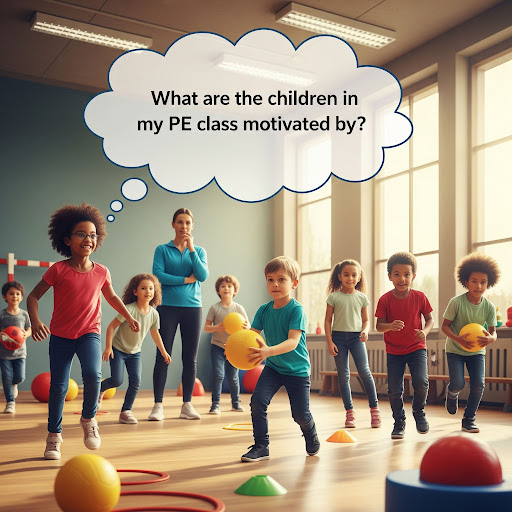
Josie encourages every listener to reflect on this question: What are the children in my class motivated by?
Conclusion
Josie asserts that physical education is vital, offering a “safe place” where movement and hyperfocus lead to praise, contrasting the typical academic environment where children with ADHD may face thousands of negative corrections by age ten.
About the Guest
This episode is a conversation with Dr Josie Perry, a chartered sport psychologist and author who specialises in working with individuals experiencing high performance anxiety, often manifested as feeling physically ill or demonstrating emotional dysregulation before competitions.
Listen
To listen to the full episode please follow these links to Spotify or Apple podcasts.

Responses