


Introduction
Physical Education (PE) is a crucial component of holistic development, promoting not only physical health but also social, emotional, and cognitive well-being. It is, therefore, vital that PE teachers ensure that all students have equitable access to participate fully and meaningfully in physical activities. By embracing inclusion, teachers can foster a sense of belonging, respect, and empathy among students while also cultivating the motivation and confidence for continued participation in physical activity.
Effective inclusive practices benefit all children, irrespective of their diverse characteristics. This includes addressing the needs of students with Special Educational Needs (SEN) so that their physical development, social skills, and overall well-being is nurtured. During 2022-23, 17.3% of students in education were receiving some form of Special Educational Needs (SEN) support (Gov.uk, 2023) and the majority of these were likely to be neurodivergent. This means that nearly one fifth of a typical PE class require tailored approaches in lessons.
The Equality Act 2010 and SEN code of practice ensure that reasonable adjustments to address potential difficulties and remove barriers for these students is a legal requirement. This can feel daunting for many PE teachers, but with a better understanding of the variety of learning needs neurodivergence encompasses, you can readily incorporate strategies into your lesson planning and delivery that will not only empower these students to participate fully but will ensure that all learning differences are attended to so that all students can experience success.
Today’s insight is the first in a series on neurodiversity in celebration of Neurodiversity Week. We will explain what this term means, how neurodivergence sits within this model of inclusion, and the range of learning differences that are considered neurodivergent. Preparing for difference will not only reduce stress and workload but is guaranteed to make your lessons more varied, engaging and supportive for all.
What does neurodiversity mean?
The term neurodiversity was initially embraced by the autistic community to combat the notion of autism being a deficit, and instead promote its valuable contribution to human diversity. Now, it is an empowering concept adopted by many to recognise that neurological differences are part of the rich and natural variations of the human mind and that those who experience the world differently are to be equally respected.
Neurodivergence
Neurodiversity is an encompassing term for neurotypical and neurodivergent minds. Neurotypical represents ‘typical’ development of the human brain and neurodivergence represents those whose cognitive functioning diverges from society’s standards of ‘normal’ (Lees, n.d.). Neurodivergence includes autism and ADHD, Specific Learning Differences/Difficulties (SpLD), Tourette’s, epilepsy as well as those with mental health conditions and acquired brain injury.
Specific learning differences/difficulties (SpLD)
Specific learning difficulties affect various aspects of learning and include a range of conditions such as dyslexia, dyscalculia and dyspraxia/Development Coordination Disorder (DCD) (SEN Code of Practice). These represent differences in the way information is learned and processed, and can affect coordination, organisation, information processing, memory, and communication. These differences might vary in combination and significance and are not always apparent to the observer, but have lifelong impact (DfE, n.d.).
The importance of adopting a neurodiversity approach to physical education
Despite growing acceptance of more holistic approaches in physical education that celebrate the unique capabilities of each student in PE lessons, an ableist attitude often prevails (Pushkarenko, Howse and Gosse, 2023). Ableism inadvertently discriminates against those with disabilities, by favouring those without, usually by applying society’s dominant norms and expectations to all. These norms may result in individuals being labelled as normal or disordered, with the responsibility for the ‘disordered’ resting with other services beyond the classroom. For neurodivergent students, this discrimination may arise from being told off or being sent out of class for forgetting a series of instructions, for continuously being late to a lesson because of difficulties finding the room, or for losing focus during a long introduction by the teacher (Lees, n.d). Instead, if PE teachers adopt an inclusive and positive approach to their teaching that is aware of the neurodiversity of their class, then they are likely to avoid harming students in this way.
Adopting a neurodiversity approach ensures that PE is truly for everyone, not just a select few. We must acknowledge the wide range of neurological conditions among students and advocate for activities that accommodate varied needs. By prioritising inclusivity, educators can remove barriers to participation, allowing all children to experience the benefits of movement.
The illustration below provides an overview of the issues experienced by neurodivergent students. It is important to recognise that each student’s learning profile will be unique to them. They may face a combination of challenges as well as possess an array of unique strengths that should be leveraged to help them reach their full potential. Some students may have an Individual Education Plan (IEP) or an Education, Health and Care Plan (EHCP). In which case, your SENDCO should be able to provide specific details of needs and strategies and also talk to parents as they know their child better than anyone else. However, it is important to remember that many students may not be diagnosed, or they may have tendencies towards these conditions but do not meet the requirements for a full diagnosis. This is why a neurodiverse approach to planning and delivering PE is so important.
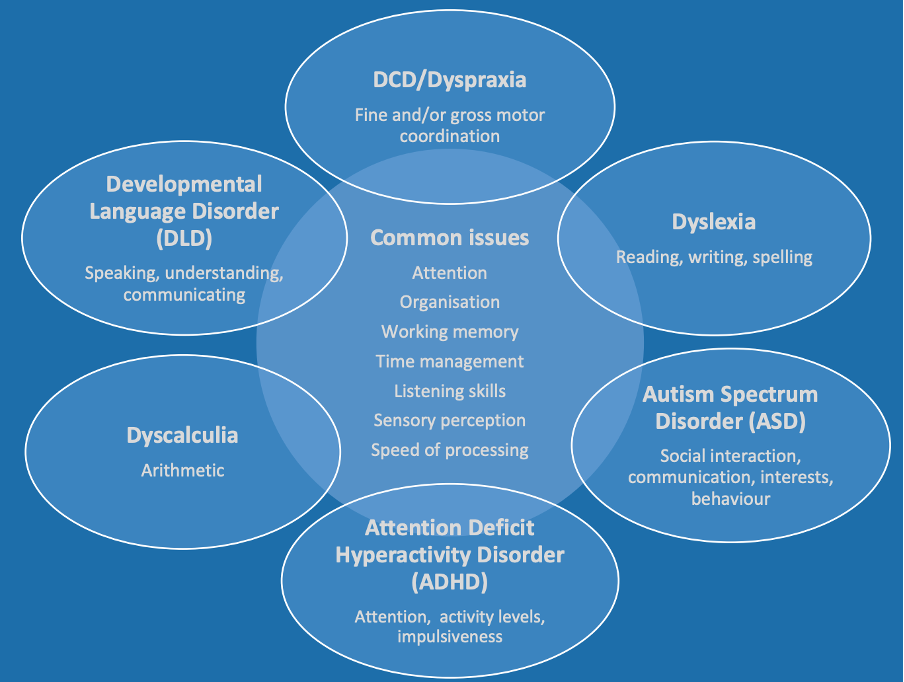
(DfE, n.d.)
The challenges in PE
Some examples of the challenges in PE that may be experienced by neurodivergent students are:
DCD/Dyspraxia: Students might struggle with coordination and motor skills, making it difficult to perform complex movements or participate in team sports.
Dyslexia: Students may have trouble following written instructions or rules, leading to confusion during games and activities.
ASD: Students might find social interactions and changes in routine challenging, affecting their ability to engage comfortably in group activities.
ADHD: Students could face difficulties with focus and impulse control, making it hard to stay on task and follow instructions.
Dyscalculia: Students may struggle with understanding and remembering sequences or scoring systems, complicating participation in games that require numerical comprehension.
DLD: Students might have trouble understanding verbal instructions and communicating effectively with peers, impacting their ability to participate fully in activities.
Conclusion
Implementing neurodiversity approaches in Physical Education (PE) is crucial for creating inclusive environments that cater to the diverse needs of all students. By embracing inclusion, PE teachers can foster a sense of belonging, respect, and empathy among students while also cultivating motivation and confidence for continued participation in physical activity. A significant number of students in any class will be neurodivergent, so it is imperative for PE teachers to understand the range of learning differences encompassed by neurodiversity and incorporate tailored strategies into lesson planning and delivery. Adhering to legal requirements outlined in the Equality Act 2010 and SEN code of practice ensures that reasonable adjustments are made to address potential difficulties and remove barriers for neurodivergent students. The key thing to remember is that, despite the labels given to these learning differences, it is vital to get to know each and every pupil so that you can teach to their unique abilities. By adopting an inclusive and positive approach to teaching that acknowledges the neurodiversity of the class, PE teachers can avoid inadvertently discriminating against neurodivergent students and create a supportive learning environment where all students can thrive.
Next in our Neurodiversity Series
Keep a look out for further insights in our neurodiversity series:
Next week’s insight will follow-up with adaptive strategies for an inclusive approach in a neurodiverse classroom.
Further insights will delve into specific strategies for Dyslexia, Dyspraxia/DCD, ADHD and Autism.
Further equality, diversity and inclusion resources and information
Here at PE Scholar, we aim to bring you expert advice, resources and research evidence on the topics that matter to PE teachers. Take a look below at a selection of items that address equality, diversity and inclusion in PE
Inspirational Sport Posters Promoting Equality, Diversity and Inclusion
‘How we talk in PE’ changing rooms poster
Wheelchair basketball student worksheets
Wheelchair rugby student worksheets
A blog post on PE Refusers – prevention is as important as the cure?
Teaching with Heart – A British Asian Perspective
Inclusive PE for SEND Children book review
Teaching Disabled Children in PE book review
Pedagogies of Social Justice book review
Female Body Bible book review
Who’s included and who’s not? An analysis of instruments that measure teachers’ attitudes towards inclusive education research paper
Understanding Girls’ Motivation to Participate in Sport: The Effects of Social Identity and Physical Self-Concept research paper
Reconceptualising Disabilities and Inclusivity for the Postdigital Era research paper
Including pupils with SEN and/or disabilities in mainstream secondary PE research paper
References
Department for Education (DfE), no date. ‘A Guide to Specific Learning Differences’ [online] Available at: https://www.patoss-dyslexia.org/write/MediaUploads/A_Guide_to_SpLD_2nd_ed.pdf Accessed: 19 March 2024)
Gov.uk, 2023. ‘Academic year 2022/23: Special educational needs in England’ [online] Available at: https://explore-education-statistics.service.gov.uk/find-statistics/special-educational-needs-in-england (Accessed: 13 March 2024)
Lees, E., no date. ‘A Beginner’s Guide to Ableism’ Available at: https://tapestry.info/wp-content/uploads/sites/2/2022/01/A-Beginners-Guide-to-Ableism-1.pdf (Accessed: 19 March 2024).
Pushkarenko, K., Howse, E. and Gosse, N., 2023. Individuals experiencing disability and the ableist physical literacy narrative: critical considerations and recommendations for practice. Frontiers in Sports and Active Living, 5.
[…] Last week’s insight introduced the concept of neurodiversity and the importance of an inclusive approach to PE teaching so that the variety of learning differences in your class are valued and supported, and all students can thrive. This week’s insight introduces the wide range of inclusive approaches that will accommodate the diverse learning needs and preferences in PE. […]
[…] previous insights in this Neurodiversity series on an introduction to neurodiversity, adaptive teaching strategies for a neurodiverse […]
[…] An introduction to neurodiversity […]