


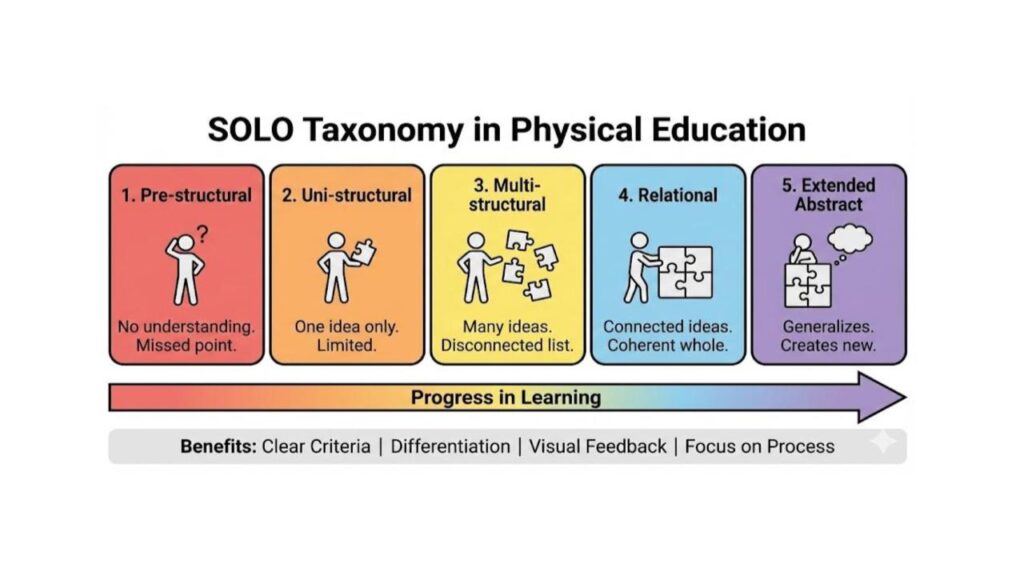
SOLO (Structure of Observed Learning Outcomes) Taxonomy is an approach that I have explored primarily through the teaching of gymnastics. In my experience, a typical gymnastics lesson often includes learners with a broad range of skill level when compared to other areas of the National Curriculum. For example, some learners may find performing basic movements such as forward and backward rolls challenging, others regularly attend gymnastics clubs and may even be at a competitive level, while many learners are somewhere in between.
The application of carefully designed differentiation strategies is therefore essential to ensure all learners are appropriately challenged, can access the content, and make progress (Haelermans, 2021). Gymnastics consistently provides opportunities to employ productive teaching styles, as well as decision-making, creativity, and independent thinking that all form an integral part of lesson content (De Las Heras-Fernández et al., 2022). Therefore, discovery-based teaching styles are particularly effective for creating lessons that promote autonomy among pupils.
However, Sloan (2007) notes that many pre-service teachers feel apprehensive about teaching gymnastics, often due to limited training and experience. This can make the subject seem daunting and managing such a wide range of abilities challenging. One strategy I have found helpful is designing tasks using the SOLO Taxonomy framework, which supports sufficient challenge and autonomy for all learners.
What is SOLO Taxonomy?
SOLO Taxonomy, introduced by Biggs and Collins (1982), provides a progressive framework for learning that promotes learners to deepen their understanding and develop higher order thinking skills (Wells, 2015).
The taxonomy outlines five stages of cognitive development: Prestructural, Unistructural, Multistructural, Relational, and Extended Abstract:
| Solo Level | Explanation | Gymnastics |
| Prestructural | The student has little understanding and needs help | I don’t know what a cartwheel is |
| Uni Structural | The student usually understands one aspect, but their understanding is limited | I have seen a cartwheel but don’t know how to do one |
| Multistructural | The student understands a few aspects but cannot connect them | I perform a basic cartwheel but may lack body tension |
| Relational | The student has a deeper level of understanding and can make a connection between the aspects | I can perform a cartwheel and link it to a sequence using rotational movements |
| Extended Abstract | The student demonstrates the ability to generalise their knowledge and apply it creatively in new contexts | I can apply a cartwheel to a routine with example from all three planes of movement |
Adapted from Hook & Richards (2013).
Learners have the autonomy to select their starting point and challenge themselves to progress through successive levels within the SOLO Taxonomy framework. This approach provides a clear and structured method of differentiation for any topic being delivered.
The example presented in the table focuses on an isolated skill; however, the framework can be applied to a wide range of tasks that address all four domains of learning, and not exclusively in the psychomotor domain that is illustrated here.
Below is an example of tasks designed to develop a routine that integrates prior work on counterbalances and rolls. The nature of these tasks combines elements of the psychomotor, cognitive, affective and social domains, promoting a holistic learning experience.
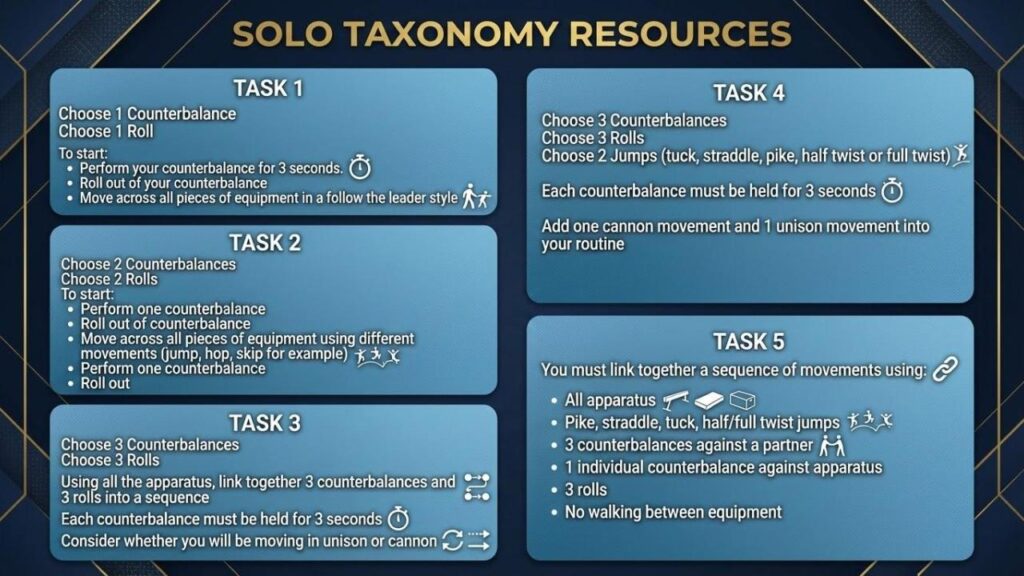
Learners are then able to either design their own form of peer assessment or use a rubric such as the one shown below which embeds the domains of learning and SOLO taxonomy.
| Domain | National Curriculum Focus | Pre-Structural | Uni-structural | Multi-structional | Relational | Extended Abstract | |
| Hands/ Doing | Develop their technique and improve their performance in other competitive sports | I recognise the basic technique but struggle to perform it in its correct form | I can perform some aspects of the correct technique but need support to do so | I can perform most skills but tend to make mistakes | I can perform a range of skills consistently in a controlled manor | I can perform a range of skills in isolation or in combination and can use these in order to gain an advantage or as part of a strategy. | |
| Head/ Thinking | Develop their technique and improve their performance in other competitive sports | I know what each activity is and am aware that individuals are trying to perform to the best of their ability | I understand that performers use a variety of different techniques to perform to their best but struggle to select the most appropriate one without support | I can select and apply the most appropriate technique to use to gain improve my performance | My technique is good, and this enables me to perform at a good level making few mistakes. I can identify mistakes I have made but am not sure how to correct them. | My technique is very good, and this enables me to perform consistently at a high level. Mistakes are few but I can evaluate how I can improve | |
| Heart/ Feeling | Develop their technique and improve their performance in other competitive sports | I understand what it means to be healthy, and I can warm up and cool down appropriately so not to injure myself. | I understand what it means to be healthy, and I can warm up and cool down appropriately so not to injure myself. | I can work effectively on my own or as part of a team performing to my best ability. I have the confidence to use the skills I have learnt in school at clubs out of school | I can work with others to develop tactics and strategies to improve my performance. I am confident in my abilities to take part in these activities competitively outside of a PE lesson | I can lead and encourage others to lead a healthy lifestyle and to develop tactics and strategies to perform to the best of their ability. | |
| Inherent National Curriculum Subject Content | Analyse their performances compared to previous ones and demonstrate improvement to achieve their personal best | Take part in competitive sports and activities outside -through community links or sports clubs | |||||
| ©The University of Lincoln | |||||||
As Ladwig (2018) highlights that learners’ experiences in Physical Education (PE) are significantly more positive when they are afforded opportunities for autonomy, SOLO Taxonomy offers a structured model that promotes autonomy within PE and has been shown to enhance pupil engagement and overall learning experiences (Jefferson et al., 2025). Tasks designed using SOLO Taxonomy can be differentiated in complexity, similar to the way Bloom’s Taxonomy is employed to challenge students’ levels of understanding and cognitive skills (Stanny, 2016).
Building on the success of implementing SOLO Taxonomy tasks, I developed a comprehensive scheme of work grounded in this framework. This scheme integrates Frapwell’s (2015) Hand, Head, Heart assessment model to ensure that all domains of learning—psychomotor, cognitive, and affective, are addressed, supporting the holistic development of the learner.
My experience with implementing SOLO Taxonomy in gymnastics has been positive, although still in its early stages. Despite this, I have observed encouraging outcomes from its application. I find SOLO Taxonomy particularly valuable for designing challenging tasks and consider it an effective strategy for engaging learners in meaningful learning.
Next Steps:
- Begin with a small-scale approach by focusing on one activity within the National Curriculum subject content.
- Review existing lesson plans to identify tasks that can be differentiated using SOLO Taxonomy.
- Develop SOLO Taxonomy task cards to support a specific activity within a lesson and incorporate exit tickets to gather feedback on the effectiveness of these tasks.
References:
- De Las Heras-Fernández, R., Cuellar-Moreno, M. J., Espada Mateos, M., & Anguita Acero, J. M. (2022). The influence of teaching styles on the emotions of university students in dance lessons according to sex. Research in Dance Education, 26(2), 182–201. https://doi.org/10.1080/14647893.2022.2144197
- Haelermans, C. (2022). The Effects of Group differentiation by students’ learning strategies. Instructional Science, 50(2), 223-250.
- Hook, P. & Richards, N. (2015) Solo Taxonomy in Physical Education. Learning through movement context. Book 1. UK, Aus, NZ. Essential Resourcing
- Jefferson, R., Sullivan, L., & Board, S. (2025). Exploring the Value of Student Autonomy in Physical Education: Two Case Studies in the UK and Australia. Journal of Physical Education, Recreation & Dance, 96(1), 43–52. https://doi.org/10.1080/07303084.2024.2418050
- Ladwig, Matthew A.; Vazou, Spyridoula; Ekkekakis, Panteleimon. “My Best Memory Is When I Was Done with It”: PE Memories Are Associated with Adult Sedentary Behavior. Translational Journal of the ACSM 3(16):p 119-129, August 15, 2018. | DOI: 10.1249/TJX.0000000000000067
- Sloan, S. (2007). An investigation into the perceived level of personal subject knowledge and competence of a group of pre-service physical education teachers towards the teaching of secondary school gymnastics. European Physical Education Review, 13(1), 57-80. https://doi.org/10.1177/1356336X07072674 (Original work published 2007)
- Stanny, C. J. (2016). Reevaluating Bloom’s Taxonomy: What Measurable Verbs Can and Cannot Say about Student Learning. Education Sciences, 6(4), 37. https://doi.org/10.3390/educsci6040037
- Wells, C. (2015). The structure of observed learning outcomes (SOLO) taxonomy model: How effective is it. Journal of Initial Teacher Inquiry, 1, 37-39.
Responses