



Introduction
In this episode of the PE Insights Podcast, Nathan talks with Will Swaithes (PE Scholar) and Catherine Fitzpatrick (Complete PE) about their recent work with the Oak National Academy PE curriculum and the new resources that they’re building. They are working to create a new PE curriculum that offers positive experiences for all pupils. Drawing from decades of combined expertise in primary and secondary education, they outline six essential curriculum design principles.
Six Key Principles of a Great PE Curriculum
1. Purpose:
The curriculum must be grounded in a clear purpose that resonates with the needs and contexts of its learners. Understanding “who” the students are is vital to shaping the “why” behind the curriculum.
2. Sequencing:
Content should be logically sequenced based on students’ prior learning and stage of development—not rigidly by year group. Continuity between primary and secondary phases is crucial for sustained progression.
3. Inclusion:
PE should be inclusive in the broadest sense—catering not just to children with SEND, but also to those with negative past experiences or lower confidence. Language, environment, and teacher flexibility all play a role.
4. Holistic Development:
High-quality PE develops more than physical skills—it nurtures cognitive, social, and emotional learning. Recognising and celebrating diverse forms of success helps children connect more deeply with movement and learning.
5. Adaptability:
A curriculum must be responsive to local contexts and flexible enough to work in diverse school settings. Teachers should be empowered to adapt resources, rather than rely on rigid scripts.
6. Tried and Tested:
Resources and strategies should be evidence-based. Both Complete PE and PE Scholar collect feedback and impact data to ensure continuous improvement and relevance in real classrooms.
Origins of the Oak National Academy PE Curriculum
Oak were a rapid response set up during COVID for home learning during COVID-19, which was quickly recognised by the DfE. As a result, PE resources were created by the Association for PE and Youth Sport Trust. However, these materials were not designed for classroom delivery after COVID. Recognising this, the team sought DfE funding to adapt them for in-school use, resulting in a new opportunity with Oak National Academy.
A Mission to Support All Schools
Will and Catherine felt a responsibility to lead this initiative, aiming to improve access to quality PE. Despite already having strong platforms (Complete PE and PE Scholar), they believed Oak’s open-access, editable resources could reach underserved schools and early career teachers lacking curriculum support.
Curriculum Design and Delivery Challenges
A major challenge was selecting what content to create under strict limits. The goal was a broad, balanced curriculum that could stand alone or supplement existing ones. A key shift was moving away from using slide decks in practical PE lessons, instead encouraging movement-focused, teacher-led delivery.
Shared Values and Holistic PE
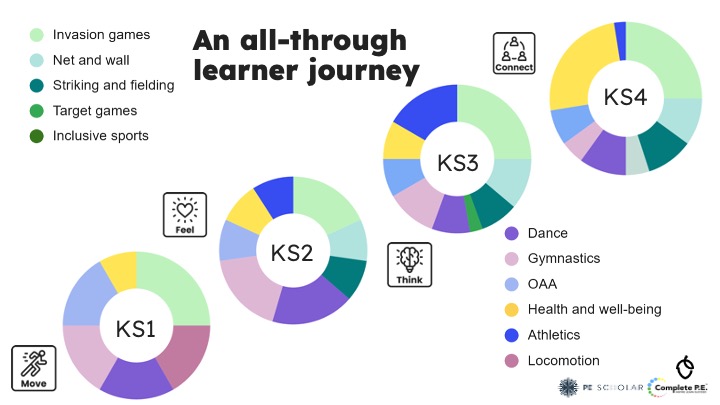
The new Oak curriculum embeds “Move, Feel, Connect” threads aligned with physical literacy. While it lacks the depth of SEN adaptations in existing platforms, it still includes accessible differentiation. The approach aims to make PE more inclusive, emotionally supportive, and aligned with National Curriculum standards.
A Stepping Stone Towards Curriculum Innovation
The conversation highlights how familiar PE models, like the sport techniques-based “multi-activity” model, can serve as accessible entry points or “mass market nudges” toward more conceptually rich and holistic curriculum designs. These frameworks encourage schools to incorporate emotional and social learning, helping teachers better understand the role of meaningful outcomes in PE
Bridging Policy and Practice Through Oak and PE Scholar
The speakers reflect on the Oak National Academy’s standardised resources and how PE Scholar’s support bridges the gap between rigid systems (like assessment frameworks) and bespoke teaching approaches. By “Oakifying” content while personalising delivery, schools can adopt consistent yet adaptable resources that are easier to implement, especially for primary generalists.
Towards Personalised and Purposeful PE
The aim is to provide schools with a flexible foundation from which to build tailored curricula. Complete PE and Oak serve as starting points, empowering educators to deepen impact through CPD, adaptive resources, and purposeful lesson design.
Key Takeaways
Iterative development, authentic feedback, and teacher engagement are essential. Less content but deeper focus (“less is more”), embedding purpose, and prioritising teacher and student well-being were emphasised as non-negotiables for high-quality PE
Looking Ahead
Will and Catherine’s shared goal is to create a meaningful, inclusive, and engaging PE journey for every child.
About the Guests
This episode is a conversation with Will Swaithes and Catherine Fitzpatrick.
Will is Education Director at PE Scholar and is an experienced teacher, teacher educator and leader of teaching and learning. With over 20 years’ experience in education, he is currently Curriculum Design Lead for Oak National Academy. Will was previously Senior Lecturer in Physical Education at Birmingham City University leading the secondary PGCE programme and continues to contribute to that programme and Initial Teacher Education at several other institutions including Loughborough and Buckingham universities.
Catherine is the Director of PE for Complete PE and is a globally recognised expert in the design and delivery of Physical Education. Since qualifying as a PE teacher in 2004, Catherine has dedicated her career to supporting teachers and wider stakeholders to deliver high quality PE. Catherine delivers courses and programs on behalf of the Youth Sport Trust (YST) as well as the Association for PE (afPE) Level 5 and Level 6 qualification to hundreds of teachers and PE leaders in different regions of the UK.
Listen and Connect
To listen to the full episode please follow these links to Spotify or Apple Podcasts.

Responses