



By Tom Butler, Head of Physical Education & Head of Pre-prep Sport and Physical Education at Summer Fields School, Oxford
My introduction to physical literacy
When I heard Margaret Whitehead explain her influential concept of Physical Literacy (PL) at a CPD event, it felt like a revelation. Suddenly, there was fresh clarity in my perspective that the purpose of PE is to prepare future generations to ‘value and take responsibility for engaging in physical activity for life’. While my interpretation of how best to aid pupils on this journey has evolved several times in the intervening years, my belief that it should be placed at the heart of any departmental vision has never waned.
The International Physical Literacy Association’s (IPLA) definition of PL is to develop:
“The motivation, confidence, physical competence, knowledge and understanding to value and take responsibility for engagement in physical activities for life” (IPLA, 2022).
This is a complex concept that we somehow need to reduce in order to help our students progress on this lifelong journey, without overwhelming them and ourselves in the process.
First forays into embedding physical literacy into practice
After my pivotal CPD experience, I spent some time playing around with the idea before landing my first role as Head of Sport and PE; an opportunity to implement my exciting, PL centred philosophy. We were off to a flying start when I presented my vision to my new team and they all nodded in agreement as I made a case for PL being the bedrock of what we would do every day. It wasn’t long until the cracks started to appear though, as my new colleagues started to ask questions with one often recurring theme.
How can we encompass such a broad range of outcomes into all our lessons?
This is a valid question. It led me to reflect on why I was so sure that PE should involve itself in issues wider than just physical development. I didn’t have to dig too deep into the literature to find supporting evidence in Richard Bailey’s (2006) research highlighting the unique potential of PE in impacting on a child’s cognitive, emotional, physical and social development. This was a notion supported by Syaukani et al. (2023) in their systematic review that reinforced the multidimensional benefits of physical education. I threw into the mix an old mentor’s analogy of filling a rucksack with the skills required to be physically active for life, supported by Bronfenbrenner’s ‘Ecological Systems Theory’ (1979) for lifelong learning.

This engaging metaphor combined with research on the benefits of PL and holistic development, provided a seemingly solid foundation to make a lasting impact on our pupils. However, questions remained. It is impossible to unpick all of them in one blog, but we can make a start by asking:
- Do we need to encompass such a broad range of outcomes in our lessons?
And, if so…
- How can we do it?
Choosing the Main Domain
To answer these questions comprehensively, I first needed to analyse each developmental domain in relation to PE. I figured the best way to elicit change and win hearts and minds among my colleagues was to bring it to life successfully in my lessons. Here, I have summarised each of the domains along with some examples of how I have encompassed them within my own practice.
Cognitive development
Cognitive development in PE highlights how students develop thinking skills, decision-making, and understanding through physical activity. It includes problem-solving during games, analysing strategies, and reflecting on performance to improve. It is well established in academic literature that cognitive development equips students with the mental tools to make informed decisions and adapt their approach to new situations in physical activity and sport (Blomqvist et al., 2005; Light, 2012; Renshaw et al., 2010).
Understanding rules, etiquette and terminology are some of my teachings in the cognitive domain when working with children from Reception to Year 6. As they move into Key Stage 3, the complexity of the expected outcomes in this domain increases as we introduce more advanced knowledge such as the impact of exercise on the body and the importance of good nutrition. The greatest areas of focus in cognitive development are problem solving, strategising and decision making, whether that be a Reception child being challenged to work out how to cross the ‘crocodile river’, or a Year 8 adapting a game in their sports leader module.
Emotional and Social development
Stronger together, in my opinion, when it comes to these two domains because social interactions often trigger emotional responses, and developing one naturally supports the other. There is plenty of crossover in these areas and, therefore, we need to create environments in which students develop empathy, resolve conflicts, and manage emotions within social contexts. By creating environments where students work together, overcome challenges, and reflect on their experiences, PE can nurture these interconnected skills, promoting personal development. You may have come across the term ‘social and emotional learning’ (SEL) within broader educational literature, and I believe that PE provides the best environment for its development, especially as so many other subjects on the curriculum are so full of content that they rarely find the time to explicitly teach and develop these essential life skills. Durlak et al. (2011) highlight the importance of SEL programs in expanding emotional regulation, resilience, and social skills, making PE an ideal setting to nurture these attributes.
I am always drawn towards emotional and social development with Reception to Year 4 children, and often for older year groups too, depending on their developmental stage. We have a largely play-based curriculum for these age groups, with games that are rich in problem-solving opportunities. The nature of games where children are immersed in competition often means that disagreements are ‘par for the course.’ Applying rules is integral to maintaining good relationships when participating in physical activity, hence the importance of looking for ways to resolve conflict. If students are to thrive in physical activities that involve teamwork or opposition, they must develop strategies to manage their emotions, build resilience, and sustain healthy relationships. Hellison (2011) emphasises that explicitly teaching personal and social responsibility in PE can help students develop these critical skills, preparing them to navigate challenges both in and beyond school life.
Developing confidence and motivation is critical, not only to enhance participation but also to foster enjoyment and a sense of achievement in physical activities. Recognising the social impact of peers on one’s engagement and performance highlights the importance of addressing the emotional and social aspects in the development of physical literacy. Garn et al. (2011) link the affective domain to student engagement in physical education, demonstrating how motivation and emotional support from peers play a key role in lifelong engagement. These skills form a foundation for lifelong participation, reinforcing the idea that holistic development is key to success in PE and beyond.
Physical development
The physical or psychomotor domain focuses on developing fundamental movement skills (FMS) and physical fitness, which are essential for physical competence and lifelong participation in activity. Gallahue and Ozmun (2011) describe FMS as the foundation for complex physical tasks, while Stodden et al. (2008) highlight their role in building movement confidence and sustaining physical activity levels throughout life. Will Swaithes, in the PE Insights podcast, describes the physical domain as PE’s ‘unique selling point’ and, therefore, each lesson should have a significant physical element. Mastery of basic physical skills, such as running, jumping, throwing, and balancing, provides the groundwork for participation in more complex sports and activities in the future.
During my experimental phase, I actually moved away from concerning myself with explicit physical outcomes for a short time. Instead focusing on creating environments that allowed for implicit development to enable the repeated practice of FMS by carefully crafting imaginative activities that were more interesting than simply repeating the skill in a linear fashion. Developing the overarm throw through the ‘Messy Bedrooms’ game, where players throw objects into the opposing team’s playing area (their ‘bedroom’), is a great example of promoting skill development. Initially, we noticed that the tennis net was not high enough to encourage the overarm action needed for success. To address this, we adapted the game by having the children throw objects over the perimeter fence. This adjustment made the overarm throw the most effective technique, and the game’s repetitive nature required the children to perform the action multiple times to ‘tidy their bedroom.’
The dynamic nature of the game also deepens learning through organic variation, as no two throws are the same. This aligns with Bernstein’s (2000) theory of the benefits of ‘repetition without repetition,’ where slight variations enhance skill development.
Creative development
We should also consider blending physical and cognitive skills to improve adaptability and innovation. Creativity in sport can be seen in the ability to outwit opponents, solve problems dynamically, and think critically under pressure.
By also acknowledging creative development as a key area of focus, we can help students develop transferable skills that extend beyond the playing field into the ‘real world.’ Csikszentmihalyi (1996) highlights how creativity enables individuals to achieve peak performance in problem-solving and adaptability, while Runco and Jaeger (2012) emphasise its role in harnessing critical thinking and resilience, essential for overcoming challenges in the ‘real world.’
Whether it’s devising new strategies in team games, improvising movements in gymnastics, or adapting to challenges in individual sports, creative thinking equips learners with the tools to approach problems from multiple angles. Incorporating activities that stimulate both physical and cognitive creativity not only enriches students’ sporting experiences but also enhances their confidence, motivation, and ability to think laterally.
A holistic approach
Brief as these summaries might be, they go some way to highlighting the unique ability that PE has to aid the holistic development of pupils. It allows students to experience cognitive, emotional, physical, and social development in a wide range of practical scenarios. Physical activities provide immediate and tangible examples of concepts like teamwork, resilience, and goal setting, making them more relatable and easier to internalise. Research supports the positive relationship between physical activity and cognitive development (Tomporowski et al., 2008), as well as exercise and academic achievement (Hillman et al., 2014). A holistic approach to PE is not only beneficial in developing habits for lifelong participation in physical activity, but this type of evidence also suggests the skills acquired have the potential to help individuals in other aspects of their life, in a dynamic way that other subjects cannot.
Time To Teach: Practical Tips For Bringing This To Life in PE
Establishing that holistic development is a worthwhile venture was the first step to a more enriching and positive PE experience for our students, but it does not answer the question of how we ensure that it is occurring in our lessons. It was clear to us all that trying to explicitly cover all of the domains in every lesson was overwhelming and counterproductive, and this led to the emergence of further quandaries.
To enable effective teaching to take place, we had to identify if all the domains should have equal weighting in their importance and how many learning outcomes we need to make explicit in any given lesson when the pressures of time and space imposed on curriculum planning means valuable physical activity time can be lost if the lesson becomes unnecessarily complex or discussion based.
The primary objective of any PE lesson must remain in the physical domain
Despite my fleeting idea that physical outcomes could be implicit, it is now clear to me that the primary objective of any PE lesson must remain in the physical domain. The impact of diminishing this could send the wrong message to other stakeholders, particularly those who are less informed on the holistic benefits of PE.
Physical development, after all, is the unique aspect of PE that distinguishes it from other subjects. Without physical skill development, it would lose its core purpose. Proficiency in movement can significantly influence the development of the other domains but they cannot be assumed or ignored. For example, developing resilience and emotional control when a physical skill doesn’t come naturally is a valuable skill in itself. Without cultivating intrinsic motivation and a desire to stay active or improve in sport X or skill Y, progress will quickly stagnate. This lack of motivation may partly explain the concerning physical activity levels highlighted in Sport England’s Active Lives Reports.
Secondary learning outcomes
Our approach to every lesson is to ensure a physical objective is always present, but in addition teachers will also set a secondary learning outcome. This outcome can be from any of the other developmental areas, depending on the specific needs of the learners. Having too many potential learning outcomes, or if they are unclear, can lead to teacher paralysis particularly in the chaotic environments that PE lessons often tend to be.
Making decisions in action
After many years of practice, I have grown more capable of making decisions ‘in action’ and, if necessary, changing to a more pressing developmental need at any given time during a lesson. The learning opportunities that I address will depend on the needs of the group or even the needs of an individual. With experience you begin to recognise when situations occur that fall into each domain and the development opportunity that arises because of it. However, even at this stage, I still prefer to work with a pre-planned explicit secondary outcome accompanying the primary, physical outcome. Here is an example of two learning outcomes that I recently used in a Year 5 lesson:
Primary outcome (Phys): To develop catching whilst moving.
Secondary outcome (E+S): To play to win whilst including all of your team.
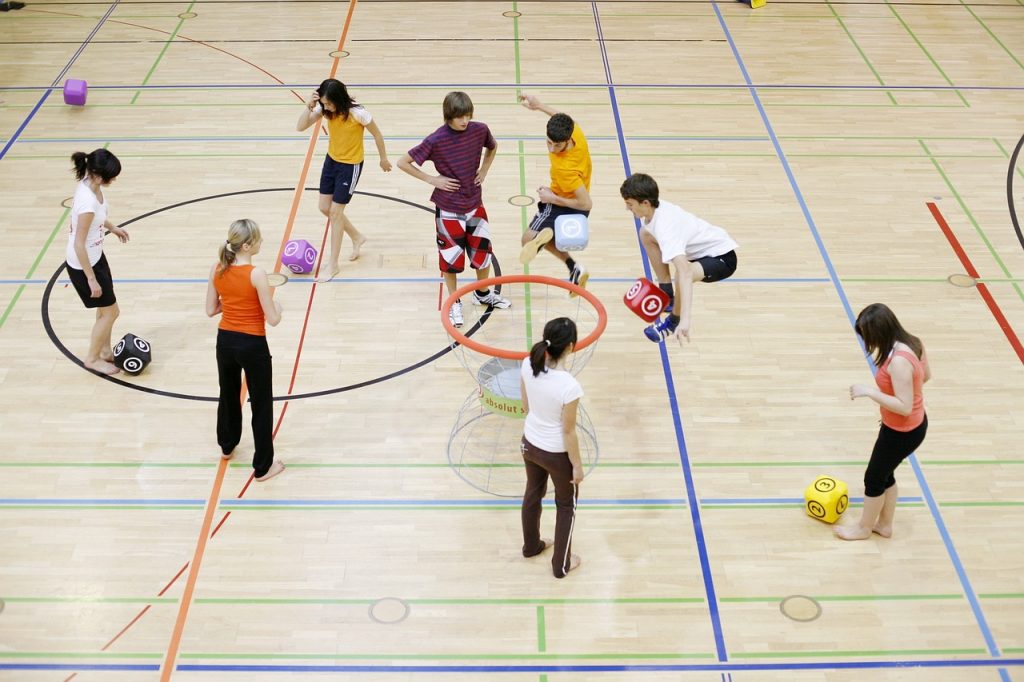
Without clear objectives, the chaotic nature of the non-sport-specific game we played, titled ‘Storm,’ would have left me directionless, uncertain of what to teach, when to intervene, or how to guide the lesson. Instead, I identified a key physical need of the group: while their stationary catching was solid, they needed to progress towards successfully catching while moving to perform better in the game. To address this, we used a constraints-led approach, as advocated by Renshaw et al. (2010) and manipulated the environment to afford more opportunities to practise ‘catching while moving.’
The emotional and social objectives prioritised inclusivity. Instead of focusing solely on winning, we rewarded and praised positive social interactions and actions that encouraged teamwork and inclusion. Engagement was further enhanced by introducing multiple balls, preventing the physically stronger and more skilled pupils from dominating the game and ensuring all pupils had a chance to contribute meaningfully.
Filling pupils’ ‘rucksacks’ with the tools to take responsibility for lifelong engagement in physical activity
Ensuring that every lesson contains only two explicit learning outcomes we found a reduced risk of teachers becoming overwhelmed when adopting this holistic approach to teaching PE. One of these objectives must always be a physical outcome and the other is taken from one of the other three domains. This has enabled us to ‘get in and teach’ without detracting from the holistic environment required to help fill our pupils’ rucksacks with more of the tools they need to ‘value and take responsibility for lifelong engagement in physical activity’. Thus, utilising a physical literacy informed approach.
This blog has been my attempt to articulate the evolution of my thinking when it comes to curriculum and pedagogical design and I would love to hear your thoughts to the following questions:
- Is this still too vague or did it resonate?
- Was there anything new in what I have said or did it align to your previous knowledge and thinking?
- Do you agree that the physical domain should be prioritised?
- Do you agree that we should concern ourselves with more than just physical development?
- Is there a better way to prevent teachers from being overwhelmed by potential developmental opportunities in lessons?
References
Bailey, R., 2006. Physical education and sport in schools: A review of benefits and outcomes. Journal of School Health, 76(8), pp.397-401.
Bernstein, B. (2000). Pedagogy, Symbolic Control, and Identity: Theory, Research, Critique. Rowman & Littlefield.
Blomqvist, M., Vänttinen, T., & Luhtanen, P. (2005). Assessment of secondary school students’ decision-making and game-play ability in soccer. Physical Education and Sport Pedagogy, 10(2), pp. 107–119. https://doi.org/10.1080/17408980500105076
Bronfenbrenner, U. (1979). The Ecology of Human Development: Experiments by Nature and Design. Cambridge, MA: Harvard University Press.
Csikszentmihalyi, M., 1996. Creativity: Flow and the Psychology of Discovery and Invention. New York: HarperCollins.
Durlak, J.A., Weissberg, R.P., Dymnicki, A.B., Taylor, R.D. & Schellinger, K.B., 2011. ‘The impact of enhancing students’ social and emotional learning: A meta-analysis of school-based universal interventions’, Child Development, 82(1), pp. 405–432.
Gallahue, D.L. & Ozmun, J.C., 2011. Understanding Motor Development: Infants, Children, Adolescents, Adults. 7th ed. New York: McGraw-Hill.
Stodden, D.F., Goodway, J.D., Langendorfer, S.J., Roberton, M.A., Rudisill, M.E., Garcia, C., & Garcia, L.E., 2008. A developmental perspective on the role of motor skill competence in physical activity: An emergent relationship. Quest, 60(2), pp.290–306.
Garn, A.C., Ware, D.R. & Solmon, M.A., 2011. ‘Student engagement in physical education: Linking the affective domain to student learning’, Journal of Teaching in Physical Education, 30(1), pp. 89–103.
Hellison, D., 2011. Teaching personal and social responsibility through physical activity. 3rd edn. Champaign, IL: Human Kinetics.
Hillman, C.H., Erickson, K.I. & Kramer, A.F., 2014. ‘Be smart, exercise your heart: exercise effects on brain and cognition’, Nature Reviews Neuroscience, 9(7), pp. 58–65.
International Physical Literacy Association (IPLA), 2022. Available at: https://www.physical-literacy.org.uk/
Light, R., 2012. Game Sense: Pedagogy for Performance, Participation and Enjoyment. Abingdon: Routledge.
Renshaw, I., Chow, J.Y., Davids, K., & Hammond, J., 2010. A constraints-led perspective to understanding skill acquisition and game play: A basis for integration of motor learning theory and physical education praxis? Physical Education and Sport Pedagogy, 15(2), pp. 117–137. https://doi.org/10.1080/17408980902791586
Runco, M.A. & Jaeger, G.J., 2012. ‘The Standard Definition of Creativity’, Creativity Research Journal, 24(1), pp. 92-96.
Syaukani, A.A., Mohd Hashim, A.H. and Subekti, N., 2024. Conceptual framework of applied holistic education in physical education and sports: A systematic review of empirical evidence. ResearchGate. Available at: https://www.researchgate.net/publication/375100120_Conceptual_Framework_of_Applied_Holistic_Education_in_Physical_Education_and_Sports_A_Systematic_Review_of_Empirical_Evidence [Accessed 26 Jan. 2025].
Tomporowski, P.D., Davis, C.L., Miller, P.H. & Naglieri, J.A., 2008. ‘Exercise and children’s intelligence, cognition, and academic achievement’, Educational Psychology Review, 20(2), pp. 111–131.
Whitehead, M., 2018. Physical Literacy: Throughout the Lifecourse. 2nd ed. London: Routledge.
Great blog and excellent insight. Thank you Tom!
Would love to know more about the lesson. Did ‘teachable moments’ arise when playing the game? In order to explicity teach to the secondary objective ‘To play to win whilst including all of your team’… or were their constraints such as everyone must touch the ball etc. How is ‘Storm’ played? Were there other activities in the lesson?
Thanks Jaxon, I am glad you found it insightful.
I have to credit Russell ‘Rusty’ Earnshaw for the idea of the Storm game as it is one that I magpied from him. I have adapted it to fit my context and it’s rich in opportunities to teach the secondary objective. I will break it down in bullets:
The Game – In short:
To score points you must pass the ball (throwing and catching) between your team mates. Each throw and catch gives you a point but you must call ‘BANK’ to secure the points and it must be the player in possession that calls it. If the other team gets possession before you bank the points, you score nothing for that sequence so you need to make a good decision as to when to bank the points.
Some ideas as to how we can promote opportunities to achieve our secondary objective. I might not use all of them, it depends if we are already achieving the aim:
– You cannot return a pass to the same persons you received it from.
– Super powers (one example: a certain player in you team gives you an auto bank of 5 points if the get possession. There are so many options for superpowers).
– Multiple balls.
– You score 50 points if you manage to get the ball to every player before banking.
– Only one player can bank the points (create a zone for them so they can’t be marked tightly if they need it).
– We keep score. This gives the game greater purpose, we don’t really care who wins, just that they are trying to help their team (by being a committed team mate).
I would start off with the students, playing a smaller sided (3v1) version where, if the ball is dropped, they change the ‘defender’.