


By Keira Wylie
After 13 years as a Head of Department and having worked across multiple schools and trusts, I recently made the decision to step away from school-based leadership. It wasn’t an easy choice – leading within a school community has shaped who I am as an educator, however it was time for a new challenge and time to explore, learn and support colleagues across a range of PE contexts using the experience I had gained. Now, as a consultant with PE Scholar, I’m focused on supporting teachers and students across a broader range of educational settings. My ambition is simple: to raise the profile of PE and help it thrive in every corner of the curriculum.
Why PE needs more celebration
There’s something that many PE teachers know – but few say aloud: we are notoriously bad at communicating positively about what we do.
Outside of our subject area, few truly understand the breadth, complexity, and sheer impact of what it means to be a PE teacher. We combine deep academic knowledge with logistical mastery, pastoral care, and a relentless energy that keeps the heartbeat of a school going well beyond the confines of a 9-3.15 timetable.
Trying to balance our, what feels like a never ending, to-do list that combines teaching, logistics, pastoral care, maintenance, marketing and so on is no mean feat. We; :
- Book coaches and manage transport logistics,
- Write risk assessments and oversee safety procedures to include adapting to the weather sometimes on an hourly basis,
- Maintain equipment and facilities,
- Wash forgotten kit and tidy store rooms,
- Scale roofs to retrieve wayward tennis balls,
- Wait long after the bell for late parents post-fixtures,
- Support students in rain-soaked Saturday competitions,
- Champion students on social media and in school newsletters,
- Are committed to role modelling healthy active lifestyles,
- And keep up to date with endless changes to dozens of sports, disciplines, and movement practices, all while nurturing the physical, mental, and emotional wellbeing of young people.
And yet, despite all this, PE is often misunderstood and undervalued – particularly in the run-up to exams, when it’s frequently the first subject to be substituted out. This, despite overwhelming evidence linking physical activity to increased cognitive function, improved mental health, and better academic outcomes. Replacing PE with revision is, quite frankly, counterintuitive. When we take away the one subject proven to support healthy minds and bodies, we hinder the very progress we seek to promote.
Our unique role in whole-school success
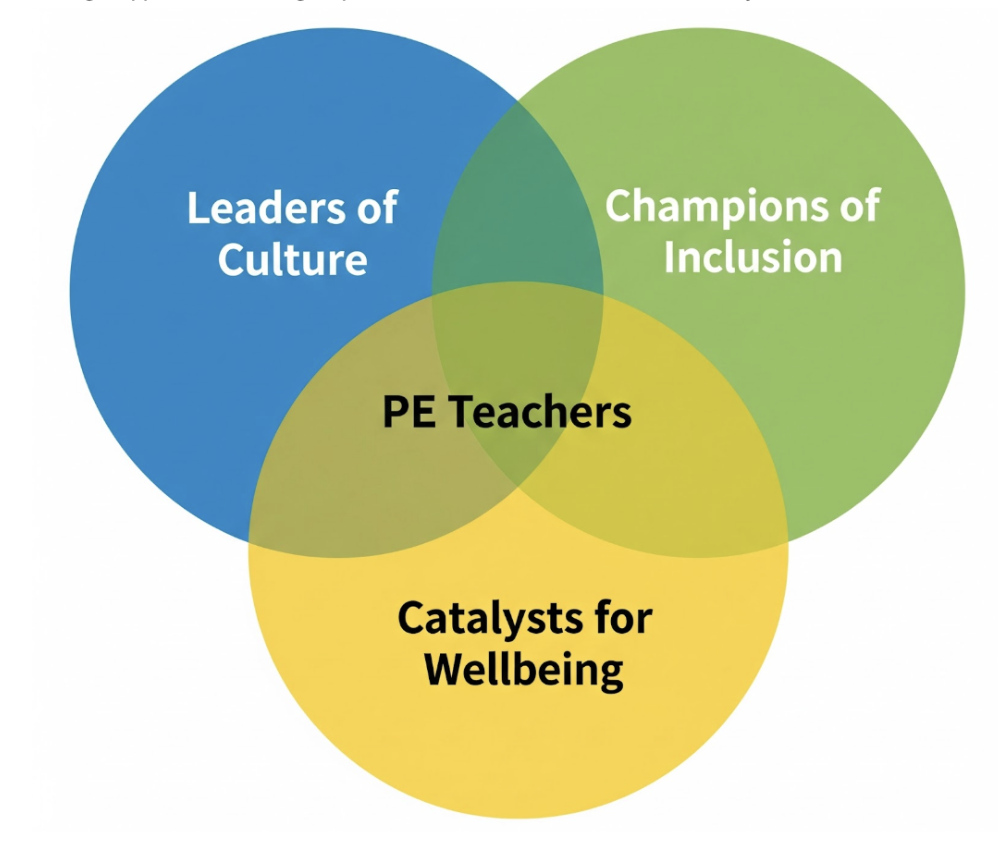
The delivery – working directly with the students – is the joyful part. It’s the purpose that drew us into the profession. But, our responsibility goes far beyond the sports hall. We are leaders of culture, champions of inclusion, and catalysts for wellbeing. If we want PE to be recognised as a core subject, we need to take a strategic approach to raising its profile across the entire school community.
We must help senior leaders, governors, and parents see PE not just as “activity,” but as a crucial driver of personal development, academic success, and lifelong health. Because without health – physical, emotional, mental – what value do grades truly hold? Parents in particular I am sure value more for their child than a set of grades.
Across the country, there are schools beginning to see the bigger picture. By placing physical education and movement at the heart of the school day, they are achieving far broader outcomes than academic attainment alone.
For example, one school in Cornwall has transformed the way mornings begin by introducing “active starts.” Tutor groups rotate through the sports facilities or take part in simple practical activities in their classrooms to energise their bodies and minds. The result? Pupils arrive switched on, focused, and ready to learn. In Devon, another school has reimagined exam preparation by introducing “walking, talking mocks.” Instead of sitting within four walls, Year 10 and 11 pupils rehearse exam-style questions while walking around the school site and local community. This not only reduces anxiety but also embeds revision in a healthier, more dynamic way. A second Devon school has found creative ways to motivate students by linking wellbeing to rewards. Pupils who attend a set number of clubs that nurture both their physical and mental health have their end-of-year points doubled, giving them greater opportunities for recognition and rewards. The message is clear: taking part in physical activity is both valued and celebrated. And at Rydon Primary School in Kingsteignton, Danny Brown, a new headteacher has quickly embedded movement into the culture of the school. By introducing a daily “Golden Mile,” adding an extra break, and providing structured, choice-led activities run by playground leaders, the impact has been striking. Behavioural incidents have dropped dramatically, disruption to learning is now minimal, and children are more engaged throughout the day – not to mention the long-term benefits for their health and wellbeing.
These examples show that when schools embrace movement, they unlock more than fitness: they create calmer classrooms, happier children, and stronger communities. The challenge now is to share these practices widely, so that every school can learn from them and every child can benefit.
Practical strategies for raising the profile of PE
Below are tangible, tested strategies that can transform the perception of PE in your school and create a ripple effect throughout the wider educational community:
1. Build a team culture that speaks volumes
- Cultivate a team identity grounded in passion, purpose, and pride.
- Share a collective “why” focused on delivering exceptional experiences for young people.
- Create an open-door policy in the PE department to foster belonging and engagement.
- Prioritise visibility and relationships – be present, be known, be connected.Read about developing positive relationships here to help boost feelings of belonging.
2. Promote PE across the whole school
- Share student successes in staff briefings – academic or extracurricular. This will allow other staff to connect with these students in their own contexts by celebrating their successes.
- Run energising INSET sessions that showcase modern PE in action. When teachers across the school experience a modern PE lesson they will definitely start to realise the kind of magic that happens in our lessons.
- Collaborate with colleagues to support clubs and build rapport with students.
- Drive cross-curricular links during school-wide events and use PE to draw attention to key events. There are some dates coming up such as World Heart day on the 29th of September, World Mental Health Day on the 10th of October or the International Day of Persons with Disabilities on the 3rd of December.
- Deliver assemblies (access some examples to tailor to your school here) to help students (and tutors who will be in the room) to recognise the value of PE.
3. Design a curriculum that truly matters
- Focus on fun, movement, and inclusion (gender diversity is a big one for us to focus on to ensure we get it right see here for some ideas on how to do this)
- Prioritise belonging above all. A useful course to support belonging in PE can be found here.
- Move beyond traditional skills and drills; embed life skills like resilience, leadership, empathy, and honesty. Show children just what else PE can do for them.
- Promote physical literacy and offer breadth without sacrificing depth. You can learn more about physical literacy in a 3 part series: Here is the link to part 1.
- Avoid rigid schemes of work – teach with inspiration, intent, and innovation.
- Awesome PE in 5 Ways will provide some good ideas
4. Celebrate every win
- Regularly contribute to school newsletters and social media.
- Create a student-led PE newspaper to celebrate all of the great things you and your students are doing.
- Develop your own social platform (with consent) where you can promote moments of greatness across the school day and beyond. Students will soon be asking you to film/photograph their achievements so they can share their successes with home.
- Link in with other impressive accounts on social media and share and celebrate great things they are doing so in the long term your exceptional work can also be noticed.
- Publicly share research-informed benefits of PE to educate and advocate.
- Send home regular, positive updates – aim to celebrate every child by mid-year.
5. Engage governors, families, and the wider community
- Attend governors’ meetings and invite them into the department.
- Host parent-child clubs and community events to build trust and shared understanding.
- Show senior teams how sport and physical activity can be used to help intervene and engage those who are struggling. I have seen schools use fun morning movement to draw in even the lowest of school attenders.
- Write to local MPs or newspapers about PE-led successes and events.
6. Empower student voice and leadership
- Gather student feedback through surveys, councils, and informal conversations.
- Offer leadership and first aid qualifications, both formal and informal. The more student leaders you have the more you can do and the more you can shout about. Use them to support in primary schools, run transition and community events and run their own extra-curricular clubs.
- Create PE Ambassadors — diverse, representative, and student-led.
- Involve ambassadors in school-wide advocacy: assemblies, open evenings, and mentoring roles.
- Access our blog and template for student voice here
A call to action: Let PE be seen
Too often, the magic of PE happens behind closed sports hall doors. But the time has come to throw those doors wide open.
PE teachers: you are leaders, innovators, nurturers, and experts. You are changing lives every single day – and it’s time to make sure your whole community sees it.
So reflect on this:
What would happen if we started celebrating all that we do – loudly, proudly, and consistently?
What could shift if we made PE a central pillar of school identity, a reason why families choose a school, and a subject that commands the respect it deserves?
Let this be your reminder and your challenge:
Raise the volume. Share your impact. Inspire others. Celebrate it all.
Because when we elevate PE, we elevate young people – and when we do that, we elevate the future.
Responses