


Creating a national curriculum resource is a significant undertaking. It involves balancing rigorous standards with the messy reality of teaching in a sports hall or on a muddy pitch. We wanted to share our reflections on the Physical Education curriculum we developed with Oak National Academy to explain why we did it and how you can get the best out of it for your students.
What attracted us to do it?
At the heart of this project was a desire to support the profession we love and make a positive difference for all young people through PE. We know that teacher recruitment, retention, workload and time dedicated to training are significant challenges in realising quality physical education for all. We strive to do everything we can to help with this endeavour.
The Oak National Academy platform is free for teachers to access and fully editable. This aligned perfectly with our philosophy of providing a framework that is recognisable across all subjects for primary generalists to use while ensuring high quality resources are available for supply staff and trainees, especially those working in challenging circumstances. We want PE to stand for positive experiences for all and not a marmite subject that best serves little versions of its physical education teachers. How can you best reach the diverse and often disaffected, demotivated and disadvantaged student populations we face in so many schools today?
How did we make it Physical Literacy informed?
National Curriculum compliance and alignment to Oak principles for all subjects was essential. We were determined to push the needle towards more meaningful content that would engage all learners and develop much more than mere sporting skills. We utilised the move, think, feel and connect language from Sport England’s consensus statement to create a holistic framework.

We broke this framework down into 12 tangible threads to support planning, teaching and assessment:
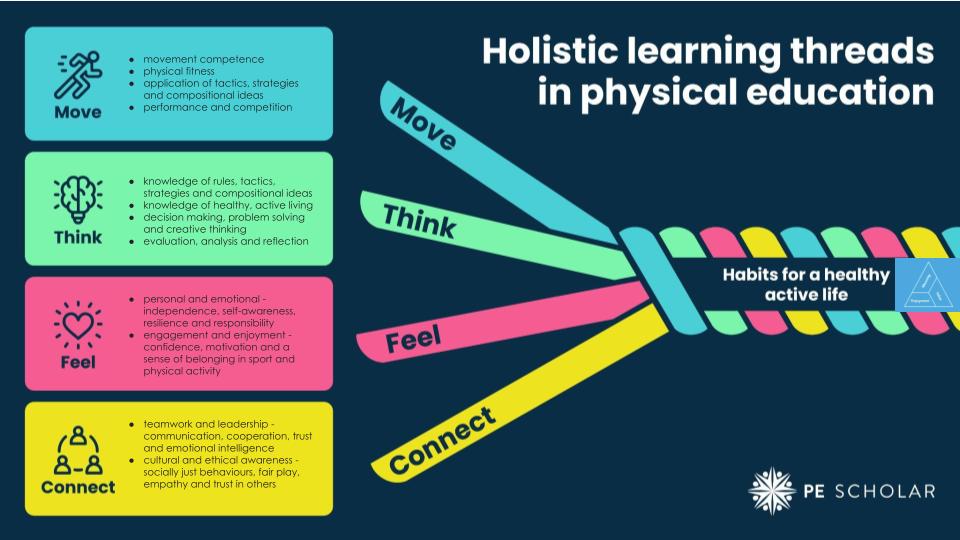
- Move: Focuses on movement competence, physical fitness, tactics and performance.
- Think: Covers knowledge of rules, healthy active living, decision making and evaluation.
- Feel: Prioritises personal/emotional development, engagement and enjoyment.
- Connect: Looks at teamwork, leadership, cultural awareness and ethics.
This ensures every lesson includes a reminder of what success looks like in the affective domain by building confidence and motivation rather than just physical skills.
What are we most proud of?
We affectionately call it our “Nudge Curriculum”. We met the DfE compliance requirements but with a deliberate nudge towards ensuring holistic outcomes are prioritised by using the move, think, feel and connect success criteria. The Curriculum and Assessment Review has reinforced that this is the right direction of travel for the future of PE.
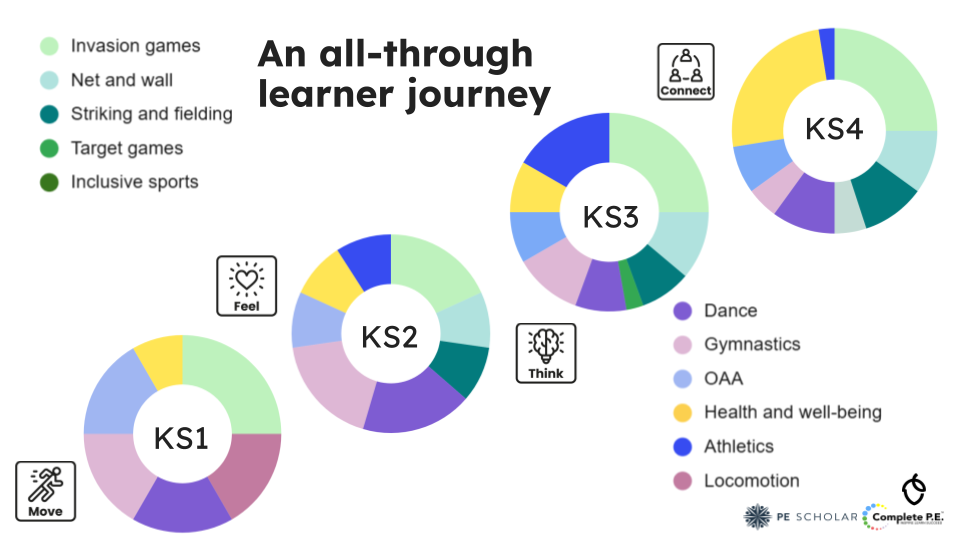
We are also incredibly proud of the all-through learner journey mapped from Year 1 to Year 11. It uses the same language and format throughout so teachers can dial up the challenge for able groups or hold back to ensure everyone achieves success before progressing.
Key highlights include:
- Learning Guides: For core PE we avoided slides and instead created learning guides to support teachers with well sequenced ideas that they can turn into lesson plans with the contextual knowledge of their specific classes.
- Real Demonstration Videos: We used real students from real schools to bring activities to life and show what success looks like.
- Generic Games Units: We start all KS2 to KS4 years with a generic principles unit focusing on knowledge and skills such as creating space or attacking and defending which can then be applied to specific sports later in the sequence. We provided a couple of examples (e.g. futsal, football and gaelic football) but encourage teachers to switch sports to suit their local context.
- GCSE Support: Comprehensive slide decks and resources specific to AQA, Edexcel/Pearson and OCR specifications.
What can you find where?
The curriculum covers the entire spectrum of school life. You can access the specific materials here:
- Primary: Key Stage 1 PE curriculum and Key Stage 2 PE curriculum
- Secondary: Key Stage 3 PE curriculum and Key Stage 4 PE curriculum
- GCSE Specific: AQA GCSE PE materials, Pearson/Edexcel GCSE PE materials and OCR GCSE PE materials
Top tips to make the most of it
To get the best out of these resources, please:
- Adapt to your context: Download the curriculum overview and compare it with your current intent to see if there are aspects you can integrate.
- Use the 3000+ videos: Watch the demonstration videos to understand setups and what success looks like at different stages of learning.
- Personalise: Use our planning templates to adapt the lessons to your context. Encourage teachers to pick the unit that fits the stage of development of their group rather than rigidly following year group schemes.
- Reward holistic growth: Ensure your assessment recognises the 12 move, think, feel and connect threads rather than just sporting performance or knowledge of the rules.
- Notice the ‘Teacher Tip’ and ‘Misconceptions’: We placed essential anchors for lesson planning and common misconceptions on the website so ensure you look for them and lift those suggestions onto your lesson planning as they have come from the minds of a great team of content creators who carry over 200 years of experiences teaching PE in England.
Who can we thank?
Massive thanks to Hannah Packer at Oak, Julie Pearson and the wider review team and most importantly an incredible team of Content Creators who brought our ambition to life. Catherine Fitzpatrick (for leading the primary team), Matt Burroughs, Jackie Brookes, Carl Broome, Lou Hacking, Katie Hart, Kirsty Hemingway, Sarah Herbert, Claire Pring, Vicky Randall, Simon Scarborough and Keira Wylie. Read more about each of them here. Finally, thanks to the amazing teachers who opened their doors to let us film real children in real schools to create the demonstration videos here:
- ACS International School, Cobham
- Aylward Primary School, Harrow
- Bishop Stopford School, Kettering, Northamptonshire
- Bluecoat Wollaton Academy, Nottingham
- Brighton Hills Community College, Basingstoke
- Butlers Court School, Buckinghamshire
- Carlton Bolling, Bradford
- Castle Hill – Greenbank Campus, Hampshire
- Castle Hill – Rooksdown Campus, Hampshire
- Cunningham Hill Junior School
- Dixons McMillan Academy, Bradford
- Fallibroome Academy, Macclesfield
- Harrow Way Community School, Andover
- Holmfirth High School, Holmfirth
- Huddersfield Grammar School, Huddersfield
- Little Common School, Bexhill-on-Sea, East Sussex
- Our Lady of Perpetual Succor Catholic Primary, Nottingham
- Prince Henry’s Grammar School, Otley
- Ripon Grammar School, North Yorkshire
- Shelley First School, Huddersfield
- St Fidelis Catholic Primary School, Bexley
- St Joseph’s Catholic Primary, Ollerton
- St Mary’s College, Hull
- St Michael’s CofE Primary School, East Wickham, Kent
- St Stephen’s CofE Primary School, South Godstone, Surrey
- Teign School, Devon
- The Redhill Academy, Nottingham
- Thorn Grove, Bishop Stortford
- Upton Court Grammar School, Slough
- Whirley Primary School, Macclesfield
Interested in learning more?
Does this all sound great but you feel like you need more information or support in implementing this into your school / teaching? If so, we can help. Contact us via [email protected] to request support or training.
Responses