


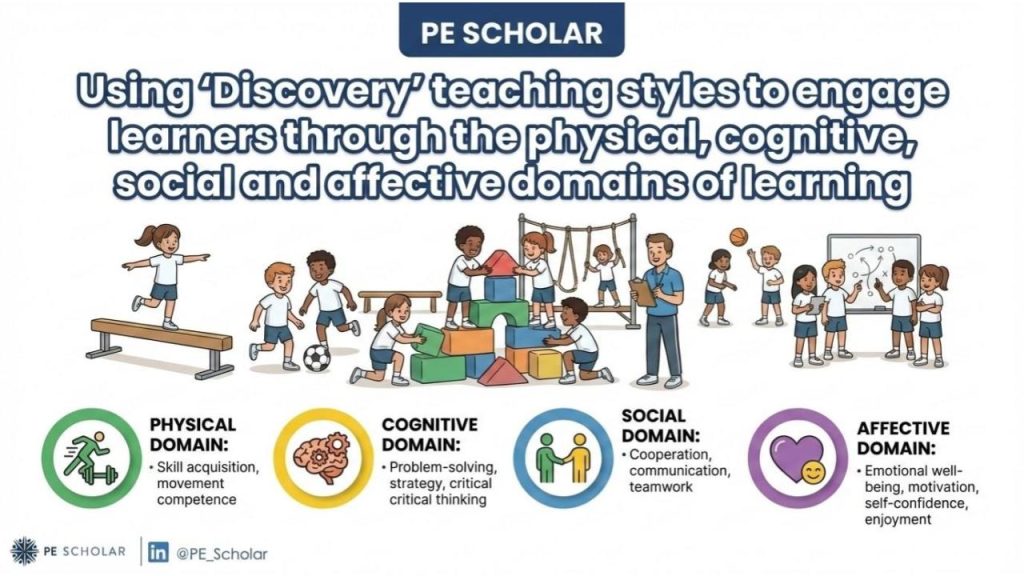
Recent research has indicated that PE curriculum time is reducing and only 1 in 3 young people are taking part in physical activity out of school (YST, 2025). Therefore now, more than ever, there is a greater need to ensure that PE lessons are engaging, enjoyable and meet the needs of all pupils. Additionally, there is also a gendered divide between the percentage of boys and girls who enjoy PE with 35% of girls and 14% of boys stating that they don’t enjoy the subject (YST, 2023). We know that for some pupils, PE is the only opportunity for them to engage in sport and Physical Activity (DFE, 2024), so it is so important that we provide them with a PE experience which makes a difference.
Why teaching style matters
Mosston and Ashworth’s spectrum of teaching styles is well known in the PE field and frequently written about (Chatoupis, 2018). Phill et al (2023) describe the spectrum as a decision-making process between the teacher and the student focussing on the ‘how’, ‘when’ and ‘why’. Whilst the reproductive styles (A-E) of the spectrum pertain to the teacher as the sole decision maker, many practitioners acknowledge that their teaching often aligns with this classification, and citing reasons such as traditional training methods; an emphasis on the psychomotor domain of learning; the perceived benefits of maintaining control and ensuring safety in the learning environment and ensuring pupil progress (Constantinides & Antoniades, 2022; Syrmpas et al.; 2017).
Embedding the productive teaching styles of the spectrum (F-K) has traditionally been more common in activities such as dance and gymnastics, where creativity, decision-making, and independent thinking are encouraged (de Las Heras-Fernández et al., 2022). However, evidence suggests that applying the full range of teaching styles can lead to a more enriching and effective learning experience for pupils across a variety of physical education contexts (Yoshida et al., 2024). Across the country, most schools still implement the multi-skills teaching approach, but critics suggest that this approach is problematic and can be the cause of disengagement and gender inequalities (Gerdin & Pringle, 2022; Sullivan, 2021).
Perhaps a strategy to approach the concern is to review the way in which we teach within the multi-activity model? (Gerdin & Pringle, 2015) where typically, invasion games form part of this multi-activity model and is mostly delivered through the reproductive teaching style (SueSee et al., 2016). Research exploring how students are supported when delivering Games within PE lessons through productive teaching styles suggests that, although planning may require more time, the duration of teacher-led instruction is significantly reduced as pupils take on the role of decision makers (Curtner-Smith et al., 2001) which will increase academic learning time thus impacting on pupil progress (Van Der Mars, 2006)
Reproductive styles in practice – from drills to discovery
For example, learning objectives focussing on passing skills can be delivered more dynamically through the productive teaching style. The term ‘drill’ is often associated with static activities that may lack challenge and fail to inspire pupils (Miller and Swick, 1976). Incorporating ‘Discovery’ styles within the teaching spectrum introduces versatility, promotes challenge, and enhances both output and pupil engagement (Chatoupis, 2018). For instance, the guided discovery approach (Suesee et al., 2021), promotes setting tasks where pupils identify a predetermined solution. This makes it well-suited to the example by encouraging pupils to develop individual passing skills. In small groups, pupils can engage in a 3v1 scenario where they must determine the most effective pass to tag a pupil with the ball in a confined space. The chest pass often emerges as the preferred option due to its speed and accuracy but, importantly, this is discovered and discussed by pupils. This activity allows pupils to refine their technique and explore alternative passing methods, avoiding reliance on a single type of pass and fostering skill development. This approach may have time management implications (Cothran & Kulinna, 2008) but results in better understanding and far ‘stickier’ learning.
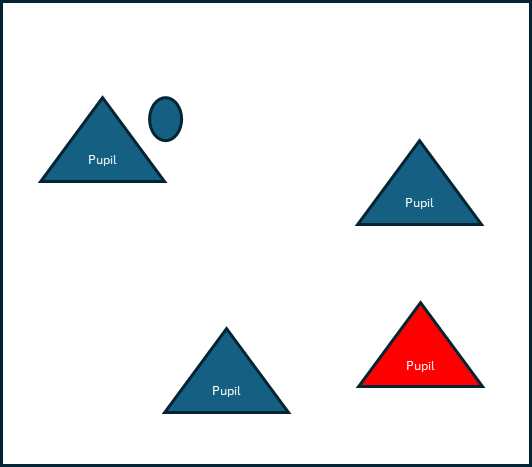
Adding another pass can be developed by using convergent discovery whereby the activity is altered to incorporate three teams working in three areas such as within a volleyball court.
- Group A is at the end of the court and must complete 10 successful passes without being intercepted.
- Group B is in the middle and sends one or two pupils in to try to intercept the ball. Group C is waiting.
- If group A are successful, they must find a way to throw the ball over to group C who then must complete 10 passes and Group B send in two different players to intercept.
- If either group is unsuccessful, they swap positions with Group B and start again.
Now they must think about what type of pass would be most appropriate for both short and further distances. Here the teacher guides the pupils to the outcome. Pupils can then work on what passes they could use to complete the tasks and master the technique.

Divergent discovery adds a further dimension; in Netball for example the group could be asked to work on a set piece for a centre pass; or in other games moving the ball efficiently along the court or pitch. Here pupils can work out what passes are the most effective for the set piece. Each group is faced with the same problem but will likely approach it in different ways and produce different outcomes.
By incorporating the range of teaching styles from both the reproductive and productive clusters, we can move away from focussing just on the psychomotor domain and engage the cognitive and affective domains too. This way we are educating the whole child and providing a more comprehensive and engaging experience for our pupils (Dyson, 2014). Therefore, by combining these approaches, PE teachers can create more engaging, equitable, and intellectually stimulating lessons. Invasion games offer rich opportunities for pupils to explore decision-making, collaboration, and creativity – developing not just physical competence but also confidence and agency as learners.
What next:
- Review your planning; what teaching styles are you using?
- Choose one learning episode where you lead and adopt a more didactic and command approach; how can you give the students more decision making opportunities?
- Reflect on the learning episode; how did it engage the pupils – what was the outcome of their work?
About the author:
Kirsty Bundy is a senior Lecturer and programme leader on the BSc (Hons) PE and Sport Degree at the University of Lincoln.
References:
Chatoupis, C. (2018) Physical Education Teachers’ use of Mosston & Ashworth’s Teaching styles: A literature review. The Physical Educator. 75(5), 82-92
Constantinides, P. and Antoniades, O. (2022) Preservice Physical Education Teachers’ Use of Reproduction and Production Teaching Styles. European Journal of Education and Pedagogy, 3(5), 93-99. https://doi.org/10.24018/ejedu.2022.3.5.442
Cithran, D.J. and Kulina, P.H. (2008) Teachers’ knowledge about and use of teaching models. Physical Educator, 65,pp. 122-133
Curtner-Smith, M.D., Todorovich, J.R., McCaughtry, N.A., & Lacon, S. (2001) Urban teachers’ use of productive and reproductive teaching styles within the confines of the National Curriculum for Physical Education. European Physical Education Review, 7(2), 177-190
de Las Heras-Fernández, R., Cuellar-Moreno, M. J., Espada Mateos, M., & Anguita Acero, J. M. (2022). The influence of teaching styles on the emotions of university students in dance lessons according to sex. Research in Dance Education, 26(2), 182–201. https://doi.org/10.1080/14647893.2022.2144197
Dyson, B. (2014). Quality Physical Education: A Commentary on Effective Physical Education Teaching. Research Quarterly for Exercise and Sport, 85(2), 144–152. https://doi.org/10.1080/02701367.2014.904155
Gerdin, G., & Pringle, R. (2015). The politics of pleasure: an ethnographic examination exploring the dominance of the multi-activity sport-based physical education model. Sport, Education and Society, 22(2), 194–213. https://doi.org/10.1080/13573322.2015.1019448
Miller, H. G., & Swick, K. (1976). Appropriate Uses of Drill Exercises. Educational Technology, 16(10), 26–30. http://www.jstor.org/stable/44421082
Suesee, B., Hewitt, M. & Phill, S. (2021) The spectrum of teaching style in physical education. Oxon. Routledge
Pill, S., SueSee, B., & Davies, M. (2023). The Spectrum of Teaching Styles and models-based practice for physical education. European Physical Education Review, 30(1), 142-155. https://doi.org/10.1177/1356336X231189146 (Original work published 2024)
SueSee, B., Pill, S., & Edwards, K. (2016). Reconciling approaches – a game centred approach to sport teaching and Mosston’s spectrum of teaching styles. European Journal of Physical education and sports Science. 2 (4)
Sullivan, L. (2021) Is Pe in Crisis? Leading meaningful change in Physical Education. Radstock. Scholary
VAN DER MARS, H. (2006). Time and learning in physical education. In D. Kirk, D. Macdonald, M. O’Sullivan (Eds.) Time and learning in physical education (pp. 191-213). SAGE Publications Ltd, https://doi.org/10.4135/9781848608009.n11
Yoshida, F., Conti, G.J., Yamauchi, T. & Kawanshi, M. (2024) A teaching styles typology of practicing teachers. Journal of Education and Learning. 3(1), 1-18.
Responses