


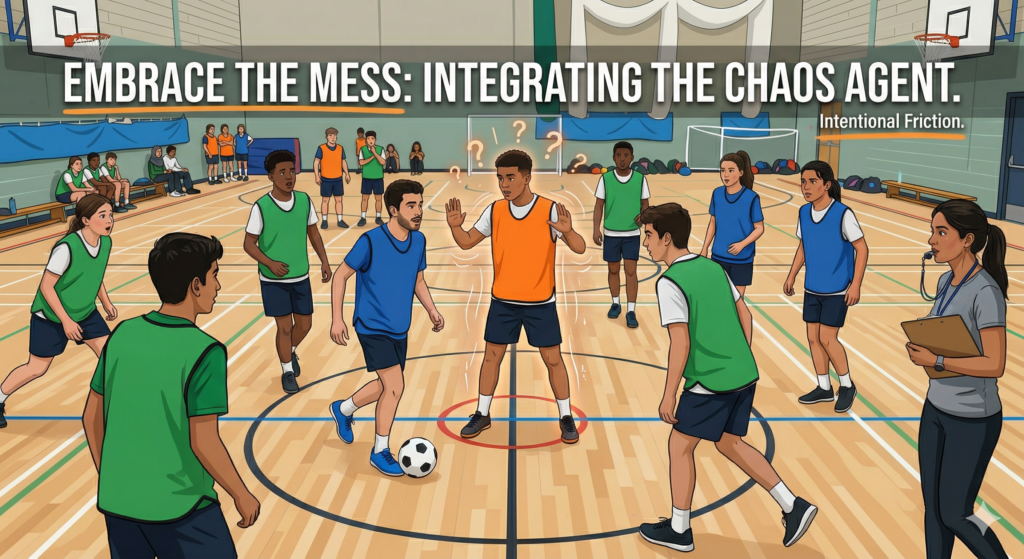
As PE teachers, we work hard day in and day out on “Levelling the Playing Field” but in doing so, are we removing vital learning opportunities? We often find ourselves planning meticulously to balance teams, obsessing over officiating decisions in lessons to ensure competition is fair and step in the second any sign of a dispute arises. We want things to be fair but this blog expands on a suggestion I made in our newsletter back in February and explores whether we should be making more use of intentional messiness.
Here’s the uncomfortable truth: The real world isn’t fair. By working too hard as teachers to make sure our games are fair, we are accidentally stripping away the very environment where students develop “Game Sense” and, perhaps more importantly, “Life Sense.” If we want to build resilient, adaptable humans who can manage their own conflict, we need to stop fixing the chaos and start intentionally creating it under controlled conditions.
Enter: The Chaos Agent.
The Pedagogy of Friction
In academic circles, this is often linked to Representative Learning Design. This theory suggests that for learning to transfer from practice to the real-world, the practice must contain the same perceptual cues and pressures as the real world.
In the real world, refs make mistakes, colleagues change the plan mid-project and sometimes the “rules” simply don’t favor you. By introducing Intentional Friction, we move students away from a fixed mindset and into a more dynamic one and teach to be able to respond in the moment.
The Chaos Toolkit: Roles & Instructions
Perhaps you already do this and call it something different? Either way, a Chaos Agent is a student given a secret or overt brief to disrupt the flow. Here’s a few examples of how you can deploy them:
| Role Name | The “Chaos” Instruction | Skill Targeted |
| The Rogue Ref | Can change a decision at any time, even if it’s clearly wrong. | Emotional Regulation: Respectful advocacy under pressure. |
| The Mercenary | Switches teams whenever a specific keyword is shouted. | Adaptability: Rapid re-communication and tactical shifting. |
| The Saboteur | Secretly told to play poorly or “leak” the game plan. | Leadership: Identifying internal issues without “blaming.” |
| The Rule-Maker | Can add a new “illegal” constraint (e.g. no dribbling) every 2 minutes. | Creative Problem Solving: Navigating shifting constraints. |
| The Glitch | This player can only move in straight lines or must remain stationary for 5 seconds after touching the ball. | Support Play: Forcing teammates to work harder to offer options. |
| The Mime | This player (usually a key playmaker) is forbidden from speaking or making noise. | Non-Verbal Literacy: Forces the team to rely on eye contact, pointing and body language. |
| The Oracle | Only this student knows the “Secret Constraint” (e.g. “you can only score after 3 passes”). The team must figure out the rule through trial and error. | Deductive Reasoning: Encourages active observation and “reading the game.” |
| The Static | This player is allowed to give “false” or “bad” advice/instructions to their own team. | Critical Thinking: Teaches students to verify information and trust their own tactical eyes over loud voices. |
| The Translator | A player on Team A who must relay all of Team B’s tactical huddles to their own team in real-time. | Counter-Strategy: Forces Team B to use coded language or deceptive movements. |
| The VIP | If this player is tagged (in tag games) or loses possession, the other team gets a point instantly, regardless of the score. | Zonal Defense: Teaches the team to form a “protective shell” and prioritise a specific teammate’s safety. |
| The Glass Cannon | This player has a “Super Power” (e.g. infinite shots), but if they are touched by an opponent, they are “out” for 2 minutes. | Risk Management: Balancing the use of a powerful asset with the high cost of losing them. |
| The Anchor | This player cannot leave a specific small circle on the pitch, but they are the only ones allowed to “restart” play after a goal. | Spatial Awareness: Forces the team to always maintain a connection to a fixed point on the field. |
| The Magnet | Every 3 minutes, they shout “MAGNET” and all players must get within 2 metres of them within 5 seconds or lose a point. | Regrouping: Teaches rapid transition from “spread out” to “compact” formations. |
| The Protected Player | Opponents cannot come within an arm’s length of this player; they have a “force field.” | Driving Space: Using a player to “clear a path” for others to exploit. |
| The Time Thief | Can “pause” one specific opponent for 10 seconds by tagging them (even in non-tag games). | Man-Marking: Understanding how the absence of one key player disrupts a whole system. |
| The Shape-Shifter | Can swap the “Game Ball” for a different object (e.g. a beanbag, a frisbee or a medicine ball) at any time. | Technique Adaptability: Adjusting motor skills instantly to new equipment properties. |
“Super Powers” for Tactical Deep-Dives
If Chaos Agents focus on social friction, Super Powers are about manipulating the mechanics of the game to highlight specific tactical concepts.
| The Time Weaver (Freeze/Slow Mo) | Can shout “FREEZE” once. Everyone stops for 5 seconds except the Weaver’s team. | Learning: Highlights off-the-ball movement and spatial awareness. |
| The Ghost (Invisibility) | This player cannot be tagged or tackled but also cannot score. | Learning: Teaches teams how to use a decoy to manipulate defensive structures. |
| The Multiplier (Double Points) | Any goal involving this player is worth double. | Learning: High-value asset protection and defensive prioritisation. |
| The Architect (Boundary Shift) | Can move the goalposts or change the scoring zone mid-game. | Learning: Forces an understanding of how geometry and spacing dictate play. |
The Tactical Timeout: When learning takes place
The learning doesn’t happen during the chaos; it happens in the reflection.
When the “Rogue Ref” makes a blatantly wrong call and the team starts to implode, don’t step in. Let it simmer for a few minutes, then blow the whistle for a “Freeze-Reflect-Restart”:
- “That decision felt unfair. What was the first thing you said to each other?”
- “Who took charge, who kept their cool and who lost their head?”
- “How should you manage conflict in the future?
- “How could you change your strategy to make the next goal undeniable, even to a bad ref?”
Access a pack of editable ‘Chaos Agent Cards’ here from 22nd April 2026.
Further Reading & Resources
To dive deeper into the science of “organsed mess,” why not read up on ecological dynamics or check out these resources:
- The Constraints-Based Approach (CBA): Learn how manipulating task, performer and environmental constraints drives skill acquisition
- Exploring non-linear pedagogy: Advocating for a shift from traditional skill-drill teaching to empowering students to become adaptable and creative problem-solvers
- Representative Learning Design (RLD): Research on why “fidelity” to the real-world environment is crucial for transfer
- Non-Linear Pedagogy: A great blog by our friend @ImSporicus with a breakdown of why learning isn’t a straight line
- Gamification: Practical ideas to increase engagement borrowing from what makes computer games so addictive
The goal isn’t just to play a game; it’s to teach students how to solve problems and how to manage conflict when the world stops making sense.
How would you introduce a “Chaos Agent” into a more individual sport like gymnastics or athletics to build that same level of adaptability? We would love to hear your thoughts and how these ideas go down in your lessons.
Responses