


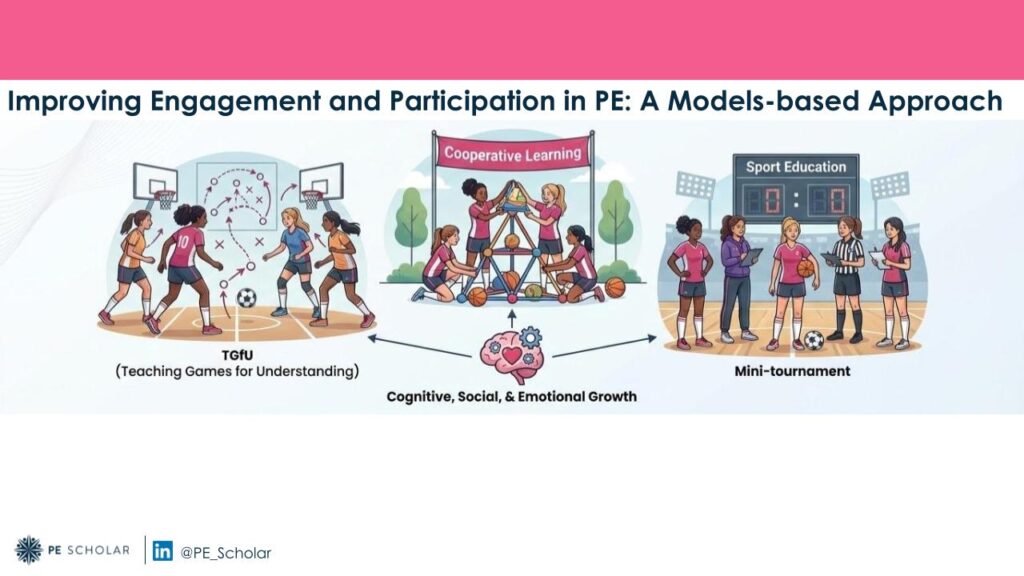
Over the past decade of teaching, I have increasingly focused on implementing a models-based curriculum to demonstrate to my department the positive outcomes I believe it can deliver. Last academic year, I made significant strides, particularly with Year 9 girls, by adapting their curriculum to better support participation and motivation. While most students engage enthusiastically in PE, I wanted to address the small number who disengage through fear of being “the worst” or “not good enough”. My aim was to reduce this anxiety by shifting towards models-based practice (MBP) that prioritised cognitive, social and emotional development over isolated physical skill execution (aka physical literacy).
Rather than using one single approach, models were selected based on the intended outcomes and life skills developed through each unit.
| Unit | Model | Key Learning Outcomes |
| Basketball | Sport Education | Leadership, responsibility, team identity |
| Netball | TGfU | Tactical awareness, decision-making |
| Touch Rugby | TGfU | Problem-solving, understanding space and strategy |
| Athletics | Cooperative Learning | Collaboration, confidence, peer support |
This approach, in my opinion, aligned with my schools “Respect & Achieve” ethos and provided opportunities to develop leadership, communication, resilience and motivation alongside physical competence.
Implementation of the 4 units
Basketball was delivered as a season within the Sport Education model. Students took on roles such as coach, captain, official and statistician. Points were awarded more for positive interactions, teamwork and inclusion than for performance. Students responded well to leading warm-ups, officiating games and supporting team progress, which led to much higher engagement levels.
In Netball and Touch Rugby, lessons were structured around decision-making rather than drill-based skills. Students explored when and why a skill should be used, communicating and problem solving together. Working collaboratively increased communication and tactical understanding, leading to better physical outcomes. Students reported feeling “less pressure” and “more confident” when learning in these units.
Athletics, traditionally seen as individual and performance focused, was taught using the Cooperative Learning model. Students worked in fixed teams, rotating through roles such as coach, motivator, recorder and warm-up leader. Success was framed around team progress rather than individual outcomes. Across 12 lessons, this approach had the strongest impact, particularly on students who would previously disengage during athletics.
Feedback
Student feedback at the end of the year demonstrated clear differences compared with previous units. When asked to describe the main changes from Year 8 to Year 9 PE, responses highlighted the MBP structures that had been included within the units:
- “Working as a group and with people we don’t normally work with.”
- “The environment was more supportive and focused on team building.”
- “I’ve been trying harder in lessons.”
- “Working in fixed teams meant we could learn each other’s strengths and weaknesses.”
- “Year 9 lessons were more enjoyable… we helped each other improve.”
- “We had more responsibility.”
When asked what they were most proud of in Year 9 PE, students referenced confidence, teamwork and having fun rather than individual performance:
- “It was very fun – lots of laughs and memories.”
- “My team really helped me and built my confidence.”
- “Being named group leader showed I can be trusted to make decisions.”
- “Problem solving as a team when someone struggled.”
Impact
Student voice data reinforced the rationale behind the adaptations, the overarching aim was to have students feel that PE was a safe space for participation. Their feedback was consistent with what I observed during lessons:
- 50% felt they engaged more than usual in models-based units.
- 50% reported increased confidence.
- 80% enjoyed working in a consistent team, highlighting improved leadership, teamwork and decision-making.
Over the course of the year, this approach altered not only how the girls participated in PE but how they felt about it. By selecting models that aligned with learning outcomes, I shifted from delivering sports to facilitating meaningful, student-centred experiences. Students who previously thought they were “not good enough” started to change quicker, get out to the lesson and get their teams warmed up first, in turn leading to increased engagement throughout the lesson specifically by the athletics unit. While not directly linked, these same students are now in Year 10 and I have the highest number of female sports leaders I’ve ever had in the class and they are doing amazing.
Our next steps as a department are to embed model progression into Year 7 and 8 and further develop our models-based curriculum to continue increasing motivation and engagement.
A call to Action : Getting started with Models – Based Practice
For colleagues considering MBP, the key message is that it does not require a full curriculum rewrite. MBP can begin with a single unit or even a small shift in lesson structure. The impact I observed came from being clear about why a model was chosen and what I wanted students to gain from the experience beyond physical performance.
If we want PE to be a safe and inclusive space for participation, particularly for students who lack confidence, we must be willing to move away from purely performance driven lessons and schemes of learning. MBP offers a practical, evidence informed way to place students at the centre of learning whilst still developing physical competence.
Top Tips for Dipping a Toe in to MBP
| Start small | Trial one unit with one class, rather than changing everything at once |
| Match the model to the outcome | Decide what you want students to learn or feel then select the model accordingly |
| Value roles as much as performance | Leadership, officiating and coaching all allow students to contribute meaningfully to learning |
| Redefine success | Reward teamwork communication and effort alongside skill execution |
| Trust the process | Lessons may feel less controlled initially, but student ownership grows quickly. |
A Final Reflection
MBP is something I am really passionate about, initially it challenged my own teaching habits, but over the years and especially this year it has transformed student engagement and confidence. Adopting a models based approach has also strengthened our ability to develop physical literacy. By intentionally combining the content (activity / sport) with the pedagogy (how learning is structured) MBP allows us to design experiences that develop not just physical competence but also confidence, motivation, knowledge and social connection. Through the range of models used, students were given meaningful opportunities to make decisions, communicate, lead, reflect and belong. These experiences are central to physical literacy and support holistic development far beyond performance outcomes. Rather than assuming physical literacy will emerge through participation alone, a models-based curriculum enables us to plan for it deliberately, ensuring that learning experiences are purposeful and developmentally appropriate. In doing so PE becomes not just about learning sports, but nurturing confident, motivated and physically capable young people. In my setting these adaptations have helped students, mainly females who previously felt ‘not good enough’ to see themselves as contributors and look beyond just the physical aspects of PE. If even a small shift in approach can change how a student feels about PE, then MBP and physical literacy are well worth exploring.
References
Casey & Goodyear (2015); Dyson & Casey (2016); Kirk (2010); Siedentop (1994)
Retter, V., Goodyear, V. and Casey, A. (2014) It’s just an ofSTED lesson: A pre-pre-service teacher’s experience of using Cooperative Learning to teach physical education. Active & Healthy Magazine, Volume 21 Issue 2/3, Australian Council for Health, Physical Education and Recreation.
Casey, A. and Goodyear, V.A. (2015) Cooperative Learning in Physical Education: A Research-Based Approach. London: Routledge.
Dyson, B. and Casey, A. (2016) Cooperative Learning in Physical Education and Physical Activity: A Practical Introduction. London: Routledge.
Kirk, D. (2010) Physical Education Futures. London: Routledge.
Siedentop, D. (1994) Sport Education: Quality PE Through Positive Sport Experiences. Champaign, IL: Human Kinetics.
Responses