


Introduction
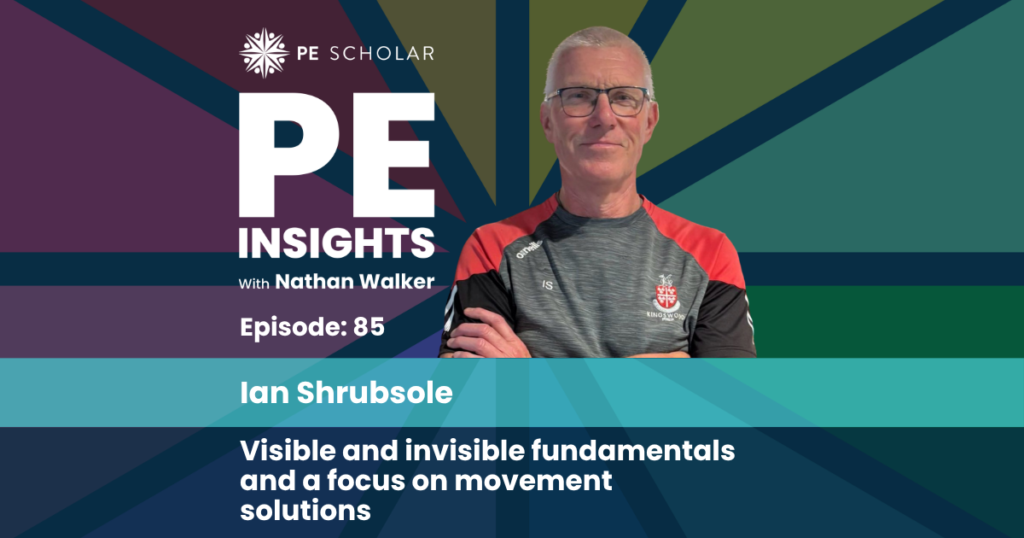
In Episode 85 of the PE Insights podcast, host Nathan Walker sits down with Ian Shrubsole. Ian is a highly experienced physical education teacher who is nearing retirement at the end of the term, having started his teaching career in 1992. He has spent the vast majority of his career at Kingswood School, an independent prep school in Bath that has grown significantly since he first joined. The conversation explores Ian’s evolution from a traditional sports coach to an advocate for games-based learning, his thoughts on the difference between technique and skill, and his passion for developing “invisible” fundamentals in young people.
Educational Journey and a Shift in Philosophy
Ian describes himself as the archetypal “sporty” child who dreamed of becoming a professional footballer or cricketer but turned out not to be quite good enough. He played local cricket to a high level and found his way into coaching through swimming teaching at Bath Sports Centre. This eventually led to a part-time role at a tiny prep school in Bath, which was later taken over by Kingswood School, allowing Ian to grow his physical education provision alongside the expanding school.
Initially, Ian relied heavily on a traditional “skills and drills” approach, teaching physical education exactly how he had been taught. He would break a skill down, practice the movement in parts and only play a game at the very end of the session. However, he gradually became dissatisfied with this method. The major turning point occurred when Ian and a close colleague attended an Independent Association of Prep Schools (IAPS) rugby conference. Both teachers left the event realising they had been doing things wrong. From that moment onwards, Ian began exploring game-based coaching and ecological dynamics, finding practical ways to apply these concepts effectively within his specific school context.
Context, Lesson Design and Removing Stigma
Working in the independent sector, Ian navigates a strong expectation for children to play competitive sports. However, he has worked to take his school on a journey towards a different type of competitiveness.
When planning a block of learning, Ian starts by asking what principles of play the children need to explore, rather than focusing purely on a specific sport. For example, instead of running traditional rugby drills, he designs games that encourage running, dodging, and avoiding opponents. He might set up an activity where students have to carry a “dragon’s egg” across a swamp while avoiding “swamp monsters”. This intentional play allows children to explore the physical skills needed for rugby without the stigma that some students attach to the sport itself.
Redefining Technique and Skill
Ian heavily challenges the persistent assumption that children must master perfect techniques before they are allowed to play a game. Using netball as an example, he points out the flaw in demanding that children learn a formal chest pass before playing. He argues that, initially, children simply need to find a way to throw and catch the ball that works for them, noting that a teacher’s “best technique” is rarely the same as a child’s due to differences in height, power, and physical development.
He draws a clear distinction between technique and skill:
- Technique: Performing a movement without context, such as zigzagging a hockey ball through a line of static cones.
- Skill: The ability to use that technique in the moment, making decisions and reacting to unpredictable opponents.
Ian argues that static cone drills do not adequately prepare students for the reality of a game. By practicing with actual opponents from the very beginning, children learn to react and utilise their techniques when the right opportunity arises.
Visible vs. Invisible Fundamentals
A central theme of Ian’s current thinking, which he frequently explores is the clear distinction between visible and invisible skills.
Visible Skills These are the elements of physical education that are easy to see and measure. A teacher can clearly see if a child is a fast runner, if they can jump over a high bar, or if they can perform a good forward roll.
Invisible Skills These are intangible qualities such as resilience, the ability to cope when things go wrong, and the capacity to collaborate and take turns. Ian argues that these invisible skills are arguably far more important for a person’s entire life than their ability to jump over a high bar.
Even for elite athletes, these traits are paramount. Ian shares that his daughter has played cricket at the very highest level, and even in that elite environment, the invisible skills (such as staying calm under pressure, coping with injury, and working with teammates) end up being more critical than the visible physical abilities. When it comes to assessment, Ian notes that it is virtually impossible to measure these invisible skills with a simple tick-box exercise; instead, it requires a careful, narrative approach.
If you like the idea of visible and invisible skills, you really must check out the work of Guy Claxton and his learning river summarised in this book review.
The Hidden Curriculum and Teacher Observation
Ian is a strong believer in the hidden curriculum of the physical education space. He strives to create an environment where children arrive feeling excited, engaged, and appropriately challenged.
Utilising a games-based approach allows Ian to change his role within the lesson. Instead of constantly handing out direct instruction, the game allows him to step back, observe, and identify which children are truly engaged or struggling. If a child is misbehaving or disengaged, Ian can observe the game to understand why, often finding that the challenge is either too high or too low, and he can then tweak the rules slightly for that specific individual.
Furthermore, Ian stresses the importance of teachers modelling vulnerability. He believes teachers must be willing to join in and deliberately make mistakes to show children that adults also have to find new ways to succeed. This actively fosters a culture where pupils feel safe to experiment and fail.
Reflections for the Future of PE
Looking back over his career, Ian views physical education through a strictly long-term lens. He highlights the vital role of generalist primary school teachers within the subject. While some class teachers may feel they are not “sporty,” Ian insists their presence in the physical space is crucial. When a non-specialist teacher participates and demonstrates that they are not perfect at a sport but are willing to try their best, it sends an incredibly powerful and positive message to the children.
Ultimately, Ian measures the success of his physical education provision with a very simple metric. Whether they are playing a heavily modified, fast-paced version of cricket or navigating an imaginary swamp, his primary goal is that every child leaves his lesson wanting to do more of the same.
Listen
To listen to the full episode please follow these links to Spotify or Apple podcasts.

Responses