



Welcome to the fourth instalment of our Neurodiversity series, where we delve into the intricacies of dyslexia and its significance for physical education teachers. Traditionally understood as a difficulty with reading and writing, the needs of dyslexic students may not seem relevant in a PE environment. However, the condition can affect many aspects of participation, learning, and overall well-being. In this insight, we outline the characteristics of dyslexia, highlighting the importance of understanding this neurodevelopmental condition in PE so that students’ unique strengths are leveraged in an inclusive and supportive spaces for all learners.
What is dyslexia?
The British Dyslexia Association (BDA) defines dyslexia as:
“Dyslexia is a learning difficulty that primarily affects the skills involved in accurate and fluent word reading and spelling. Characteristic features of dyslexia are difficulties in phonological awareness, verbal memory and verbal processing speed. Dyslexia occurs across the range of intellectual abilities. It is best thought of as a continuum, not a distinct category, and there are no clear cut-off points. Co-occurring difficulties may be seen in aspects of language, motor co-ordination, mental calculation, concentration and personal organisation, but these are not, by themselves, markers of dyslexia.”
In addition, the BDA states that:
“Dyslexia is a specific learning difficulty which primarily affects reading and writing skills. However, it does not only affect these skills. Dyslexia is actually about information processing.”
and stresses that:
“Dyslexia is a neurological difference and can have a significant impact during education, in the workplace and in everyday life.”
But what does this mean and why is this relevant in PE?
Let’s break down the characteristics of dyslexia to understand what they mean in terms of learning and how these might be apparent in physical education:
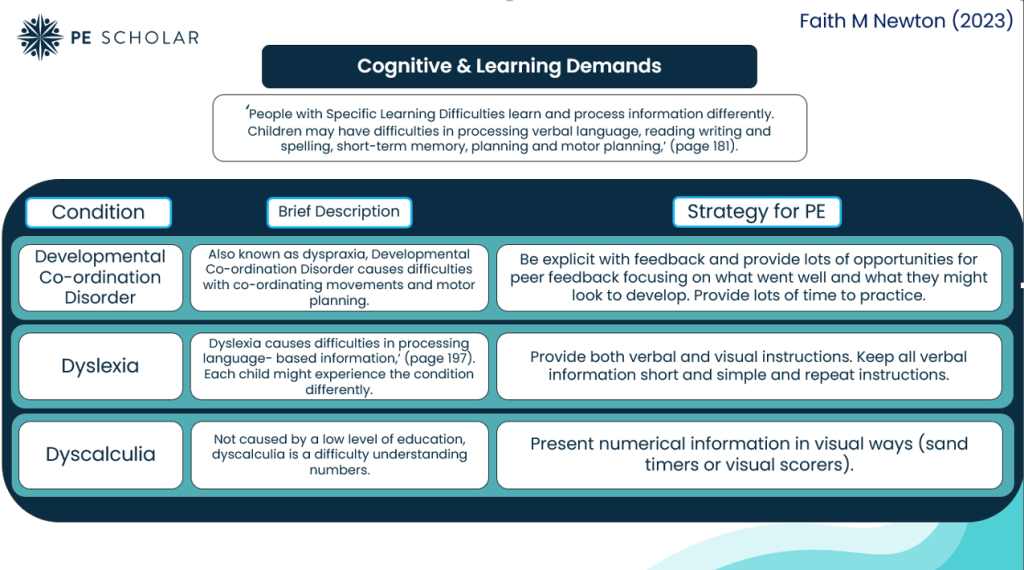
Phonological awareness is the key characteristic of dyslexia that involves the skills necessary for spelling, reading and writing. This includes an awareness of the sounds and parts of words, as well as letter names. In a PE environment, this will affect reading of written instructions, whether displayed or on handouts. It will also affect students’ written responses. Processing of verbal instructions and communication are likely to also be affected.
Verbal memory and processing speed is the processing of auditory information or information that is heard. A student with lower verbal memory and processing speed will have 2-3 seconds of memory compared to 6-9 seconds in the rest of the population (Dyslexia UK, 2023). This means that the capacity to ‘turn around’ information is reduced, as well as the ability to hold information. In PE lessons, this can make it difficult to follow sets of instructions, answer complex questions and sequence movements in order. Students may also forget names, words and prior learning.
Language: As a result of difficulties with phonological awareness, some students might find the pronunciation of words, acquisition of new vocabulary and understanding of grammar difficult. They may confuse words in a conversation and use more fillers (um, like, sort of etc.) when trying to explain something. This should be considered when asking students to speak in front of a class, learn new PE terms, or in any written work.
Motor co-ordination is perhaps the most obvious consideration in a PE lesson. The part of the brain (cerebellum) that affects timing and coordination of elements of language for speaking and reading has also been found to affect timing and coordination of movement (DRT, 2020). So, students with dyslexia might exhibit challenges with balance and posture, as well as fine motor skills that affect handwriting. In PE, students with dyslexia may also find keeping rhythm difficult as well as confuse directional words. PE teachers need to be aware of these challenges in all practical and written work.
Concentration: The cognitive overload resulting from the extra effort required to process information can lead to inattention and fatigue, particularly when long periods of concentration are required. In PE lessons, students with dyslexia might need extra motivation and interest to sustain focus, as well as regular breaks.
Personal organisation is another obvious factor for PE teachers to be aware of. Challenges with personal organisation may result from difficulties with memory and sequencing. Therefore, students with dyslexia may frequently forget sports equipment and kit, not achieve homework deadlines, miss appointments, be slower to change, or end up in the wrong place at the wrong time.
Irlen Syndrome (sometimes referred to as visual stress)
Though not a characteristic of dyslexia, this is a condition that can often affect neurodivergent students, and nearly half of those with dyslexia. It is not an issue with the eyes but the brain’s processing of visual information. The condition is sometimes disputed but according to the Irlen Syndrome Foundation link signs include:
- Light Sensitivity
- Reading Problems
- Headaches and Migraines
- Attention and Concentration Problems
- Strain and Fatigue
- Problems with Depth Perception
- Print or Environmental Distortions
The syndrome can make it difficult to focus on written words, particularly black font on a white background. Words may appear blurred, make patterns, or jump around on the page.
The superpower of dyslexia
It is vital that we recognise and cultivate students’ strengths rather than focusing on their weaknesses. Adaptive teaching strategies should always highlight the individual strengths of all pupils to foster their confidence, motivation, engagement, and sense of accomplishment. Emphasising students’ strengths empowers them in their personal learning journey and develops self-awareness and resilience. Always take the time to understand each student’s capabilities. It is well known that people with dyslexia often excel in design, problem solving, creative skills, interactive skills and oral skills (BDA, n.d.). These may be evident in their:
Creativity
Ability to visualise
Practical and problem solving skills
Lateral thinking skills
Being able to see the big picture (global thinkers) in terms of strategies and problem
solving
Good visual-spatial awareness
Good verbal communication skills
High levels of motivation and persistence
(DfE, n.d.)
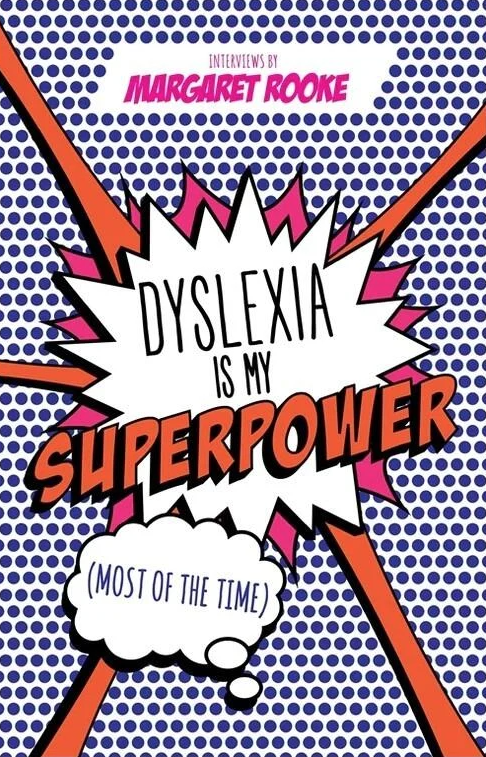
For personal stories on the ‘superpowers’ of dyslexia, take a look at this inspiring book Dyslexia is My Superpower
Adaptive teaching strategies in PE
With a bit of thoughtful planning and consideration, you can adapt your teaching to draw on the strengths of learners with dyslexia. And remember that these strategies will enhance engagement for all learners. Here are some ideas to consider:
Phonological awareness
- Visual aids: Supplement written instructions to students with visual aids such as diagrams and videos and verbal instructions.
- Use gestures and body language: to reinforce visual and verbal instructions as these help to convey meaning.
Verbal memory and processing speed
- Verbal instructions: Keep verbal instructions short and say a little at a time. Give very clear instructions which require one activity at a time, remembering to keep instructions in the order of the activity
- Speak slowly: Slow down your rate of speaking to give students time to process what you’re saying.
- Check understanding: Give time to students to think and respond and be prepared to repeat yourself. Remain patient and give time for overlearning/rehearsal.
- Prompt cards can help reinforce key learning points.
- Use ‘signal words’ that become familiar and alert learners to what’s required.

Language
- Use simple sentences that avoid jargon and complex language. Avoid or explain idioms and double meanings. Always think about how what you are saying might be construed by students.
- Give students time: Allow ‘think time’ and ‘talk time’.
Motor co-ordination
- Adapt activities and provide choice of alternative versions for all learners. Reduce any complex movements into simple steps.
- Demonstrations: Modelling through demonstrations is helpful for dyslexic students to enhance their understanding of how to perform movements or develop skills. Ensure that demonstrations are clear and concise.
- Provide extra practice time so that students can work on developing their skills.

Concentration
Multisensory teaching: Incorporating multisensory teaching techniques play to learners’ strengths and are particularly appropriate to learners with SpLDs. They provide opportunities for over-learning, improve information processing and also encourage learners to improve their meta-cognition through discussing which techniques work best for them. Engage the five senses as much as possible through a combination of the following:
- Incorporating visual aids and demonstrations to turn auditory input into visual memory.
- Using tactile and kinesthetic methods through gestures, modelling and ‘What a Good One Looks Like’ (WAGOLL). Encourage peer teaching.
- Audio recordings combined with visual cues for instructions such as abbreviations/symbols, mind maps and doodles.
- Memory hooks such as acronyms and mnemonics are useful to help students remember sequences of instructions or sets of movements.
- Voice: Encourage students to use their own voice through discussion, teaching on, recording and listening back. If allowed, encourage the use smart phones for assistive technology.
Metacognition: This involves ‘knowing about knowing’ or ‘awareness and understanding of one’s own thought processes’. Encouraging this in your students stimulates active learning and keeps them engaged. It also has a long-term benefit of building self-esteem and motivation. Here are ideas on how to develop metacognition:
- Talk students through an activity they completed successfully and what worked for them. Can they apply the same learning techniques to other activities, movements or skills?
- Talk them through what makes things difficult. Get them to consider the reason for persevering. Ask them whether they have learnt or undertaken similar activities, movements or skills and what they learnt that could also help with the task in hand.
- When they have learnt a new activity, movement or skill successfully, encourge them to teach it to another pupil.
- Regularly reflect and review learning through ‘education passports’ link that students have access to and can see their progress and recall strategies that helped them.

Personal organisation
- Visual timetables: use pictures, diagrams, flowcharts, symbols etc to remind students of a series of activities. Individual timetables with colour coding are also helpful to remind students of activities, equipment and kit needed. However, remember that students may not inherently understand how to use organisational tools. If necessary, teach them how to use them and what they need.
- Displayed information: Don’t expect students with dyslexia to copy information from the board. If you can, allow them to take photos. Otherwise, provide simple print outs (see Irlen Syndrome below).
- Homework: Always set homework well in advance so it can be planned into their schedule. Give plenty of reminders for completion.
- Assistive technology is hugely beneficial for neurodivergent learners. It provides support at their fingertips as well as the ability to develop their organisational skills independently and in a way that suits them. Encourage IT to support organisation when possible. This might include recording devices, apps and timers. Head to abilitynet for further ideas.
Head to Dyslexia UK for an explanation of these strategies and further ideas
Irlen Syndrome/Visual stress
- Coloured paper and backgrounds: Any students identified by an optometrist or SpLD assessor as having visual stress will usually have a particular colour background that helps reduce the contrast of black on white. They may already have glasses with a special tint to help them. If possible, always print their materials onto this colour or display writing on a similar coloured background. However, many students may not be identified so it can help all students if material printed or displayed on screen is on a cream or light pastel background.
- Fonts and spacing: The British Dyslexia Association produces a useful style guide that can be found here. Remember to alter format options onscreen, on an interactive whiteboard and on for anything to be printed.
Conclusion
The adaptive approaches suggested in this blog post might seem like a lot to remember! The key is to adaptive teaching is remain mindful of the neurodiversity of your classroom. All the above strategies will help most learners in your class and ultimately help you to plan engaging and varied lessons in a supportive learning environment. Above all, your students will benefit from peer support, celebration of their strengths and achievements, and patience.
Next in our Neurodiversity Series
Keep a look out for further insights in our neurodiversity series:
Next week’s insight will delve into specific strategies for Development Coordination Disorder (DCD)/Dyspraxia
This will be followed by the final insight in the series on ADHD .
Previous insights have included:
An introduction to neurodiversity
Adaptive teaching strategies for neurodivergent students
Autism and creating a supportive PE environment
Read
To read more about adaptive teaching strategies click here
Resources
Read here for further adaptive teaching considerations
References
Department for Education (DfE), no date. ‘A Guide to Specific Learning Differences’ [online] Available at: https://www.patoss-dyslexia.org/write/MediaUploads/A_Guide_to_SpLD_2nd_ed.pdf (Accessed: 19 March 2024)
Dyslexia Research Trust (DRT), 2020. ‘Co-ordination in poor readers’ Available at: https://www.dyslexic.org.uk/coordination-in-poor-readers (Accessed: 19 March 2024)
Dyslexia UK, 2023. ‘Addressing core features of dyslexia – verbal memory’ Available at: https://www.dyslexiauk.co.uk/addressing-core-features-of-dyslexia-verbal-memory/ (Accessed: 26 March 2024).
Newton, Faith M., 2023. Inclusive PE for SEND Children, FB3 Publishing.
[…] Last week’s insight outlined the unique strengths and learning differences of students with Dyslexia. Today’s insight focuses on Developmental Coordination Disorder (DCD) also known as Dyspraxia so that PE teachers can be more aware of characteristics of the condition and how best to support students who have DCD. […]
[…] For adaptive teaching strategies to help with organisation, head to our previous insight on Dyslexia […]