


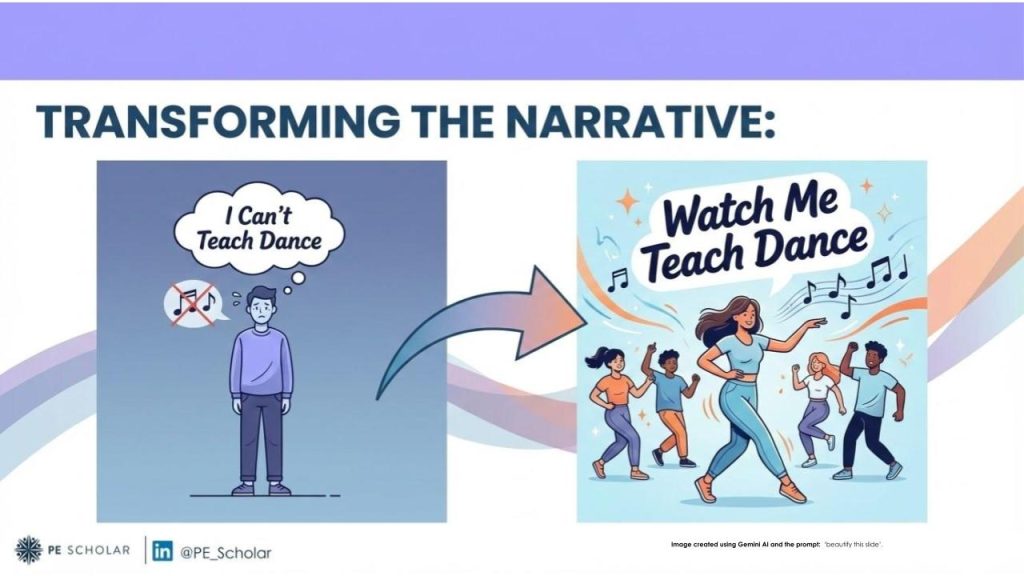
Introduction: What We’re Feeling and Why It’s Valid

(Image downloaded from Pixabay – royalty free. Student Books School – Free photo on Pixabay)
I understand the hesitation – I’ve worked with many educators who feel ill-equipped to teach dance, often believing it’s beyond their expertise. Perceptions and confidence within the workforce vary significantly for teaching dance in comparison to the teaching of invasion games. But, that’s exactly where we can shift the narrative and call for change in physical education (PE). If you’re reading this, you’re already halfway there. You’re demonstrating a willingness to learn more about this subject area, and that’s the most important step!
Here’s the key insight… Dance is movement. As a PE specialist, movement is your expertise. What we’re doing is applying familiar pedagogies within a different context. It is not about being a dancer. It is not about perfection or excellence. It’s about being a great educator; applying creative, cognitive and social strategies within high-quality learning contexts, with movement as your physical domain.
Therefore, regardless of perceptions or experiences, we should consider the core purpose and value of including dance in the PE curriculum from a holistic perspective. So the question is… do you believe you can shift your thinking from ‘I can’t’ to ‘I must’? Great – the purpose here is to empower educators to teach dance with confidence – even if you think you can’t (yet)!
Part 1: What We Found and What Next?
Concerns Raised
There have been a number of issues identified in the recent Curriculum and Assessment Review (2025) in relation to dance. Here is a summary of the key findings:
Dance is part of the PE curriculum in Key Stages 1 to 4, but it is reportedly not taught to all pupils as part of PE or, where it is taught, is not well organised. This adds to the problem identified in Ofsted’s ‘Levelling the playing field’ PE report (2023) which found that the PE curriculum in many schools does not match the ambition of the national curriculum and dance is either taught poorly or not at all.
There are concerns for inconsistencies in the delivery and many PE and primary teachers lack confidence when teaching dance. According to Langnes and Bratten (2025), PE teachers not only experience insecurity and unfamiliarity when teaching dance activities but also tend to avoid incorporating the subject into their practice based on background experiences and abilities.
This therefore raises the question of whether adequate training is provided for pre-service teachers, and if students on Physical Education Teacher Education (PETE) programmes are provided with enough opportunity to develop confidence through embodied experiences to reduce feelings of nervousness or perceived lack of competence.
Consequently, in-service teachers report that their capacity to teach dance is restricted, as they lack the confidence in their subject knowledge and, in turn, doubt their ability to deliver the subject effectively (El-Sherif, 2016).
Furthermore, it was reported that dance is popular among children and young people, but the curriculum focuses only on movement and performance, excluding choreography and appreciation which form the fundamental principles of dance. Stakeholders have called for a clearer PE programme of study that sets out the subject knowledge to support teachers to deliver Dance effectively.

(Image downloaded from Pixabay – royalty free. Puzzle Missing Particle Last Piece – Free photo on Pixabay)
Recommendations
It is evident that challenges persist for the educator when teaching dance. Here are the key recommendations:
- Review how Dance is taught in key stages 1 to 4 Programmes of Study that supports high-quality teaching and learning.
- Introduce a concise, scaffolded approach to the key stage subject content within the programmes of study for dance.
- Include detail to clarify expectations for Dance, retain focus on movement, but also include choreography and performance appreciation to allow progression to further study.
The review highlights gaps for how Dance is included and taught in PE, calls for clearer guidance with detailed curriculum content, and recommends improvements to improve teaching quality and student progression.
Part 2: From Evidence to Impact
(Image downloaded from Pixabay – royalty free. Teach Education School – Free photo on Pixabay)
Dance is a fundamental aspect of the National Curriculum for Physical Education (PE) in England and dance should be taught across all key stages (Department for Education, 2013). Its inclusion plays a pivotal role in providing a broad and comprehensive PE curriculum. To enable every educator to feel confident when teaching dance, they must have access to meaningful support and resources, and have the relevant tools and strategies to support this.
Firstly, it is important to address educator positivity, commitment and interest in teaching dance will result in higher motivation and enjoyment from your students. For example, wouldn’t it be great for young people to know that their PE teacher is inspired and challenged when facilitating a learning environment that is out of their comfort zone? Consider the wider benefits for building a safe space where you and your students can exchange learning experiences together, to develop social, cognitive and practical elements together.
Fink (2024) suggested that there are many health benefits for prioritising dance as part of the PE curriculum which contribute to the development of motor skills, rhythms and key movements – vital for promoting physical well-being through the practical elements. However, educators should place equal value on the social and collaborative benefits to its inclusion. This can be achieved by understanding that choreography is a socially creative process through arrangement of movement, and appreciation is recognising the value and quality of movement (which can be woven into formative assessment practices). This will allow young people to explore movement and appreciate dance within historical, cultural and social contexts, gaining insight into global traditions, practices and shared meanings for how we move, think, feel, and connect (Durden-Myres, 2025). Thus, aiming to develop a culturally responsive curriculum that nurtures physical, creative, cognitive and social development for all learners.
As educators, the issues identified in the report clearly align to subject knowledge. Educators should aim to implement a scaffolded approach to support understanding and consequently student progression. If a programme of study could provide a clear and structured pathway where learning is broken down into progressive steps and manageable chunks, this would enable clarity, progression, accessibility and curriculum alignment.
Dance has often been perceived as being performance-focussed and highly technical to teach, and has been marginalised within the PE curriculum. However, afPE (2025) advocates that dance must be taught with the same rigour and enthusiasm as other PE activities. Through participation in dance, young people can develop an understanding and a positive relationship with movement and physical activity that is transferrable into adulthood, influenced by our lived experiences (Durden-Myres, 2025). With the right mindset and relevant support, we can begin to shift the narrative.
Part 3: Closing the Gaps: Practical Strategies for Educators
By embracing the following top tips, educators can begin to build a culture of collaboration and growth, whilst designing impactful and engaging learning experiences for young people.
Top Tips
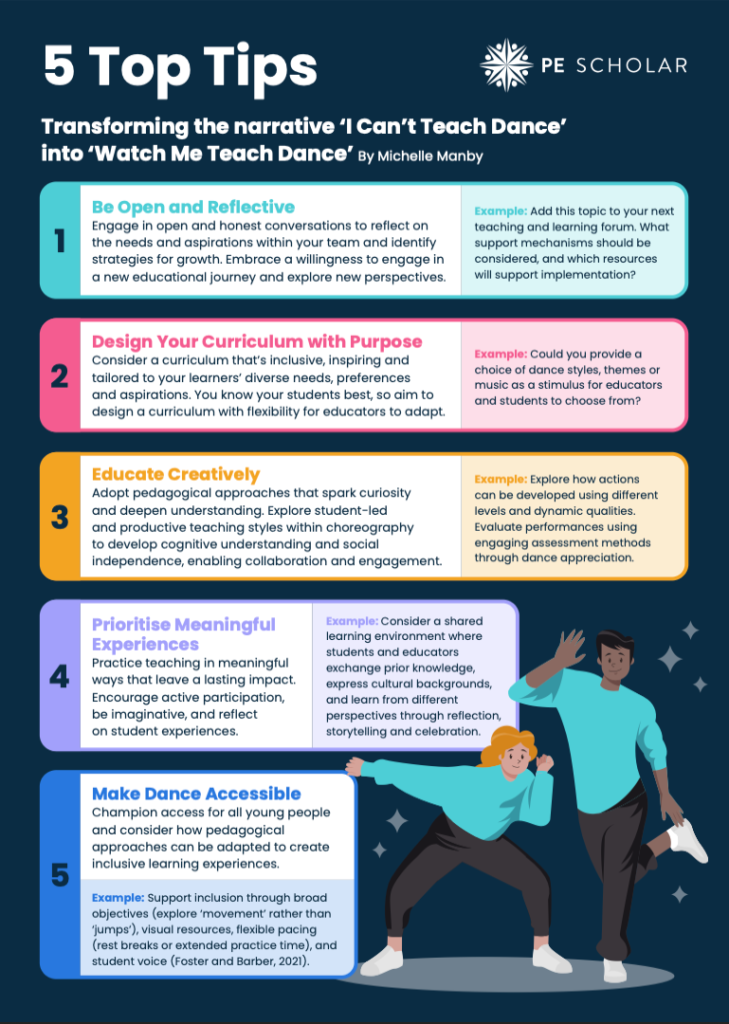
1. Be Open and Reflective
Engage in open and honest conversations to reflect on the needs and aspirations within your team, and identify strategies for growth. Embrace a willingness to engage in a new educational journey, to explore ideas and perspectives.
Example: Add this topic to your next ‘teaching and learning forum’ for discussion. What support mechanisms should be considered, and which specific resources/strategies will help with implementation?
2. Design Your Curriculum with Purpose
Consider a curriculum that’s inclusive, inspiring and tailored to your learners’ diverse needs, preferences, and aspirations. You know your students the best, so aim to design a curriculum with flexibility for the educator to adapt to the needs of their learners.
Example: Could you provide a choice/variety of dance styles/themes/music (as the stimulus for the dance), for the educator and students to choose from?
3. Educate Creatively
Adopt pedagogical approaches that spark curiosity and deepen understanding. Explore student-led and productive teaching styles within choreography for learners to develop cognitive understanding and social independence, to enable a collaborative learning environment and enhance student engagement.
Example: Discover how actions can be developed using varying levels and dynamic qualities. Evaluate performances using engaging assessment methods through dance appreciation.
4. Prioritise Meaningful Experiences
Practice teaching in meaningful ways that leave a lasting impact. Encourage active participation and engagement, be imaginative, and reflect on student experiences.
Example: Consider a shared learning environment where students and educators exchange prior knowledge, express cultural backgrounds, and learn from each other’s perspectives. In dance, this could be achieved through reflection, storytelling through movement, and celebration.
5. Make Dance Accessible
Champion access for all young people and consider practices required to amend or change pedagogical approaches to create meaningful and inclusive learning experiences.
Example: Implement thoughtful adjustments to support inclusion in dance by using broad objectives (explore ‘movement’ rather than ‘jumps’), visual resources, flexible pacing (allow rest breaks or longer practice time), and student reflection/voice (Foster and Barber, 2021).
Conclusion
Believe in yourself as the educator. A teacher is an occupation. An educator is someone who can shape an individual’s understanding of the world and themselves by guiding and nurturing through their learning journey (Schupp, 2024).
Through an aesthetic lens, dance should be an essential component of your PE curriculum to support physically-literate, confident and competent individuals. Despite your own initial hesitations for teaching dance, you should consider the wider benefits and transferrable skills for young people, and the lasting impact this will have as part of their learning journey into adulthood.
Coming Soon: NEW Educator Dance Resources
A new collection of resources is on the way, designed to support the educator in the delivery of dance. A toolkit packed with insights and inspiration for teaching dance to ensure that learning is meaningful, enjoyable and impactful for young people. Please get in touch if you would like to contribute or test ideas before they go live for all.
Resources designed to support the educator – just as you would provide resources to support your own students (because your growth matters just as much as your students)!
This ‘Dance Resource Pack’ will be available to download here from 4th March 2026.
About the author
Michelle Manby is Senior Lecturer, University of Lincoln and Teacher of PE, The Priory Academy LSST Lincoln, England.
Drawing from her own dance background, Michelle has a particular interest in curriculum dance and its position within Physical Education. Using her knowledge and expertise, she is committed to empowering educators, both current and future, by enhancing their knowledge, skills, and confidence in teaching dance through a pedagogical content knowledge (PCK) lens. Michelle’s work is dedicated to ensuring that dance is meaningful, enjoyable, and impactful for young people by supporting professional practice.
References
Department for Education (2025) Curriculum and Assessment Review: Final Report. Retrieved from: Curriculum and Assessment Review Final Report – GOV.UK
Department for Education (2023) Levelling the playing field: the physical education subject report. Retrieved from https://www.gov.uk/government/publications/subject-report-series-pe/levelling-the-playing-field-the-physical-education-subject-report
Department for Education (2013) National curriculum in England: PE programmes of study. Department for Education. Retrieved from https://www.gov.uk/government/publications/national-curriculum-in-england-physical-education-programmes-of-study
Durden-Myres, L. (2025). Embedding Physical Literacy in PE and Dance: Supporting the Findings of the Curriculum Assessment Review. Retrieved from https://www.pescholar.com/insight/embedding-physical-literacy-in-pe-and-dance-supporting-the-aims-of-the-curriculum-and-assessment-review/
El-Sherif, J, L. (2016) Learning, Teaching and Assessing Dance in Physical Education. Published: Strategies: A Journal for Physical & Sport Educators, Vol. 29, Issue 5, p31-36.
Fink, L, A. (2024) Dance Advocacy and Inclusion in the Physical Education Curriculum Is Vital for Health Education. Published in: JOPERD: The Journal of Physical Education, Recreation & Dance.
Foster, R. & Barber, L. (2021). Physical education for young people with disabilities: a handbook of practical ideas created by practitioners for practitioners. First Edition. Published New York, Routledge.
Langnes, T, F, and Bratten, J, H. (2025) Developing embodied competence while becoming a PE teacher: PETE students’ embodied experiences and reflections after micro-teaching. Physical Education & Sport Pedagogy, British Education Index.Schupp, K. (2024) Rethinking the Pedagogy of Dance Pedagogy. Published in: Research in Dance Education, ERIC.
Brilliant Michelle – can’t wait to see the resources!
This is great and the resources sound brilliant!